

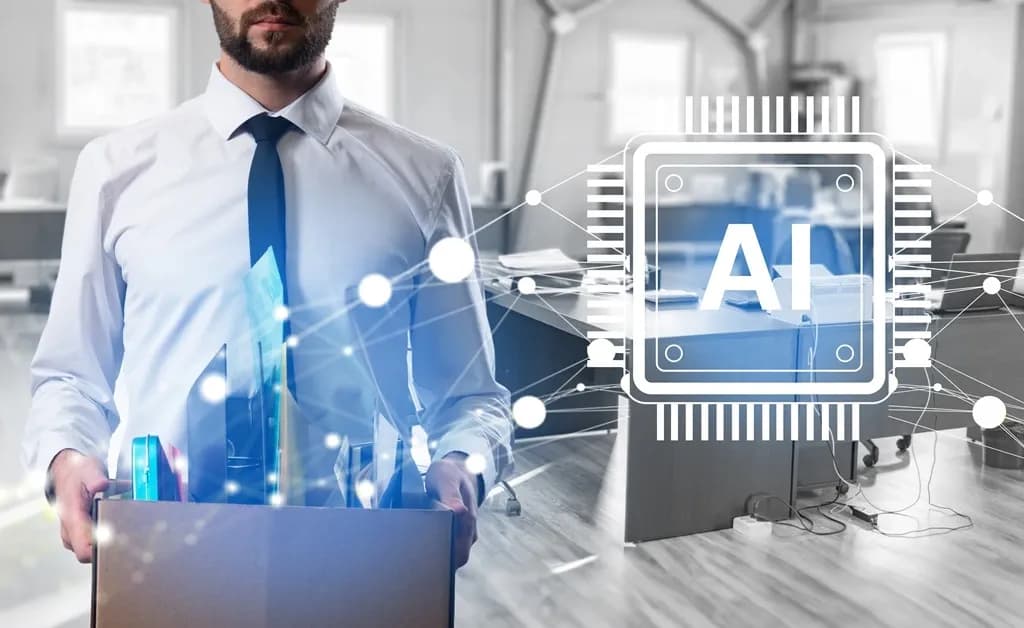
Key Takeaways⭐
The landscape of 2026 has proven that the "AI Revolution" is less of a sudden extinction event and more of a rapid genetic mutation of the professional world. To truly future-proof your career, you must move beyond simply knowing the tools and begin mastering the economic and strategic shifts they represent.
Here are a few key points to help you navigate AI and your career:
- Use AI to automate grunt work, such as scheduling and policy lookups.
- Keep human guardrails in place for ethics, compliance and bias control.
- The cost of an unvetted AI error can exceed the cost of a human expert. While AI may seem cheaper at first, it can cause hidden costs later.
This year, global labor markets are seeing a shift away from future job anxieties toward actual AI-centric restructuring. Many fear that many jobs replaced by AI may never return to humans, but the reality is more nuanced than what the headlines may suggest.
For anyone in the job market today, it’s only natural to wonder, “What jobs will AI replace?” However, the key to really understanding the answer is to look past doomscrolling and focus on human-in-the-loop (HITL) workflows: entry-level jobs dying and making way for AI orchestrators.
The New Economics: Why AI Isn't Taking Every Job Yet
Going into 2026, the job market is at an impasse: intelligence is cheaper than ever, but reliability remains expensive. Put simply, for high-stakes or judgment-heavy work, humans remain more cost-effective once reliability is factored in.
That is largely because organizations that realize that an AI job might be displaced might come up with solutions in seconds, but they require expensive, specialized hardware. Humans are also still better at making calls in these “edge case” decisions than robots, which struggle to operate in shades of gray.
Moreover, the March 2026 Anthropic Labor Market Report found that most examples of AI displacing jobs seem to be related to entry-level narrowing. Hiring for high-exposure roles for workers aged 22-25 dropped 14%, suggesting that companies are using AI, not humans, for grunt work.
Moravec’s Paradox in the modern age
These work trends remind us of the ultimate paradox of AI today: Tasks that are relatively hard for humans (think: complex analysis or drafting code) are often easy for humans. On the other hand, things that seem easy for humans (think: physical dexterity and real-world judgment) are hard for AI. This scenario is called Moravec’s Paradox.
To illustrate, GPT-5.5 could relatively easily create a cloud database, but it couldn’t fix an HVAC system. As a result, this paradox has created a "blue-collar shield" for the economy.
Furthermore, a 2026 BCG study reported that 57% of the roles it studied that required hands-on work or human interaction were less likely than other roles to face AI disruption. In comparison, the remaining 43% of jobs studied, in which 40% or more of tasks are automatable, are more likely to experience AI disruptions. Overall, BCG projects 50-55% of American jobs will be reshaped in some capacity over the next 2-3 years.
The task vs. role reframing
The fundamental definition of a "worker" has undergone a radical transformation. Value is no longer derived from your ability to manually execute a task (whether that is writing a paragraph or a line of code) but from your ability to orchestrate an entire role.
Put differently, the labor market rewards the "architect" over the “builder." AI can help many workers make this leap. For instance, to stay competitive, a writer may work with AI agents to write in volume but act as the source of stylistic and ethical control, like an editor-in-chief. A coder might act as a system architect, focusing on logic and security and using AI to handle boilerplate syntax.
High-Risk Industries: Where Displacement Is Happening
The automation of white-collar tasks has accelerated rapidly over the last 24 months globally, particularly in sectors that deal primarily with digital inputs and outputs. Jobs at risk from AI often have screen-based deliverables, according to several experts.
Content & creative industries face a "quality floor"
The barrier to entry for copywriting and basic graphic design has essentially vanished. Junior roles that once served as training grounds are being absorbed by agentic workflows, forcing newcomers to demonstrate senior-level strategic thinking immediately.
In fact, the number of content marketers using AI for editing doubled from 2025 to 2026, from 19% to 38%. Additionally, the World Economic Forum ranks graphic design as the 13th-largest declining job market by 2030, largely due to AI.
Software development and the death of boilerplate
Bloomberg reports that early-career developers (ages 22-25) recently saw a 13% decrease in employment. This drop is largely attributed to AI job displacement.
Junior developers are no longer hired to write unit tests or boilerplate code. With the rise of advanced reasoning models, the software engineering lifecycle has shortened, enabling a single developer to do work that may have required a larger team in the past.
Administrative and clerical roles are the most exposed
The highest level of generative AI job displacement is found in scheduling, data entry, and basic office management.
AI-driven precision is essential: IDP solutions designed specifically for AI, with a foundation in machine learning, excel in achieving both speed and accuracy. Research indicates that AI-powered IDP platforms can extract data up to ten times faster than traditional methods, all while upholding an impressive accuracy rate of 99.9% across a variety of document types.
This means that with the integration of machine learning algorithms, organizations no longer have to choose between speed and quality: they can have both. Docsumo, for instance, utilizes its proprietary machine learning models and rigorous validation checks to consistently provide highly precise data output on a large scale.
Customer service moves beyond the chatbot
Several companies are shifting high-volume support chatbots from human-in-the-loop to fully autonomous. However, the AI automation of customer service seems to be moving slower than once anticipated.
In fact, a 2023 Gartner projected that 80% of customer service companies planned to use some form of AI. However, in 2025, Gartner reported that only about 20% of organizations have actually reduced their agent headcount due to AI.
The rate of AI displacement hasn’t quite reached the levels once predicted for customer service, but jobs have still been displaced as a result of AI implementation. Fewer humans means only complex or emotionally charged chats are sent to humans for intervention.
To summarize, this table explains the above industries’ AI displacement risks:
| Industry Sector | Primary Deliverable | Risk Level | Specific Task Displacement | The "Human-in-the-Loop" Value |
|---|---|---|---|---|
| Administrative & Clerical | Digital Coordination | Critical | Data entry, meeting scheduling, basic office management, and record keeping. | High-stakes executive coordination and complex physical logistics. |
| Customer Service | Resolution & Support | High | Tier 1 support, FAQ handling, ticket routing, and basic troubleshooting. | Managing complex, emotionally charged escalations and high-value negotiations. |
| Software Development | Digital Logic/Code | High | Unit testing, boilerplate code generation, documentation, and basic QA. | Architectural systems design, security logic, and cross-functional team leadership. |
| Content & Creative | Visual/Written Media | Moderate-High | SEO copywriting, basic stock asset creation, resizing, and standard layouts. | Brand identity strategy, high-level creative direction, and unique storytelling. |
The Hierarchy Of Vulnerability
To navigate the current labor market, it’s important not just to identify fields at high risk of AI takeover, but also the skills related to those jobs that make them vulnerable. Discovering which skills those are involves distinguishing between high-risk tasks that will be automated and human-essential tasks that provide a competitive edge.
Here are a few examples of each of these specific tasks sorted by profession.
| Profession | High-Risk Tasks | Human-Essential Tasks |
|---|---|---|
| Legal Assistant | Document review, case research, citation | Client empathy, courtroom strategy, ethics |
| Graphic Designer | Stock assets, basic layouts, resizing | Brand identity, creative direction, storytelling |
| Financial Analyst | Data reconciliation, reporting, trends | Strategic risk assessment, bespoke advice |
| Junior Coder | Boilerplate code, unit tests, debugging | Architectural design, security logic, UX |
| Medical Researcher | Literature review, data synthesis | Clinical trial oversight, patient interaction |
Why "Soft Skills" Are Becoming "Hard Skills"
In a world where computational logic is a commodity, the premium on emotional intelligence (EQ) has risen sharply. The ability to manage a team, handle complex negotiation tactics (think: managing a merger) or use multidisciplinary synthesis to resolve workplace conflict are now "hard" requirements for career longevity.
The "specialist" who knows everything about one narrow, repeatable task is at extreme risk. Conversely, the generalist who can synthesize information across multiple disciplines (and then prompt an AI to execute the details) is the new corporate superstar.
The human-AI value shift
As AI masters the technical, humans must master relational and ethics-based skills. The following table illustrates some of the 2023-2025 market value shifts for core professional skills, according to Cornerstone:
| Skill Category | 2026 Value Metric | Market Trend |
|---|---|---|
| Enthusiasm | Engagement, motivation, cultural growth | +999% |
| Working Independently | Taking initiative as AI handles routine tasks | +850% |
| Rigor | Quality, compliance, & accuracy | +780% |
| Data Entry | Increasingly automated using AI | -75% |
| Telemarketing | Increasingly automated using AI | -68% |
| Basic accounting | Increasingly automated using AI | -65% |
Multidisciplinary synthesis is the ultimate shield against displacement. This method involves combining knowledge from multiple disciplines to solve a problem while adhering to the rules of each field. If you can bridge the gap between technical possibility and human need, your role will remain secure regardless of how fast AI replaces jobs.
Survival Guide: How To Future-Prove Your Career
The most successful professionals in 2026 moved from being creators to curators. Instead of starting with a blank page, they use a multi-model workflow to generate several drafts, then apply their domain expertise to improve the best version.
Adopt the multi-model workflows
Relying on a single AI model is like a carpenter who uses only a hammer. To remain competitive, you must know when to use Claude Sonnet 4.6 for its creative nuance, GPT-5.5 for its logical rigor or Gemini 3.1 Pro for its massive context window.
For instance, the models could help a marketing director with the following:
-
Gemini 3.1 Pro: Analyze 200-page competitor annual reports in seconds.
-
GPT-5.5: Identify logical gaps in the current market plan.
-
Claude Sonnet 4.6: Draft high-conversion ad copy based on what Gemini 3.1 Pro and GPT-5.5 discovered.
Develop a "golden combo"
The most unreplaceable professionals possess a golden combo: deep domain expertise (such as 10 years in logistics) plus high AI literacy. This combination allows you to identify AI-driven efficiencies that a technologist without industry experience would never see.
Constant upskilling is the new baseline
The half-life of technical skills has dropped to less than 18 months. You must commit to a lifestyle of continuous learning, specifically focusing on how to integrate emerging AI tools into your specific vertical before your competitors do.
The future-proof skill stack (sorted by level of priority)
1. AI Orchestration: Ability to string multiple models into a single workflow.
2. Prompt Engineering 2.0: Moving from "chatting" to "agentic instruction."
3. Critical Fact-Checking: Identifying hallucinations in AI outputs.
4. Cross-Disciplinary Literacy: Understanding how AI impacts sales, tech, and HR simultaneously.
How Lorka AI Empowers The "Unreplaceable" Professional
The key to surviving jobs replaced by AI is not fighting the tools, but mastering the entire ecosystem. Lorka AI is designed for the professional who refuses to be a "one-model" worker and instead chooses to be an AI architect of their own career.
Our tool helps you become an essential strategic curator. It gives you access to bots such as GPT-5.5, Claude Sonnet 4.7 and Gemini 3.1 Pro in one platform. The ability to cross-verify information using several bots helps you avoid hallucinations that often lead to human replacement.
Lorka AI eliminates the friction that makes it hard to stay on the cutting edge of AI technology. Stay ahead of the curve and leverage Claude Sonnet 4.7 for high-end copywriting, GPT-5.5 for complex analytical logic, and Gemini 3.1 Pro for research involving thousands of pages of documentation.
Real-world efficiency: The procurement manager example
Imagine you’re a procurement manager whose job is at risk due to automated contract software. Lorka AI can help you avoid being displaced by automation by teaching you how to best leverage it in your job.
For instance, use Gemini 3.1 Pro via Lorka AI to ingest 50 different contracts simultaneously. Then, use Claude Sonnet 4.7 to draft personalized emails to each vendor, completing a week of manual work in 20 minutes.
The competitive edge of multi-model mastery
Professionals who use Lorka AI aren't tied to the limitations of a single developer's roadmap. If ChatGPT‘s GPT-5.5 is better for code but Claude Sonnet 4.7 is better for branding, Lorka AI users have the ultimate technical flexibility to choose the best tool for the specific task at hand, making them exponentially more productive than colleagues stuck in a single-model ecosystem.


Future-Proof Your Career with Lorka AI
Compare GPT-5.5, Claude Sonnet 4.6, and Gemini 3.1 Pro in one place to build smarter AI workflows and stay ahead of job disruption.
Try Lorka AIFAQs
By 2030, most entry-level data processing, telemarketing and basic accounting roles will likely be fully automated. The focus will shift entirely to the oversight and planned management of AI-powered systems.