

Key Takeaways⭐
- AI skills let you use AI tools to do your job better.
- Beginners should focus on using AI strategically rather than on building systems.
- Top in-demand skills include prompt engineering and verification.
- Consistent practice with routine and real tasks is key to improving.
- You can learn AI skills without being a coding expert with multi-model platforms.
What Are AI Skills? (And Why They Matter Now)
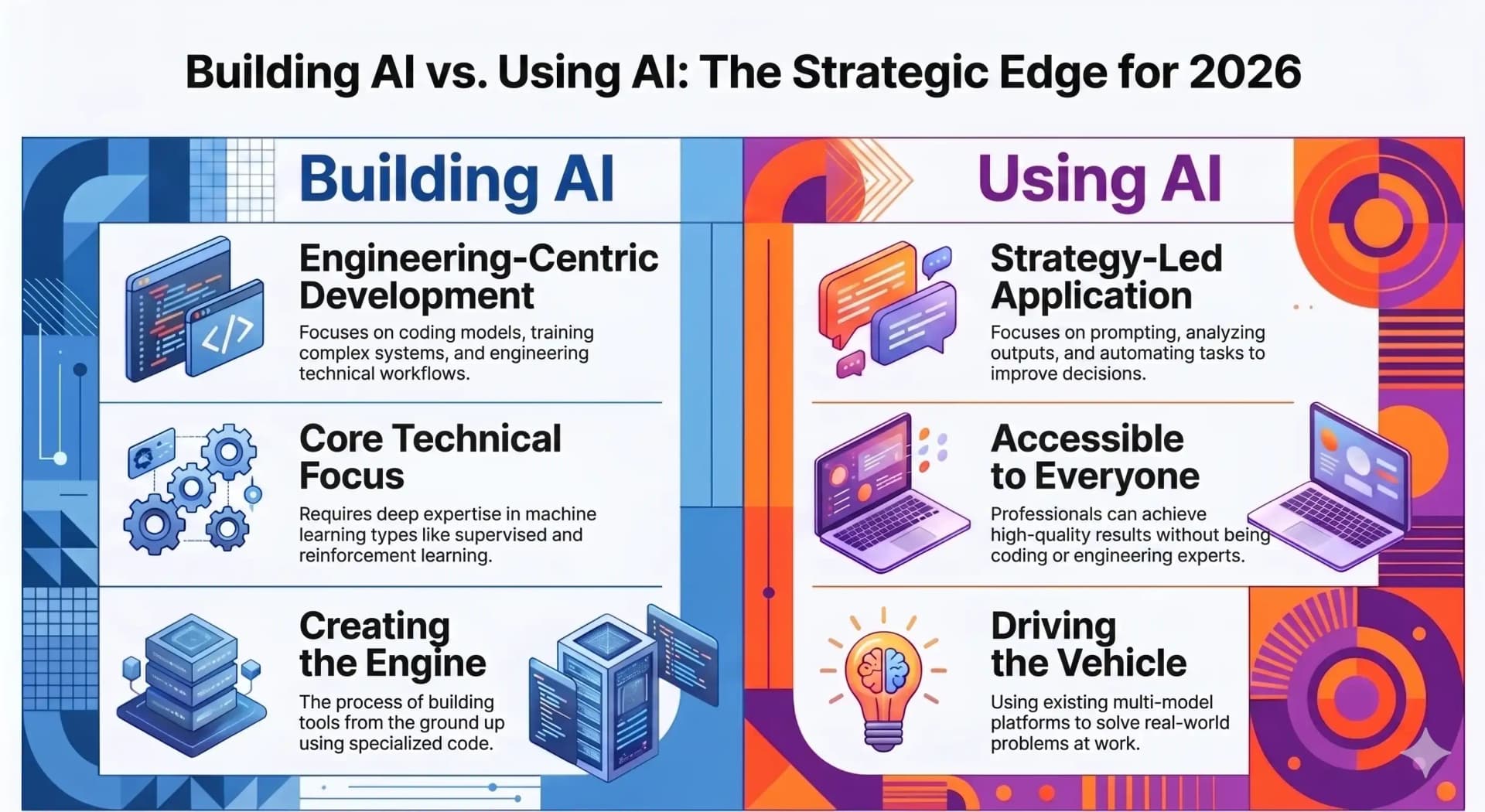
AI skills refer to the ability to effectively use artificial intelligence to solve real problems at work, as opposed to building AI systems, which involves coding and engineering.
Here are some important differences between building AI and using AI:
- Building AI = Coding models, training systems, engineering workflows
- Using AI = Prompting, analyzing outputs, automating tasks, improving decisions
- AI literacy = Understanding what AI can and can’t do effectively
Today, most professionals will benefit more from learning how to use AI strategically than from creating it from the ground up.
That’s why it’s important to build your AI skills, as those who can apply AI well consistently outperform those who don’t.
Top 5 In-Demand AI Skills for 2026
Below is a list of artificial intelligence skills that are highly sought after by hiring managers and can be applied in different professional settings. These skills can help you save time and improve output quality.
1. 🧠 Prompt engineering
Used by: Marketers, consultants, founders
Prompt engineering is guiding AI with a clear structure that includes role, context, and task to achieve high-quality results.
A marketer can ask GPT-5.4 to act as a senior strategist and come up with a campaign plan that is specific to a certain audience. A founder can use it to write updates for investors or improve the messaging for a product.
2. 📊 AI data analysis
Used by: Analysts and product managers
By having strong AI data analysis skills, you can upload spreadsheets or datasets and ask the AI to find trends or performance information.
A product manager can use data about how users behave to find drop-off points, and a sales team using a model like Claude Opus 4.6 can quickly find the best-performing segments without having to do any math.
3. 📚 AI-Assisted research & summarization
Used by: Researchers, content teams, consultants
This skill is about using AI to sort through a lot of data and quickly find important information.
For instance, a consultant can use Gemini to distill a 50-page report into useful suggestions, or a content team can review many sources and put together structured briefs in minutes rather than hours.
4. ⚙️ Workflow automation
Used by: Operations, marketing teams, entrepreneurs
Finding tasks that need to be done repeatedly and using AI to handle them is what workflow automation is all about.
For example, an automation manager can use AI tools to automate weekly reports or email replies, and a marketing team can use AI tools to make the process of creating content from draft to publication more efficient.
5. 🛡️ AI ethics & verification
Used by: Analysts, editors, decision-makers
AI ethics and verification focus on evaluating AI outputs to help guarantee accuracy and reliability.
Analysts can validate AI-generated insights before making decisions, while an editor can use various models such as DeepSeek, ChatGPT, and more to fact-check content to avoid hallucinations or misleading information.
How to Use the Best AI Tools in 2026 to Learn and Improve Your Skills
Below are some tips to help you learn AI skills faster and get started using them, so you can begin applying them in your daily tasks.
Start with routine work
Pick a daily or weekly task like writing briefs or reviewing spreadsheets so you can keep practicing.
Learn basic prompt structure
Give the AI model relevant context and define the exact task and output you want.
Compare different models
Run the same prompt in GPT-5.4, Claude, Gemini, or another LLM to see which model handles reasoning, tone, summaries, or structure best.
Create various prompts
Save prompts that work well, which you can then organize by task. You can then refine them over time into reusable templates for quicker results.
Five Minute Challenge (Quick Action Plan)
To test your AI skills and improve them over time, carry out the following action plan in 3 steps:
1️⃣ Choose a tedious task, such as writing a report.
2️⃣ Write a prompt to assign this task to AI in a specific context (see our guide on how to write a prompt).
3️⃣ Save the prompt that works best, and turn it into a template to reuse in your daily work.
The Multi-Model Secret
One common mistake is choosing a single AI model and using it for all of your tasks. Different models have different strengths.
For example, Claude is stronger in data analysis and coding, while Grok is typically better at staying up to date on market trends.
Using a multi-model AI platform can help you get the most out of different models in a single chat and improve your workflow.
Practice AI Skills for Beginners and Professionals With Lorka’s Multi-Model Platform
The best way to master your AI skills is to test, refine, and apply them regularly with different models in a single workspace that’s built to help you improve your workflow and the way you use artificial intelligence.
- Multi-model AI chat: Test outputs by switching between models like ChatGPT, Claude, and Qwen3 in a single conversation.
- Practice real tasks: Write, analyze, summarize, and automate using different LLMs.
- Build reliable AI workflows: Turn repeated tasks into structured, reusable processes.
You can also explore Lorka’s knowledge hub for up-to-date trends, tips, and practical ways to keep improving your skills and using AI models.


Practice AI Skills with Real Tools
Learn prompt engineering, data analysis, and automation by testing multiple AI models like GPT, Claude, and Gemini in one place, no coding required.
Start Practicing with LorkaFAQs
You don't have to be a coding expert to work with artificial intelligence.
Coding skills may be necessary for developing AI systems, but most professionals who use existing AI tools do not need to have a lot of coding ability to work well with models and carry out their tasks.