


I’m sure you’ve experienced this situation before.
You type what seems to be a normal question into a customer service chat window on a website. Perhaps it’s a common issue that a normal person would easily understand and be able to answer in two seconds.
The bot then fires back a menu of five options that all have nothing to do with your needs. You rephrase the question. It shares another menu with equally useless suggestions. You typed, "talk to a human." The bot says, "I'm sorry, I didn't understand that."
That was conversational AI. It was terrible.
Today, we have ChatGPT and other generative AI models. You can describe your situation in plain English, even with typos and poor grammar. The system follows your thought process, poses clarifying questions, and provides you with a useful answer on your first attempt.
That was also conversational AI.
The phrase "conversational AI” covers everything from a 2009 pre-recorded phone tree to a 2026 Claude Code Kanban board with collaborative agent execution. That range is absurd, which is why most explanations of this topic leave people more confused than when they started.
I've been working in digital marketing since 2017.
I watched the whole arc play out firsthand, from clunky chatbots that annoyed people more than they helped, to 2022-2023, when real possibilities started showing up, to now, when the intelligence behind these systems has finally become good enough for practical value.
If you've already read our guide on what generative AI is, you have the foundation. Generative AI is the engine. Conversational AI is one of the things you build with that engine.
How Conversational AI Works
The short version
Conversational AI is artificial intelligence designed to understand human language and respond in kind, holding a back-and-forth dialogue rather than returning a single output.
A spam filter is AI, but it doesn't talk to you. Midjourney creates images, but you're not having a conversation with it. You provide a prompt, receive a picture in response, and that's the end of the interaction.
Conversational AI is specifically about the exchange. The ability to follow a thread, remember what was said earlier, and respond in a way that makes sense given everything before it.
So how does this concept relate to generative AI?
Think of it like a car and an engine. Generative AI is the engine, the technology that creates new content by predicting what comes next. Conversational AI is the car built around that engine, designed to carry a conversation.
Old chatbots were conversational AI but not generative. They picked from pre-written scripts. Midjourney is generative AI but not conversational. ChatGPT is both: generative AI deployed as conversational AI.
Core components of conversational AI
Modern conversational AI does three things every time you send a message.
1. It figures out what you mean. When you type "cancel my subscription," the system identifies what you want to do (cancel), what you're targeting (your subscription), and the tone you're expressing.
This is Natural Language Understanding (NLU). Old bots are built on a technology based on keyword matching, while current systems have genuine reasoning capabilities for more nuanced engagement.
2. It tracks the full conversation. Ask an old bot a follow-up question, and it has no idea what you were talking about. Someone had to type out every possible answer variation in advance and come up with dynamic variables to make it appear intelligent.
Modern systems hold the entire conversation in a working memory file, called a context window. That's why you can say "actually, make that two instead" five messages into a conversation with ChatGPT, and it knows exactly what "that" refers to.
3. It constructs a response from scratch. In older systems, responses were pre-written templates. Current systems generate responses in real time, word by word, using a next-word prediction algorithm.
We also call this Natural Language Generation (NLG). This innovation is why modern chatbots sound more natural and are capable of advanced reasoning.
These systems keep getting better at an accelerating rate. The models you're using today are measurably stronger than the ones from even six months ago.
Types of Conversational AI
The technology behind conversational AI has changed so dramatically that calling old chatbots and modern AI assistants by the same name is misleading. There have been three distinct generations, and the capabilities gap between them is enormous.
| Generation | Era | How it works | What it felt like |
|---|---|---|---|
| Gen 1: Rule-Based | 2000s-2015 | Decision trees, keyword matching, scripted paths | "Press 1 for billing." Rigid, broke the moment you went off-script |
| Gen 2: Intent-Based NLP | 2015-2022 | Design templates with dynamic variables; ML classifies your intent and routes and populates pre-built templates. | Understood "billing issue" and "why did you charge me?" meant the same thing. Still fell apart on anything complex |
| Gen 3: LLM-Powered | 2022-present | Large language models understand context, generate original responses, maintain conversation | The conversation is dynamic and resembles a conversation with a real person. ChatGPT, Claude, Gemini |
Let’s take a look at each phase in greater detail.
Gen 1: rule-based conversational AI
Gen 1 was a choose-your-own-adventure book with only the author's branches. You were unable to deviate from the script as there was none.
Most "AI-powered" chatbots from this era are essentially just mathematical decision trees disguised as chatbots. I built dozens using tools like ManyChat and BotPress before the days of LLMs and generative AI. These old-school systems could handle simple flows, but the second a user asked something unexpected, the whole thing collapsed.
Gen 2: intent-based NLP
Gen 2 was smarter. Tools like Google's Dialogflow, IBM Watson, and Microsoft LUIS could recognize the intent behind what you said. "I need help with my bill," "billing issue," and "why did you charge me twice?" are all mapped to the same category.
Better, for sure. But the responses were still pre-written templates, and the cost/complexity increased dramatically. VoiceFlow and Intercom brought improvements; however, when they went beyond the training scope, the overall experience deteriorated.
Gen 3: LLM-powered
Gen 3 broke the pattern entirely. Large language models don't pick from a menu of templates. They generate responses in real time, the same way generative AI creates any other content. They comprehend the context of the entire conversation and maintain your flow of thought, even when you veer off course in mid-sentence.
One of the biggest conversational AI benefits is that we can now design multi-step reasoning workflows as simple as writing a prompt, and integration into any website or software is finally seamless as a result of the universally accepted Model Context Protocol (MCP).
I experienced this firsthand while studying math for an algorithmic trading course.
The notation looked like hieroglyphics to me, stochastic calculus that I couldn't parse no matter how many times I read the textbook. So I copied the intimidating-looking formulas into ChatGPT and asked embarrassingly basic questions. Five times. It stayed perfectly patient. The AI presented the concepts in various ways.
I finally understood the optimization algorithm because it broke it down like an RPG fantasy game. I grew up playing video games, and the AI figured that out and used it.
A Gen 1 or Gen 2 system would have shown me an FAQ page about "math help" and called it a day.
The business world has already begun adopting Gen 3 conversational AI systems. Now they're capable of completing complex tasks such as quotes, sales, and technical support.
74% of consumers now rate AI interactions positively, and 62% prefer chatbots over waiting for a human agent for straightforward requests.
However, the Gen 1 chatbots were widely disliked. Nowadays, conversational AI powered by Large Language Models (LLMs) has solved the problems of previous generations while simultaneously redefining what we consider "intelligence."
These AI agents (such as Gemini or Claude) are the newest and fastest-growing category. An agent is capable of performing complex tasks such as web search, image editing, and code generation.
On Lorka, you can access multiple conversational AI models, ChatGPT, Claude, Gemini, and others, through one platform. Different models have different strengths, and having access to several means you match the right engine to the job.


Conversational AI vs. Generative AI
This is the question everyone asks after using ChatGPT for a week: "Wait, is this conversational AI or generative AI?"
Both. And that's the honest answer for most modern tools. But the distinction is still useful for building based on your needs.
| Dimension | Conversational AI | Generative AI |
|---|---|---|
| What it does | Holds a dialogue, understands and responds to you | Creates new content: text, images, code, audio |
| Core goal | Understanding your input and responding appropriately | Producing something new from learned patterns |
| Interaction style | Back-and-forth exchange across multiple turns | Often single-turn: prompt in, output out. Acts like an engine |
| Examples | ChatGPT, Claude, Gemini, customer service bots | Midjourney, DALL-E, GitHub Copilot, Suno |
| Relationship | Often uses generative AI as its engine | The underlying technology that powers creation |
A few years ago, these columns were cleanly separated. Conversational AI meant chatbots. Generative AI meant content creation tools. By 2026, the distinction between chatbots and content creation tools has completely disappeared.
ChatGPT simultaneously serves as both a content creation tool and a conversational agent. So is Claude. So is Gemini. The engine that predicts the next word also happens to be useful for predicting images, video, audio, and pretty much everything else scientists have thrown at it.
But the distinction still holds for plenty of tools.
Midjourney generates images but doesn't converse with you. Your bank's old chatbot converses with you but doesn't generate anything new. Knowing where a tool sits on this spectrum helps you understand what it can and can't do.
For a deeper look at how generative AI works under the hood, our guide covers it in detail.
Why Businesses Are Spending Real Money on This
The global conversational AI market hit roughly $17-19 billion in 2025 and is growing at 20-23% per year. That spending reflects real, measurable returns.
Always on. A single chatbot handles thousands of conversations simultaneously, around the clock, with no overtime pay.
For businesses with customers in multiple time zones, this alone changes the economics of support. If you've ever needed help at 11 p.m. and hit a "we'll get back to you during business hours" wall, you know why the difference matters.
Cheaper per interaction. An AI chatbot interaction cost roughly $0.50 vs. $6.00 for a human agent at the end of 2025. Organizations reported 30-50% reductions in customer service costs after deploying conversational AI, with e-commerce achieving 82% resolution rates without human handoff.
Consistent quality. Human agents have bad days. AI doesn't. Every response follows the same standards, uses the same information, and maintains the same tone based on its prompt and training. You get the same answer whether you call at 9 a.m. on Monday or 4:55 p.m. on Friday.
Iterative automated testing consistently improves performance, unlike traditional talent that requires costly ongoing training and replacement.
Data Leverage. Every conversation transforms into a structured data source, revealing your customers' needs, areas of difficulty, and frequently asked questions. Rather than speculating on the topics your FAQ should address, you can pinpoint the precise areas where people actually struggle.
This data is also invaluable for building additional AI/ML business systems.
What is an example of conversational AI?
Conversational artificial intelligence takes several forms. Here's a quick map of a few tools you might recognize.
| Type | What it is | You've used it in |
|---|---|---|
| AI Chatbots | Text-based dialogue systems | ChatGPT, Claude, Gemini, website support chats |
| Voice Assistants | Conversational AI with a speech interface | Siri, Alexa, Google Assistant |
| Voice Bots | Phone-based conversational AI | Pre-recorded phone systems such as customer service systems and travel management |
| AI Agents | Conversational AI that takes action, not just responds | Claude with subagents enabled, AI that books meetings or files tickets, ChatGPT searching the web |
Real-World Use Cases
Conversational AI already shows up in places you interact with every day:
- Customer service is where most people encounter it. Bank of America's Erica has handled over 3 billion client interactions, processes 58 million per month, and resolves 98% of inquiries without transferring to a person.
- Healthcare uses it for patient intake, symptom triage, appointment scheduling, and medication reminders. The AI handles the administrative overhead so doctors can handle diagnosis.
- E-commerce runs product recommendations, order tracking, and returns processing through it. You ask a question instead of searching an FAQ page.
- Enterprise tools are a growing category. These tools include IT helpdesks, HR bots, and onboarding assistants. The shift from "search the wiki" to "ask and get an answer" is changing how people find information inside their companies.
I saw the potential clearly with a heavy equipment client. They sell GPS laser systems from Topcon and tilt rotators from EngCon.
Their quoting and education process was completely manual, buried in archaic PDFs full of specifications. During the discovery, I showed them how a chatbot connected to their knowledge base could answer 90–95% of customer questions without a human in the loop.
The information already existed. It was just locked in formats nobody wanted to read.
The pattern across all of these: high-volume, repetitive, language-based interactions. That's the sweet spot. Conversational AI handles the volume that surrounds the human expert and frees them for work that actually requires a person.
Conversational AI Challenges and Limitations
Gen 3 is a big upgrade. It is also not magic. If you're going to use conversational AI, or put it in front of your customers, you should know where it breaks down.
Hallucination doesn't disappear just because the interface is conversational.
A Gen 3 system can confidently give you wrong information in a friendly, natural tone. The fluency makes errors harder to catch.
Writing an advertorial, which was intended to be emotional and romantic, taught me the hard truth. Midway through, the AI turned into a quirky science teacher, making crude high school jokes about brain chemistry. The voice and tone changed completely between paragraphs.
For anything with stakes, verify the output. One practical trick: run the same question through multiple models and compare answers. On Lorka, you can switch between ChatGPT, Claude, and Gemini in seconds, which makes cross-checking fast.
Empathy is simulated, not felt. Modern models match tone, express concern, and calibrate formality well. For routine interactions, the gap between simulated and real doesn't matter much. When someone is grieving, angry, or in crisis, the difference becomes clear fast.
Most deployed "AI" is still Gen 1 or Gen 2. When you interact with a chatbot on a business website, you have no way of knowing whether it's powered by a large language model or running a 2017 decision tree with a modern-looking interface. The label "AI-powered" tells you nothing about which generation you're dealing with.
Studies suggest that soon Gen 3 conversational systems will be distinguishable only by humans because they are more articulate, empathetic, and charismatic. In early 2024, a study in Nature showed that AI had better bedside manners than real doctors.
The Future of Conversational AI
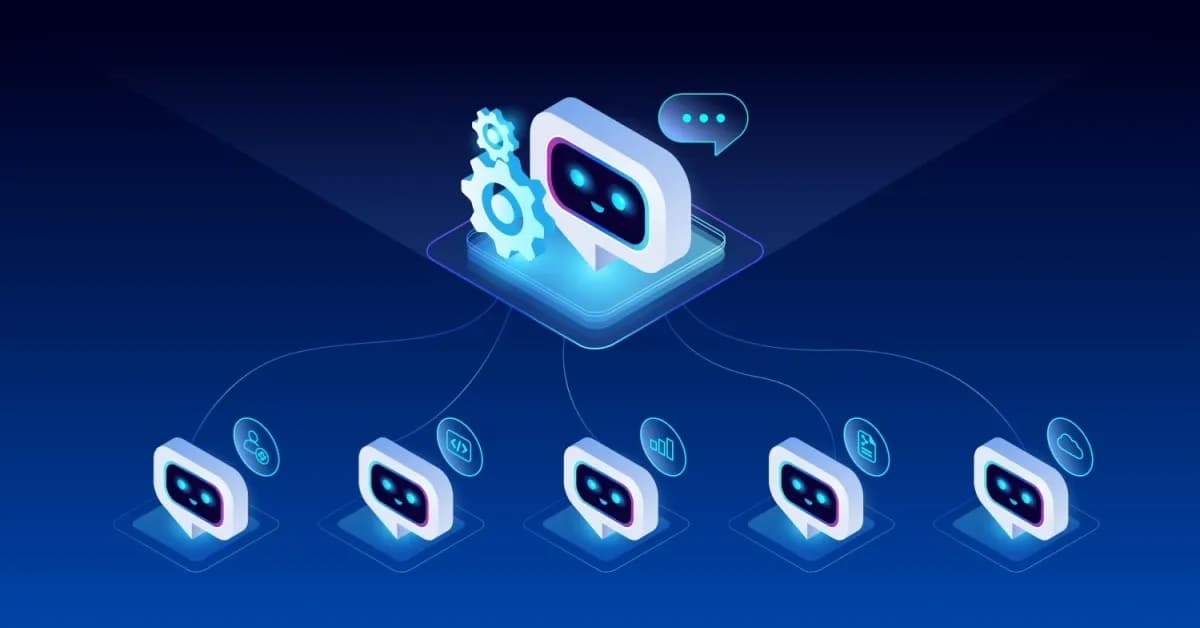
These trends are not independent. Multimodal systems with persistent memory, coordinating as teams of agents: that's where this is headed. Together, they point toward a shift from AIs you talk to toward AIs that act on your behalf.
Multimodal dialogue
Images were created using Midjourney, music was generated in Suno, and video production was experimental only with Sora. Seeddance 2.0 has released the first video model that’s able to create near-cinema-quality clips.
Now Gemini 3.1 handles text, images, video, and audio inside one model. Google's Gemini 2.5 Flash Image, commonly referred to as NanoBanana, can write legible text inside generated images and produce detailed infographics, something older models still can't do.
Every quarter, there are new major releases in the industry with no signs of slowing down across any modality. The magic is that these systems integrate seamlessly with every medium a human interacts with.
Multi-agent orchestration
Multiple AIs coordinating on a task is different from one AI answering questions. One researches, another writes, and a third checks the work. OpenClaw, the most popular open-source orchestration framework, passed 100,000 GitHub stars in months.
Currently, it’s primarily just developers using it for building Discord/Telegram bots and business automations. But developers build it first, and then it gets packaged for everyone.
Persistent memory
By 2025, both ChatGPT and Claude had added memory to their chat apps. In 2026, memory moved into CLI agents and developer tools. Four types are being developed:
- Short-term: context during a single conversation
- Long-term: preferences and history across sessions
- Working: task-specific, like a to-do list mid-project
- Shared: lets multiple agents access the same information
None of them has been fully solved. However, an AI that remembers you is more useful than one that does not. Every year, model providers improve the solutions they provide.
Agentic AI
This is where the threads connect. An AI that can see images, generate media, remember you, and coordinate with other agents is no longer a chatbot. It does work. You describe what you need, and it books the meeting, runs the query, and writes the report.
Less than 1% of people use these features today, but the infrastructure is in place. My prediction: these agentic AI go mainstream by late 2026 to mid-2027. More Jarvis than Terminator. Although Jarvis is still in its infancy, the direction of its development is clear.
And here's the funny thing. A Gen 1 chatbot and a Gen 3 agentic system look identical from the outside. The chat window and text box are identical. Underneath, it's the difference between a wooden wind-up child’s toy and a self-driving car with both heated and cooled massage seats.
FAQs About Conversational AI
No. ChatGPT is one product built on conversational AI technology. The category includes everything from Siri and Alexa to customer service bots and AI-powered phone systems. ChatGPT is the most well-known example, but it's one tool inside a much broader category.
Key Takeaways⭐
- The chatbot you hated was Gen 1. What you're using today is Gen 3, which shares the same name but utilizes entirely different technology.
- Generative AI is the engine. Conversational AI is the car. Modern systems use both. Old ones didn't.
- 74% of consumers now rate AI interactions positively. The experience has genuinely changed.
- High-volume, repetitive, language-based interactions are the ideal scenario. That's where conversational AI creates the most value.
- The future is agentic. AI will act on your behalf, booking meetings and running queries. The infrastructure is already in place.
What happened to the customer service bot mentioned earlier in this article, the one that was unable to comprehend your question? That technology is a relic. Did the ChatGPT conversation follow your thought process? That's a preview of how you'll interact with software for the next decade.
The difference between a chatbot that frustrates and one that helps is the model running underneath. Claude handles long documents and careful reasoning well. Gemini is strong with multimodal inputs. ChatGPT is versatile across creative and analytical tasks. Different engines are available for different types of jobs.
Lorka gives you access to all of them through one platform, one subscription. You can select the model that best suits the task, switch as needed, and discover why the engine is more important than the chatbot's name.