

Use Claude Sonnet 5.5 Online for Fast, Capable Coding and Analysis
Chat with the latest Claude Sonnet model on Lorka AI to complete tasks related to coding, analysis, document work, and much more without a separate Anthropic subscription.
Opus, Sonnet, or Haiku: Which Claude Model You Actually Need
Review what each Anthropic model does best and decide which tool to use for your workflow or even combine each in Lorka’s AI chat.
Sonnet: Everyday coding, analysis, and document work
Select Sonnet if you need workflow balance that is fast enough for back-and-forth work and strong enough for real coding and analysis.
Opus: Complex, essential work
Can take longer to complete tasks but is worth the extra wait when the task is long or genuinely hard. It's useful for a 40-page contract or analysis where one wrong assumption is expensive.
Haiku: Fast, repetitive tasks at a high volume
Built for fast, repetitive work such as classifying hundreds of tickets or summarizing documents at scale.
Fable: Long-horizon technical planning
Designed for long-horizon planning and difficult technical work. It is narrower than Sonnet and not the model to choose by default. Test Fable when even Opus cannot complete the job reliably.
Explore the full Claude model comparison →
The Best Type of Work to Use Claude Sonnet for
Move beyond one-off answers to code that actually runs and multi-step tasks that finish without constant prompting.
| Capability | What you can use it for |
|---|---|
| Coding | Debug a failing endpoint, write the test that catches it, and refactor across files. Sonnet follows through instead of handing you an isolated snippet. |
| Long document analysis | Review contracts, research papers, and lengthy transcripts. The context window can accommodate substantial source material, so you are not pasting it in fragments. |
| Multi-step tasks | Give Claude Sonnet a goal and constraints. It can plan, execute, validate, and explain what still needs your attention. |
| Everyday speed | Work through code, documents, and analysis interactively. Its response speed makes Sonnet ideal for slightly advanced work when you need speed. |
See How Claude Sonnet Can Improve Your Workflow
The following output is an illustrative example of how you can use the Claude model to complete a coding task.
Review this checkout service, find the bug causing duplicate charges after a payment timeout, implement the safest fix, add regression tests, and explain how to validate it before release.
Root cause The payment provider can complete a charge after the local request times out. The retry path then creates a new payment attempt and a new idempotency key, so the provider treats the retry as another charge. Safest fix Persist one idempotency key for the checkout attempt before contacting the provider. Reuse that key for every retry, and add a database constraint that prevents more than one active payment attempt for the same order.
1// payments/createPayment.ts2export async function createPayment(orderId: string) {3 return db.transaction(async (tx) => {4 const attempt = await tx.paymentAttempt.upsert({5 where: { orderId },6 create: {7 orderId,8 idempotencyKey: `checkout:${orderId}`,9 status: "pending",10 },11 update: {},12 });1314 const charge = await paymentProvider.charge({15 amount: await getOrderTotal(orderId, tx),16 idempotencyKey: attempt.idempotencyKey,17 });1819 return tx.paymentAttempt.update({20 where: { id: attempt.id },21 data: {22 providerChargeId: charge.id,23 status: "completed",24 },25 });26 });27}Regression tests
1it("reuses the payment attempt after a provider timeout", async () => {2 provider.charge3 .mockRejectedValueOnce(new TimeoutError())4 .mockResolvedValueOnce({ id: "charge_123" });56 await expect(createPayment("order_42")).rejects.toThrow(TimeoutError);7 await createPayment("order_42");89 expect(provider.charge).toHaveBeenNthCalledWith(10 1,11 expect.objectContaining({ idempotencyKey: "checkout:order_42" })12 );13 expect(provider.charge).toHaveBeenNthCalledWith(14 2,15 expect.objectContaining({ idempotencyKey: "checkout:order_42" })16 );17});1819it("creates only one attempt during concurrent retries", async () => {20 await Promise.all([21 createPayment("order_42"),22 createPayment("order_42"),23 ]);2425 expect(await db.paymentAttempt.count({26 where: { orderId: "order_42" },27 })).toBe(1);28});Validate before release 1. Run the payment unit and integration tests with successful, rejected, and timed-out provider responses. 2. Confirm retries send the same idempotency key in staging. 3. Trigger concurrent retries and verify that only one payment attempt and provider charge exist. 4. Canary the change and monitor duplicate-charge alerts, payment failures, and reconciliation mismatches.
Claude Sonnet 5.5 Benchmark Results
These benchmark results reflect the latest Sonnet release. Scores depend on the effort level, available tools, and structure of each evaluation.
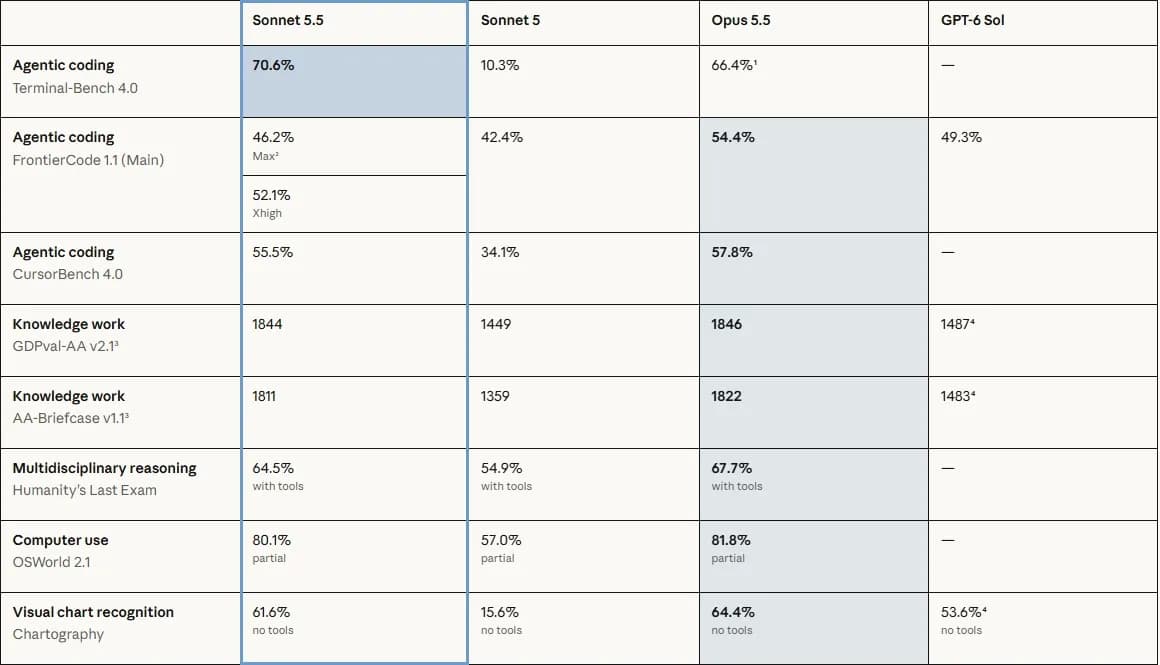
Source: Anthropic
Access Claude Sonnet With Leading AI Models in One Workspace
Use Sonnet on Lorka AI for everyday work and combine its features with more top models from Anthropic, OpenAI, Google, DeepSeek, and beyond when the task calls for different strengths.
Try out multiple frontier models
Give Sonnet and another AI model like Opus or GPT-6 the same prompt and source files and compare outputs.
Match features to needs
Start with Sonnet, then move to another model like Opus or Fable for harder judgment calls, or choose Haiku for fast repetitive work.
Keep the project together
Continue working on projects from the same AI chat instead of having to start from scratch.
Test before you standardize
Before you pick one model for your team’s workflow, run the models on a recurring task.
Get AI subscriptions for less
Chat with the latest AI models from ChatGPT, Gemini, and more under one plan rather than paying for several plans at once.
Claude Sonnet vs. Opus, GPT-6, Astra, Gemini Flash, and More
Review how Sonnet matches up with the latest versions of Opus, Gemini Flash, and more models available on Lorka AI.
| Models | Reasoning | Speed | Multimodality | Context | Ideal use cases |
|---|---|---|---|---|---|
Claude Sonnet | 💡💡💡💡💡 | ⚡⚡⚡⚡⚡ | 🤖🤖🤖🤖🤖 | 🧠🧠🧠🧠🧠 | Everyday coding, analysis, documents, and multi-step work. |
Claude Opus | 💡💡💡💡💡 | ⚡⚡⚡⚡⚡ | 🤖🤖🤖🤖🤖 | 🧠🧠🧠🧠🧠 | Complex work where judgment and reliability matter most. |
Claude Fable | 💡💡💡💡💡 | ⚡⚡⚡⚡⚡ | 🤖🤖🤖🤖🤖 | 🧠🧠🧠🧠🧠 | Long-horizon planning and difficult technical work. |
Claude Haiku | 💡💡💡💡💡 | ⚡⚡⚡⚡⚡ | 🤖🤖🤖🤖🤖 | 🧠🧠🧠🧠🧠 | Fast, repetitive tasks at high volume. |
GPT-6 | 💡💡💡💡💡 | ⚡⚡⚡⚡⚡ | 🤖🤖🤖🤖🤖 | 🧠🧠🧠🧠🧠 | Advanced programming and technical research and analysis. |
Gemini Flash | 💡💡💡💡💡 | ⚡⚡⚡⚡⚡ | 🤖🤖🤖🤖🤖 | 🧠🧠🧠🧠🧠 | Quick analysis of videos and visual documents. |
Grok | 💡💡💡💡💡 | ⚡⚡⚡⚡⚡ | 🤖🤖🤖🤖🤖 | 🧠🧠🧠🧠🧠 | Long-running workflows with repeated tool use. |
Claude Sonnet
Everyday coding, analysis, documents, and multi-step work.
Claude Opus
Complex work where judgment and reliability matter most.
Claude Fable
Long-horizon planning and difficult technical work.
Claude Haiku
Fast, repetitive tasks at high volume.
GPT-6
Advanced programming and technical research and analysis.
Gemini Flash
Quick analysis of videos and visual documents.
Grok
Long-running workflows with repeated tool use.
Earlier Claude Sonnet Versions
Older Sonnet releases are no longer available separately. Here is the latest version you can use that replaced the legacy models.
- Previous models: Sonnet 4, Sonnet 4.5, Sonnet 4.6, Sonnet 5
- What to use instead: Claude Sonnet 5.5
What improves when you upgrade to the latest version of Sonnet?
The latest model completes well-scoped work faster and performs better across coding and professional tasks when compared to older versions.
- Stronger coding: Better performance on debugging, repository-wide changes, and agentic terminal workflows.
- Faster workflows: More responsive back-and-forth during coding, analysis, and document work.
- More efficient work: Fewer steps and output tokens can reduce the cost of completing many tasks.
- Better professional output: Improved performance on document creation, knowledge work, visual understanding, and multi-step analysis.
Access the latest version of Sonnet now on Lorka AI and combine it with models to create efficient workflows, generate images, videos, and much more.
Chat With Claude Sonnet Today
Access Claude Sonnet on Lorka now. Create an account and start a multi-LLM workflow with Sonnet, GPT, and more.
Claude Sonnet FAQs
You pay $29.99/month, with every model included, as well as AI image generation tools, an AI text humanizer, and more. Your Lorka AI subscription gives you access to Claude Opus alongside GPT, Gemini, Grok, and other available models.