What Are AI Chatbots, and How Do They Work?
AI chatbots are tools, built on top of large language models, that let you ask questions and give instructions in a conversation. They use AI models trained on large amounts of data to understand your input and generate responses.
Depending on the chatbot and available tools, they can also help you analyze documents, write code, explore images, and more.
How We Compared These AI Chatbots
Our best AI chat model comparison focuses on practical tasks most people use these tools for every day.
Our comparison was done in our all-in-one AI platform under the following conditions:
- Environment: A shared AI model workspace in Lorka AI, with native app features considered separately.
- Models: The exact version, mode, and available tools for each option.
- Tasks: At least two prompts per category, covering writing, reasoning, research, coding, document analysis, and conversation.
- Fairness: Identical prompts, files, constraints, and follow-ups, starting in fresh conversations.
- Scoring: Weighted criteria, with results dependent on the selected prompts, versions, and available tools.
The 6 Best AI Chatbots Compared
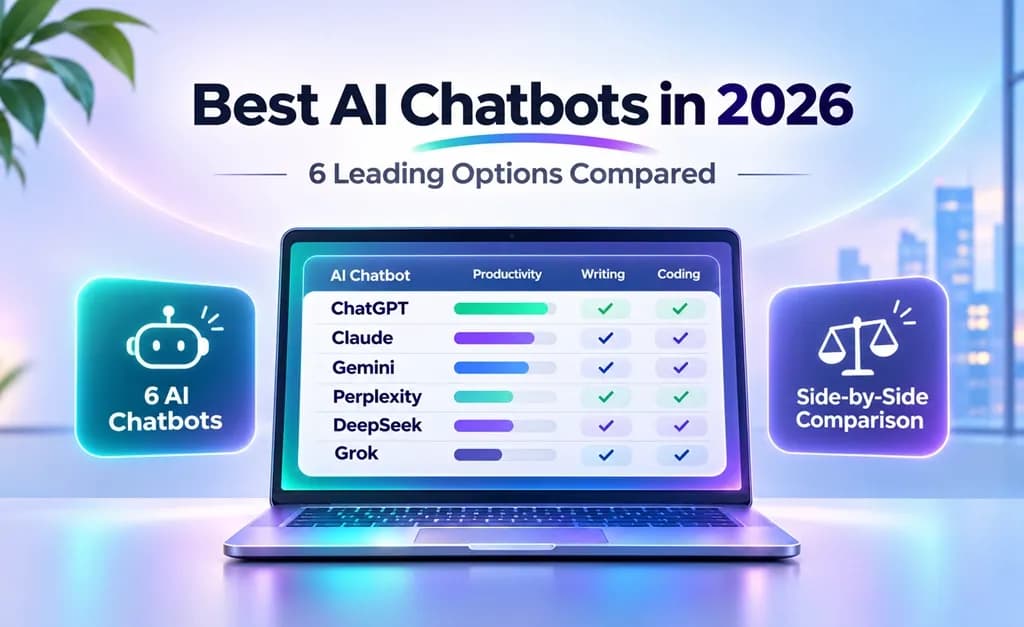
The best AI chatbot for you depends on what you want to accomplish. Our ratings compare six leading options that feature in Lorka’s multi-model AI chat across writing, reasoning, coding, accuracy, instruction-following, and usability.
1. ChatGPT: Best for everyday productivity 🥇
Overall score: 9.1/10 | Model: ChatGPT-6.1 | Strong use case: General-purpose work
ChatGPT-6 is a versatile choice for drafting, planning, and organizing information. There are also different versions, Astra, Terra, Sol, and Luna that each specialize in different areas. For example, you could use Terra to turn meeting notes into a structured action plan and Astra for coding.
Its speed and usability scores is lower than Gemini’s, Perplexity’s, and Grok’s. Still, it’s a strong all-rounder if you want one chatbot for varied daily tasks.
2. Claude: Best for writing and editing 🥈
Overall score: 9.1/10 | Model: Claude Sonnet 5.5 | Strong use case: Writing, analysis, and coding
Sonnet earns the highest writing and clarity score in our comparison. It’s a good choice for refining a draft, adapting its tone, or breaking down complex information.
The Claude family includes Sonnet, Fable, and Opus. Sonnet 5.5 is designed for everyday tasks and coding, while Opus 5.5 is aimed at more complex work, and Fable even more advanced tasks that even Opus may struggle with at times.
3. Gemini: Best for multimodal tasks 🥉
Overall score: 8.9/10 | Model: Gemini 4 | Strong use case: Media and document analysis
Gemini 4 and even Flash models are good choices for working with information across different formats. For example, Gemini 4 Argon can analyze charts and identify details in images, making it useful for tasks that combine visual material and documents.
The family also includes Gemini 4 Carbon, which builds on Argon with improvements in coding, complex workflows, and multimodal understanding. Its coding score in our comparison is lower than its reasoning score, but Gemini remains a versatile option for visual and document-heavy work.
4. Perplexity: Best for research
Overall score: 8.8/10 | Model: Sonar | Strong use case: Source-led research
Perplexity is designed specifically for discovery and archiving. It’s good for researching a topic and cross-checking sources. For example, you could ask it to put together recent news and tell you what sources it consulted to provide its answer.
Perplexity is a research application that can use different models, so the underlying model and search setup matter. Its coding score is the lowest in our comparison.
5. DeepSeek: Best for technical reasoning
Overall score: 8.7/10 | Model: DeepSeek V4-Pro | Strong use case: Problem-solving and coding
We found that DeepSeek is the current best AI chatbot in 2026 for reasoning and is a strong option for technical tasks. You could use it to work through a logic problem or debug a small function.
Its model family includes DeepSeek-V4-Pro and V4-Flash, as well as the earlier V3.2. Availability and modes can be different depending on the platform.
DeepSeek’s writing is not as strong as Anthropic or OpenAI models; however, its reasoning and coding scores make it a better fit for structured problem-solving.
6. Grok: Best for brainstorming
Overall score: 8.6/10 | Model: Grok 4.7 | Strong use case: Creative ideas and conversation
Based on our comparison, xAI Grok models are worth trying when you want to brainstorm ideas and refine them through follow-up questions. For example, it can help you explore different directions for a marketing campaign.
The Grok family includes Grok 4.6 and 4.7, with versions designed for coding and knowledge work. Its accuracy and instruction-following scores are lower than those of the other options.
AI Chatbot Comparison Table: Complete Scores and Best Uses
Review our 2026 chatbot ranking to see the strengths and best use cases of each model. All the scores are out of 10.
Overall scoring weights:
| Criterion | Weight |
|---|---|
| Accuracy and task completion | 30% |
| Instruction-following and conversational consistency | 20% |
| Writing quality and clarity | 15% |
| Reasoning and problem-solving | 15% |
| Coding performance | 10% |
| Speed and practical usability | 10% |
| Chatbot/model family | Best use case | Accuracy and task completion /10 | Instruction-following /10 | Writing and clarity /10 | Reasoning /10 | Coding /10 | Speed and usability /10 | Overall score / 10 |
|---|---|---|---|---|---|---|---|---|
| ChatGPT | Versatile everyday work, structured answers, and general productivity | 9.1 | 9.2 | 9.1 | 9.1 | 9.0 | 8.8 | 9.1 |
| Claude Sonnet and Opus | Writing, editing, detailed analysis, and coding | 9.0 | 9.2 | 9.5 | 9.1 | 9.3 | 8.4 | 9.1 |
| Gemini | Document analysis, multimodal tasks, and productivity | 9.0 | 8.9 | 8.8 | 9.1 | 8.7 | 9.0 | 8.9 |
| Perplexity | Source-led research and concise information synthesis | 9.1 | 8.7 | 8.7 | 8.6 | 8.0 | 9.0 | 8.8 |
| DeepSeek | Technical reasoning, coding, and problem-solving | 8.8 | 8.6 | 8.3 | 9.2 | 9.1 | 8.2 | 8.7 |
| Grok | Conversational brainstorming, creative ideas, and timely topics | 8.5 | 8.5 | 8.7 | 8.8 | 8.3 | 9.0 | 8.6 |
What Our Same-Prompt Tests Revealed
The same prompt can produce very different answers depending on the model. Below you can get an idea of how we compared responses between models in Lorka’s multi-AI chat across writing, coding, and research to see how well each chatbot followed instructions and completed the task.
Writing and editing
Copy-paste prompt ✍️
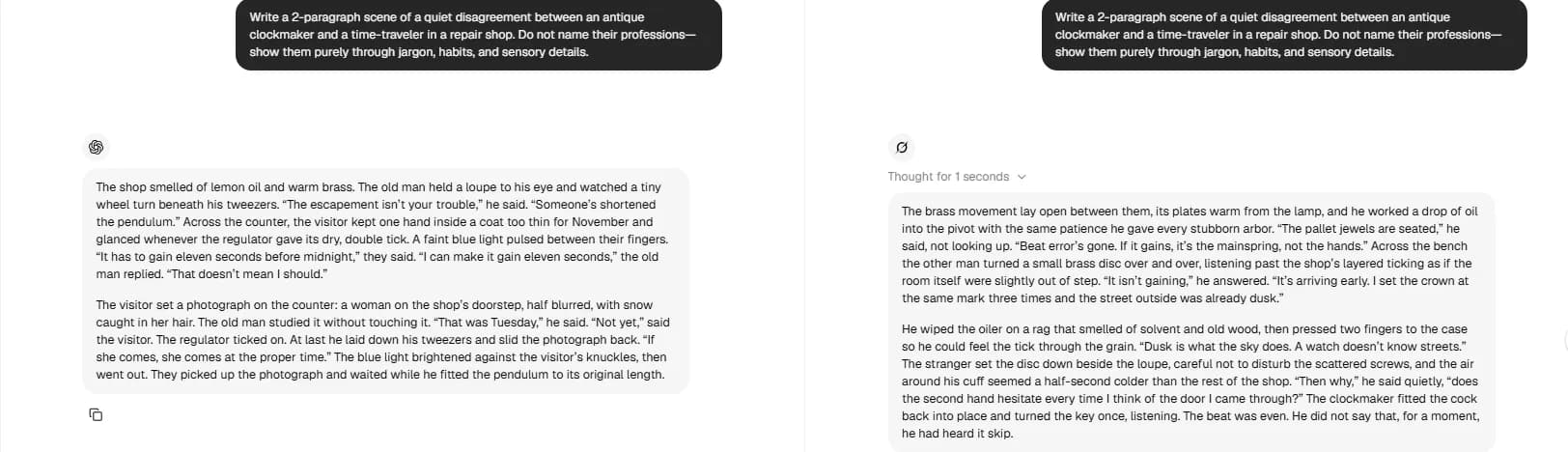
Write a 2-paragraph scene of a quiet disagreement between an antique clockmaker and a time-traveler in a repair shop. Do not name their professions—show them purely through jargon, habits, and sensory details.
What we found: GPT-6.1 Terra responded faster and used details like a loupe and pendulum to suggest the characters’ roles. Grok 4.7 also created an atmospheric scene but named the clockmaker despite the instruction.
The example between ChatGPT and Grok shows that strong creative writing depends on following the brief as well as producing vivid prose.
Reasoning or coding
Copy-paste prompt ✍️
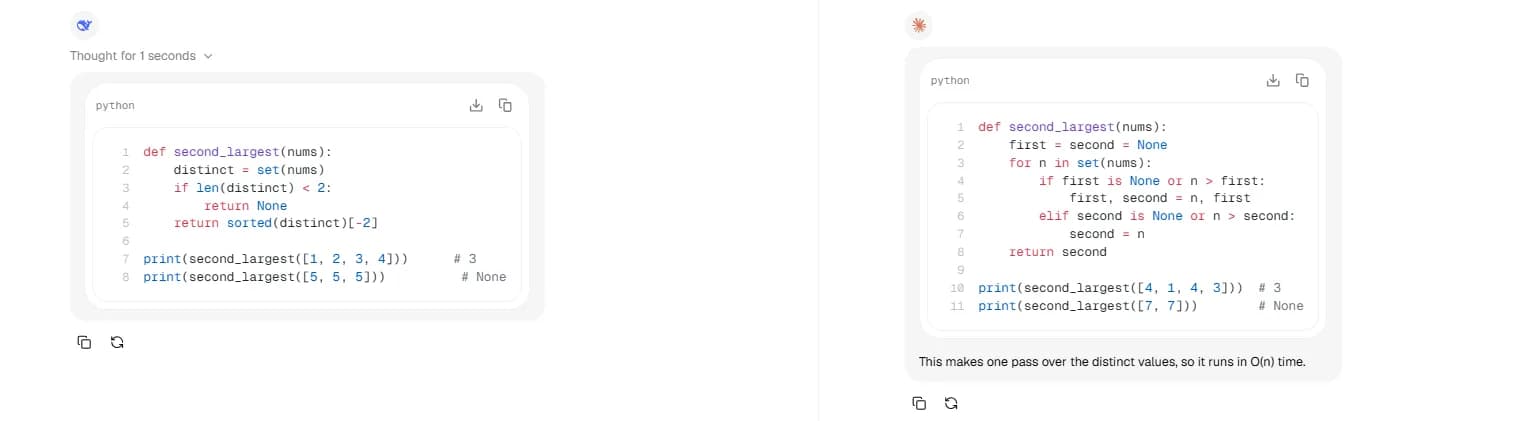
Write a Python function that returns the second-largest distinct number in a list. Return None if fewer than two distinct numbers exist. Include the function and two short examples. Keep your answer under 100 words.
What we found: DeepSeek V4-Pro and Claude Opus 5.5 both provided solutions that handle duplicates and return None when needed. DeepSeek gave a shorter solution that sorts the distinct values. Claude used a longer approach that avoids sorting and explained its time complexity and should be the better choice for larger lists.
Source-led research

Copy-paste prompt ✍️
According to NASA, what is the difference between weather and climate? Explain it in no more than 50 words and include a link to a relevant NASA source.
What we found: Perplexity Sonar and Gemini 4 Argon both gave brief yet detailed explanations and included a NASA link. Perplexity displayed a larger list of source links, while Gemini added examples of weather conditions in the output. For research, the useful takeaway is to check the linked source as well as the summary.
How to Choose the Best AI Chatbot for Your Workflow
The ideal chatbot or chatbots depends on how much detail and analysis your tasks need and the features you need most. Think about the following elements when choosing your AI model.
- Main task
Think about your priorities, whether writing, research, planning, analysis, or another type of task.
- Current sources
For up-to-date research, check whether it can search the web and cite sources.
- Coding
Ask yourself whether you need simple code suggestions or tools for larger development projects.
- Inputs
Check whether it accepts the documents, images, or other files you want to analyze.
- Response style
Compare answers for clarity, detail, tone, and how well they follow instructions.
- Speed
Look for a model that balances response quality with the speed your tasks require.
Why Limit Yourself to One Model? Use Different Models in Lorka
Different chatbots bring different strengths to your work. With Lorka, you can switch between AI models and access additional AI tools in a single chat.
Try this workflow:
- Draft or analyze a task with one model, such as Opus 5.5 or GPT-6 Astra.
- Ask another model to critique the answer against specific criteria.
- Check disagreements using reliable sources or tests.
- Refine the final output using what you’ve learned.
Combine models in our all-in-one chat to create a dynamic workflow and work with the latest AI models under one subscription.


Compare AI Chatbots Side by Side with Lorka AI
See how ChatGPT, Claude, Gemini, and other leading AI models respond to the same prompt. Compare their answers and find the best fit for your tasks.
Find Your Best AI ModelFAQs
The best AI chatbot depends on your workflow and specific task. However, ChatGPT-6 models are our top choice for daily and general use because they handle a wide range of tasks.