Key Takeaways ⭐
- GPT-6 Astra vs Claude Opus 5.5 has no universal winner. The better model depends on the task, the context, and the constraints you give it.
- A fair comparison needs identical inputs. We used the same prompts, source material, output format, and scoring criteria for both models.
- Benchmarks tell part of the story. Results shift with model version, reasoning effort, tools, prompts, and test harness.
- Opus 5.5 led our coding and planning tests, in line with public results that favor it for coding and knowledge work.
- Astra led our research and document-analysis tests by staying closer to the source material. OpenAI reports its strongest results in complex reasoning, science, and computer use.
- Human review still decides the final output. Neither model removes the need to check code, sources, or high-stakes decisions.
How We Tested GPT-6 Astra and Claude Opus 5.5
A fair model comparison requires the same prompt, source material, expected output, and evaluation criteria for both models.
Is GPT-6 Astra better than Claude Opus 5.5? You can’t answer that from a single impressive demo. So we set up four tasks that mirror real work and ran each one in both models, under the same conditions.
The four categories were coding, research, document analysis, and planning. Each test used one prompt, one fixed set of source material, and one required output format.
We ran every test in Lorka, in a fresh chat for each model, so neither one carried context from an earlier conversation. Browsing and file uploads were switched off. All source material was pasted directly into the prompt.
Settings matter here. Claude Opus 5.5 uses adaptive thinking that is always on, with a default effort level of medium. GPT-6 Astra also offers several reasoning levels. Different effort levels are not directly comparable, so we recorded the setting used for each run.
| Element | Test Rule |
|---|---|
| Test date | October 18, 2026 |
| Interface | Lorka, fresh chat per model and per test |
| Model versions | GPT-6 Astra, Claude Opus 5.5 |
| Reasoning setting | Default for each model in Lorka |
| Tools | Browsing off, no file uploads, source text pasted into the prompt |
| Prompt and sources | Identical for both models |
| Output format | Identical, specified in the prompt |
| Evaluation | Accuracy, reasoning, usefulness, structure, reliability |
| Review | Human editorial review against the rubric below |
| Limitation | One set of tasks cannot prove universal superiority |
Each output was scored from 1 to 5 on five criteria. The combined score is an editorial comparison using stated criteria, not objective scientific proof.
| Criterion | What We Assessed |
|---|---|
| Accuracy | Does the output correctly use the information provided? |
| Reasoning | Does it identify trade-offs, assumptions, and relevant steps? |
| Usefulness | Could a professional use it with limited revision? |
| Structure | Is it clear, organized, and easy to act on? |
| Reliability | Does it avoid unsupported claims, hallucinations, or risky actions? |
Coding and Research Tests
The coding and research tests show how each model handles precision work, where small mistakes are easy to miss and expensive to ship.
Coding Test: Fixing a Discount Function
The task: find and fix the bugs in a short Python function that applies discount codes to a shopping cart, without changing its signature.
We picked a contained example on purpose. The function has three real problems: it crashes on an invalid code, it checks the minimum order value after the discount instead of before, and a fixed discount can push the total below zero.
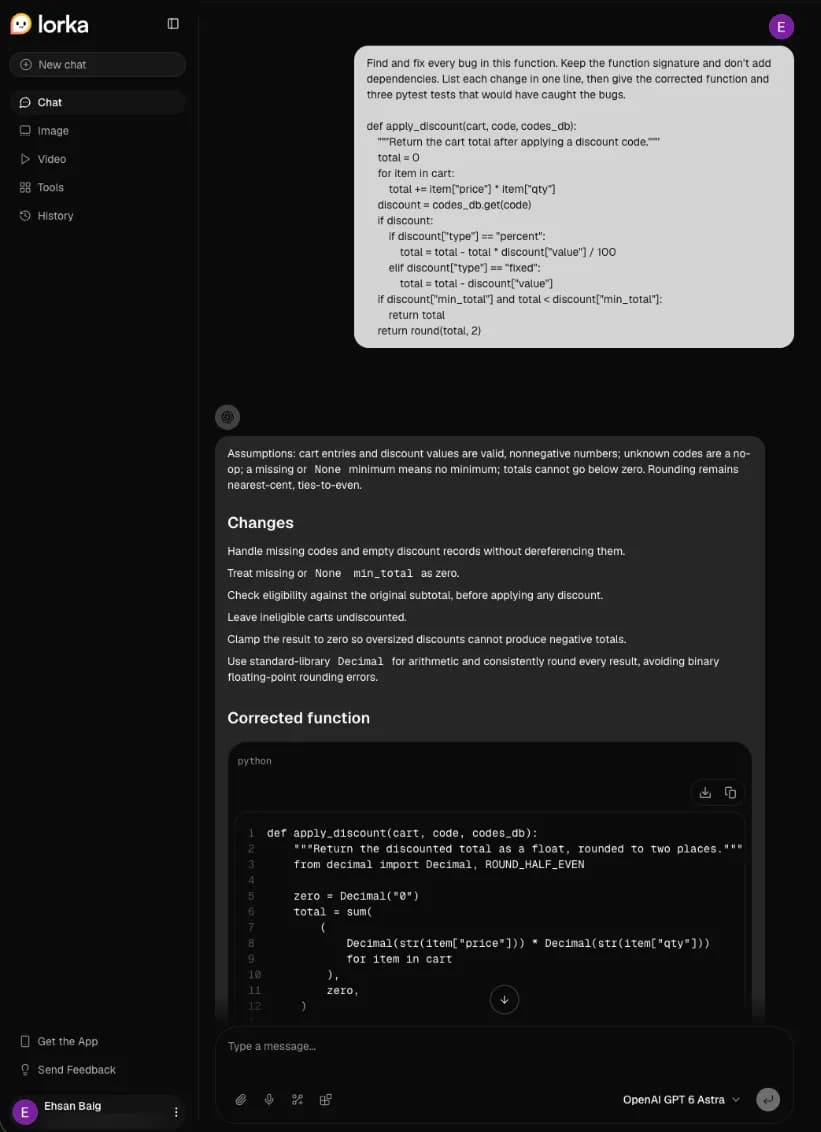
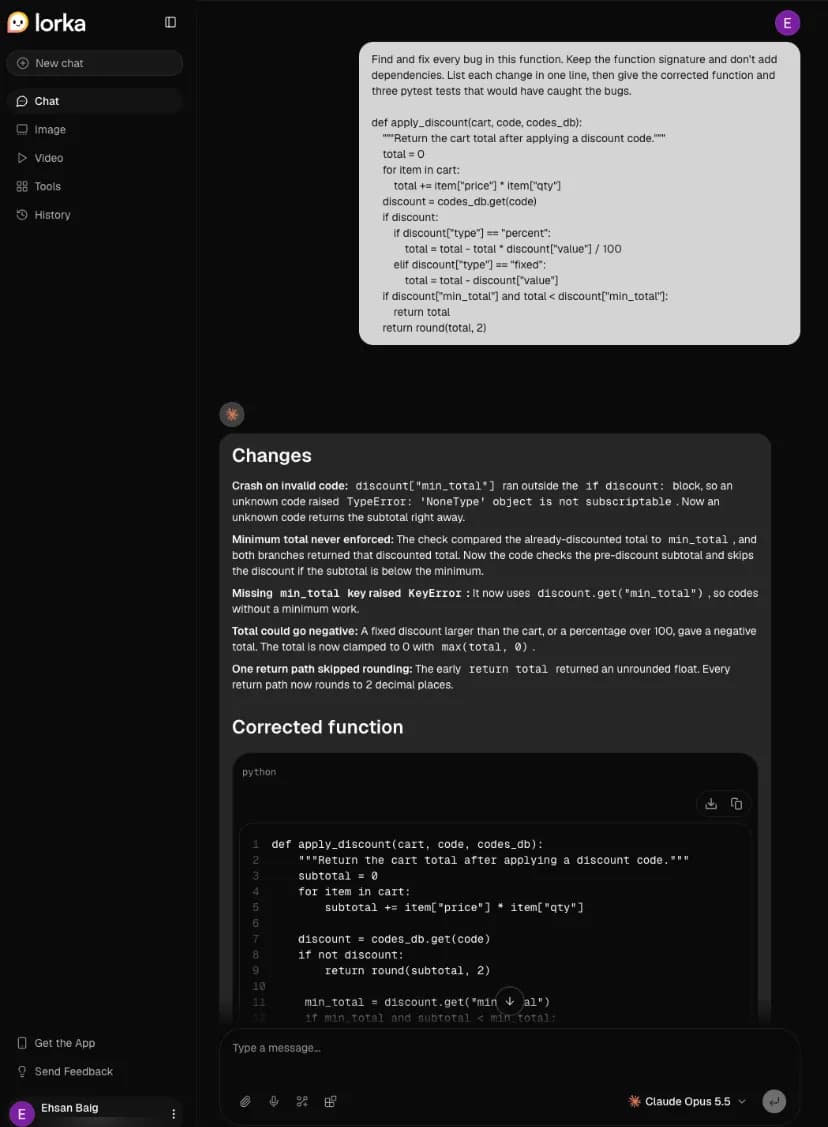
The prompt: “Find and fix every bug in this function. Keep the function signature and don’t add dependencies. List each change in one line, then give the corrected function and three pytest tests that would have caught the bugs.”
This is a good test of GPT-6 Astra coding versus Claude Opus 5.5 coding in everyday terms. It rewards correctness and scope control, and it punishes models that rewrite code nobody asked them to touch.
GPT-6 Astra output:
Claude Opus 5.5 output:
| Criterion | GPT-6 Astra | Claude Opus 5.5 |
|---|---|---|
| Accuracy | 5 | 5 |
| Reasoning | 4 | 5 |
| Usefulness | 3 | 5 |
| Structure | 4 | 5 |
| Reliability | 3 | 4 |
| Total (out of 25) | 19 | 24 |
Both models found all three bugs and the unrounded early return, and both handled a missing min_total key. They differed in approach.
GPT-6 Astra stated its assumptions up front, handled empty and None discount records, and rewrote the arithmetic with Decimal to avoid floating-point rounding errors. Its tests were thorough, covering the exact minimum threshold, optional minimums, and oversized discounts.
The cost was scope: the Decimal rewrite changes rounding behavior nobody asked about, and its parametrized tests stretch “three tests” into about 15 cases.
Claude Opus 5.5 kept the original structure, explained why each bug happened, and wrote exactly three tests that each fail on the original code. It also flagged that “minimum total” could be read two ways.
Astra’s fix is the more defensive of the two, while Opus’s is easier to review and ship.
What to look for in your own coding tests: did the model fix only what was broken, and would its tests actually fail on the original code? A confident fix that changes behavior elsewhere is worse than a partial one.
Research Test: Synthesizing Four Sources
The task: read four short source documents about a proposed four-day-week pilot for a support team, then write a sourced recommendation.
The sources were written for this test. They disagree in places, and one contains a claim with no supporting data. That’s deliberate. A strong research answer should notice both.
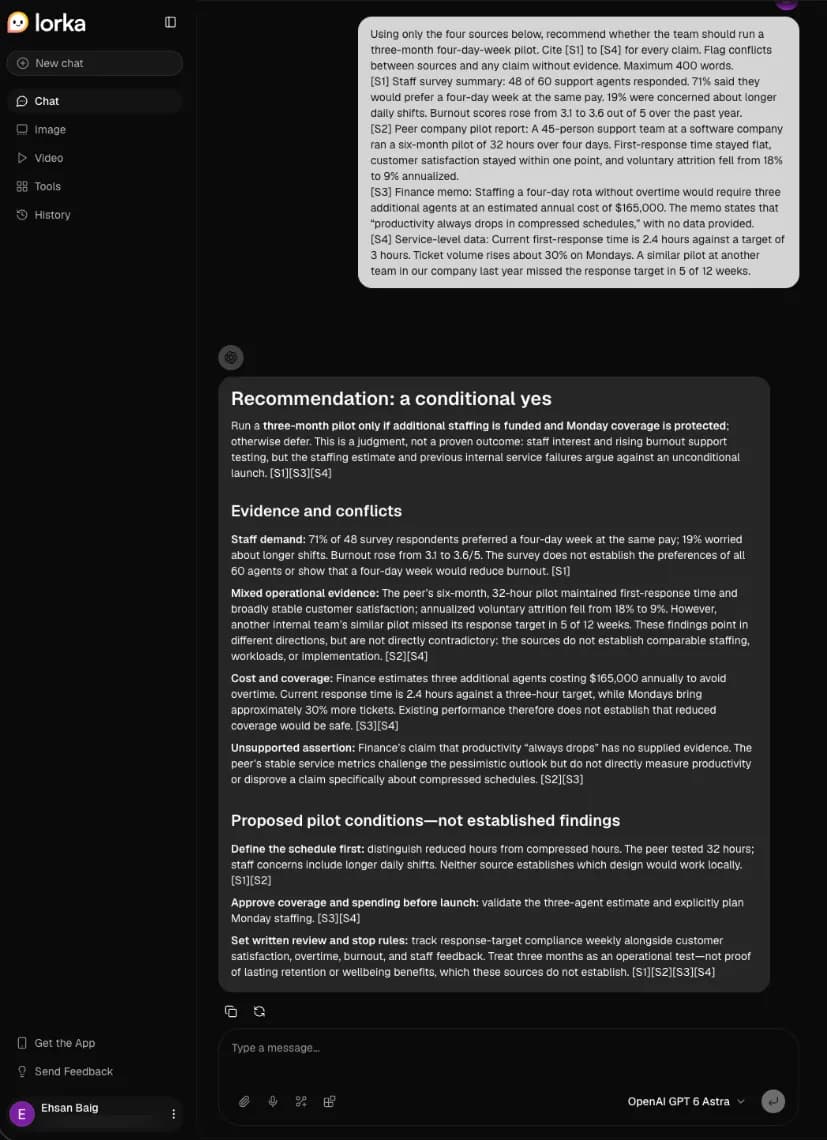
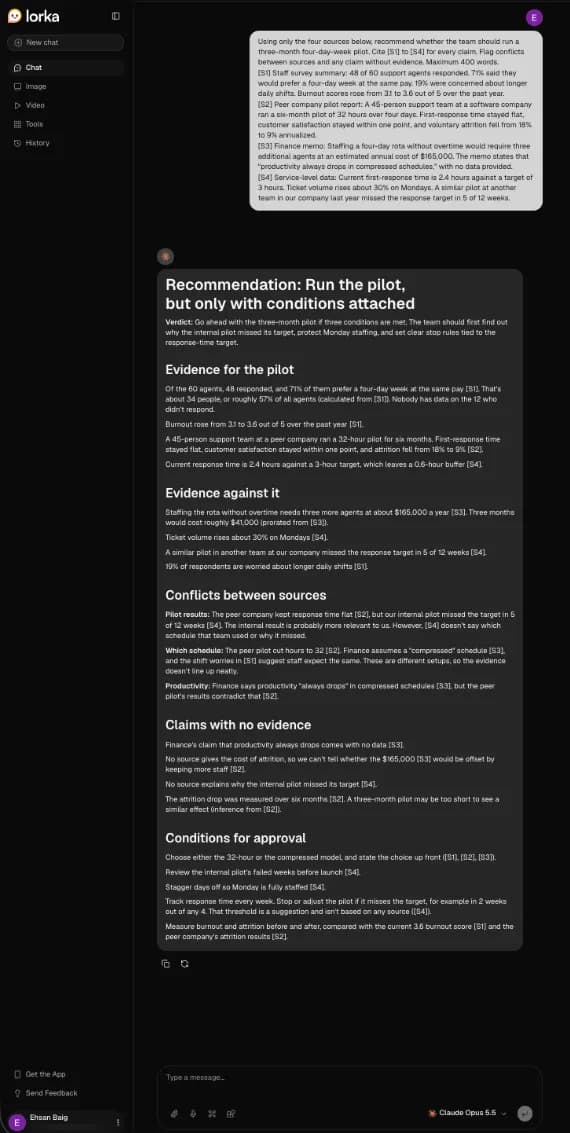
The prompt: “Using only the four sources below, recommend whether the team should run a three-month four-day-week pilot. Cite [S1] to [S4] for every claim. Flag conflicts between sources and any claim without evidence. Maximum 400 words.”
This is where GPT-6 Astra vs Claude on research gets interesting. Both models can write a fluent recommendation. The real question is whether they stay inside the sources or quietly add facts of their own.
GPT-6 Astra output:
Claude Opus 5.5 output:
| Criterion | GPT-6 Astra | Claude Opus 5.5 |
|---|---|---|
| Accuracy | 5 | 4 |
| Reasoning | 5 | 5 |
| Usefulness | 4 | 4 |
| Structure | 4 | 4 |
| Reliability | 5 | 4 |
| Total (out of 25) | 23 | 21 |
Both models recommended a conditional pilot, flagged the unsupported “productivity always drops” claim in S3, spotted the gap between the peer pilot in S2 and the internal pilot in S4, and raised Monday ticket volume as a scheduling risk.
The differences were in citation style, added numbers, and length. Claude Opus 5.5 cited nearly every sentence individually and labeled its own inferences. But it added figures that aren’t in the sources (about 34 respondents, a $41,000 three-month cost, a two-weeks-in-four stop rule), and it said the peer pilot contradicts the productivity claim, which S2 never measures. At roughly 560 words, it also ran well past the 400-word limit.
GPT-6 Astra stayed near 370 words, added no new figures, and was more careful about what the sources can and cannot prove. However, it grouped its citations at the end of paragraphs, which makes individual claims harder to trace, and its pilot conditions were less specific.
Neither was clearly better: Astra followed the constraints more closely, while Opus gave more concrete next steps.
Unsupported claims are the failures worth watching. Our guide to grounding in AI explains why keeping a model tied to its sources matters so much for research work.
Document Analysis and Planning Tests
The document and planning tests reflect everyday professional work, where the best answer is the one a manager can act on straight away.
Document Analysis Test: Meeting Notes to Executive Brief
The task: turn roughly 350 words of messy launch-review meeting notes into a short executive brief.
The notes bury one important detail in the middle: legal sign-off hasn’t been received, and the launch date depends on it. A good brief should move that to the top.
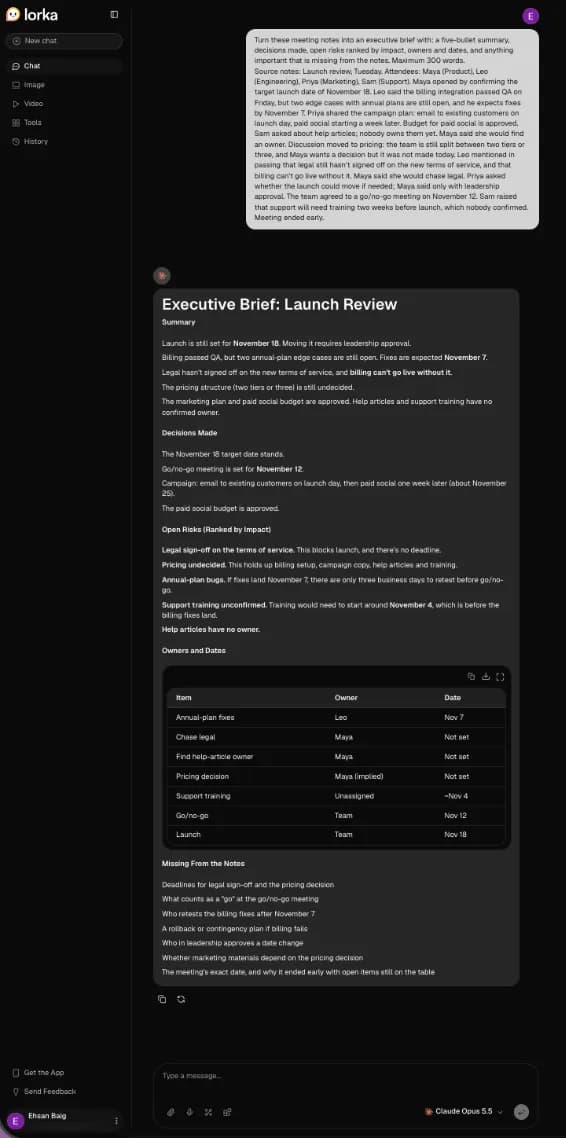
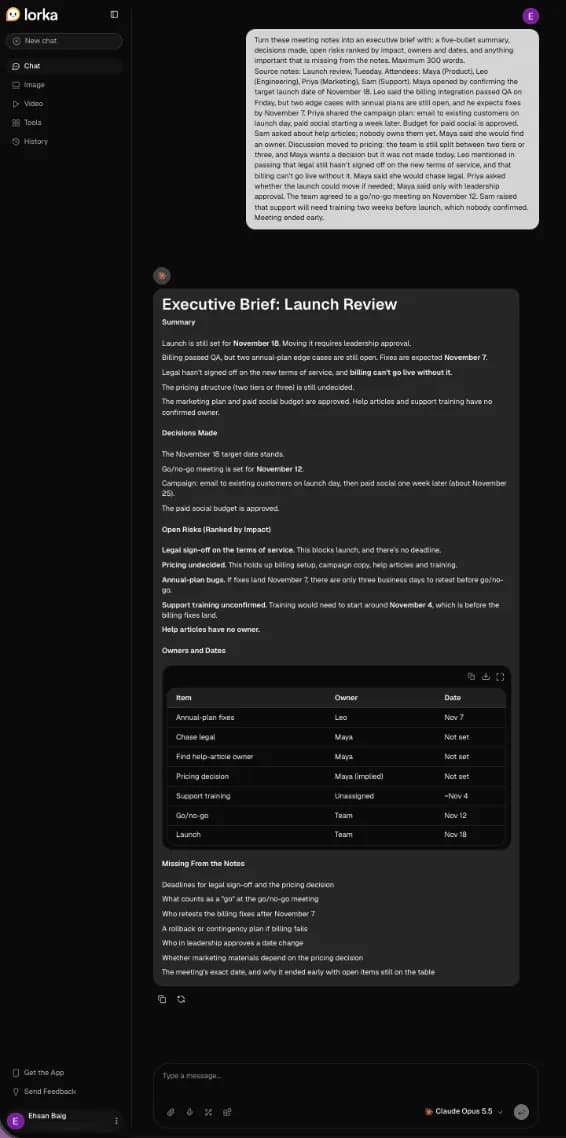
The prompt: “Turn these meeting notes into an executive brief with: a five-bullet summary, decisions made, open risks ranked by impact, owners and dates, and anything important that is missing from the notes. Maximum 300 words.”
GPT-6 Astra output:
Claude Opus 5.5 output:
| Criterion | GPT-6 Astra | Claude Opus 5.5 |
|---|---|---|
| Accuracy | 5 | 4 |
| Reasoning | 4 | 5 |
| Usefulness | 5 | 4 |
| Structure | 5 | 4 |
| Reliability | 4 | 3 |
| Total (out of 25) | 23 | 20 |
Both models ranked the legal sign-off first and noted that it has no deadline. Both also caught the undecided pricing tier, the missing help-article owner, the unconfirmed support training, and the open annual-plan edge cases, and both listed what the notes left out, such as a contingency plan and go/no-go criteria.
Neither invented a date outright, though both derived a November 25 paid-social date from “a week later” and labeled it. Both filled some owner gaps by inference: both listed “Team” as owner of the go/no-go, and Opus also listed “Team” for the launch and “Maya (implied)” for pricing.
Opus also claimed that the pricing decision holds up billing setup, campaign copy, help articles and training, which the notes never say. In its favor, Opus spotted that only three business days separate the November 7 fixes from the November 12 go/no-go, and that support training would have to start before the fixes land.
GPT-6 Astra’s brief was shorter (about 265 words against Opus’s roughly 300), labeled risks by severity, and marked missing deadlines plainly. It would need little editing, while Opus’s would need the unsupported claim removed and a trim to stay under the 300-word limit.
Planning Test: A Help Center Migration
The task: build a project plan to move 400 help articles to a new platform, with a fixed team, three languages, and a hard deadline.
The constraints contain a deliberate tension. The prompt asks for a ten-week plan, but the December 15 code freeze lands at the start of Week 9. The better plan should notice and say so, rather than quietly scheduling launch work into the freeze.
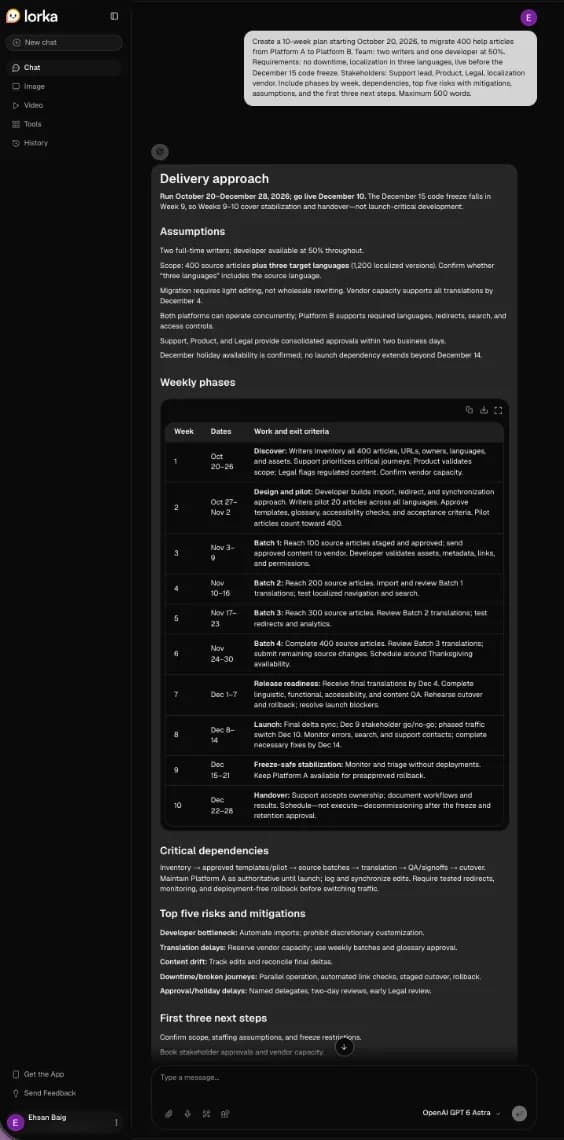
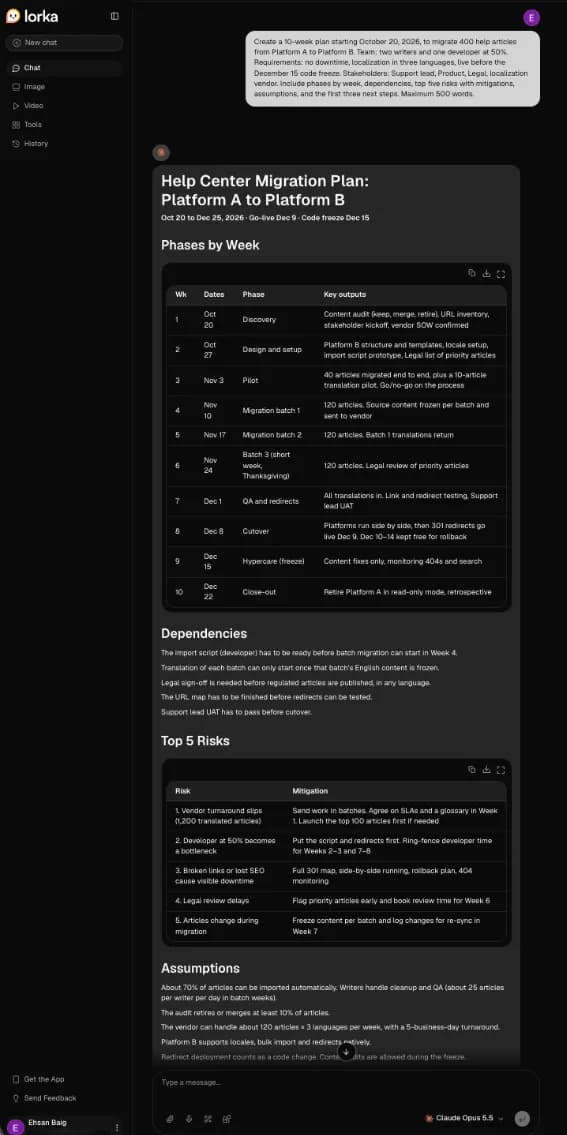
The prompt: “Create a 10-week plan starting October 20, 2026, to migrate 400 help articles from Platform A to Platform B. Team: two writers and one developer at 50%. Requirements: no downtime, localization in three languages, live before the December 15 code freeze. Stakeholders: Support lead, Product, Legal, localization vendor. Include phases by week, dependencies, top five risks with mitigations, assumptions, and the first three next steps. Maximum 500 words.”
This is a direct look at GPT-6 Astra vs Claude reasoning under pressure. Sequencing, feasibility, and honesty about the timeline matter more than polish.
GPT-6 Astra output:
Claude Opus 5.5 output:
| Criterion | GPT-6 Astra | Claude Opus 5.5 |
|---|---|---|
| Accuracy | 5 | 5 |
| Reasoning | 4 | 5 |
| Usefulness | 4 | 5 |
| Structure | 4 | 5 |
| Reliability | 4 | 4 |
| Total (out of 25) | 21 | 24 |
Both models produced a workable ten-week plan that launches before the December 15 freeze and uses Weeks 9 and 10 for stabilization and close-out. GPT-6 Astra came closest to naming the timeline problem, noting that the freeze falls in Week 9, and it also asked whether “three languages” includes the source language.
Claude Opus 5.5 also went live before the freeze and marked Week 9 as hypercare, but didn’t call out the tension between a ten-week plan and the freeze.
Opus was more specific about execution: it added a content audit, capacity math for the writers, ring-fenced developer weeks, and support UAT before cutover, and it noted that redirects count as code changes during the freeze.
Astra’s weekly exit criteria were clear, but its risks and next steps were more generic. Both relied on optimistic assumptions about vendor turnaround, and both labeled them. Neither plan is final without a feasibility check.
Final Score Summary
Here’s how the four tests compare side by side. Treat the totals as an editorial signal, not a precise measurement.
| Test | GPT-6 Astra | Claude Opus 5.5 | Practical Verdict |
|---|---|---|---|
| Coding | 19/25 | 24/25 | Both fixed every bug. Opus made a tighter, easier-to-review fix, while Astra’s larger Decimal rewrite needs more checking. |
| Research | 23/25 | 21/25 | Both caught the key problems. Astra stayed inside the sources and the word limit, while Opus gave more concrete steps but added numbers and ran long. |
| Document analysis | 23/25 | 20/25 | Both ranked legal first and caught what was missing. Astra stayed closer to the notes and needed less editing, while Opus had sharper timeline insights but one unsupported claim. |
| Planning | 21/25 | 24/25 | Both launched before the freeze. Astra flagged where the freeze falls, while Opus gave a more detailed, execution-ready plan. |
The totals are close (86 for Astra, 89 for Opus), and no model won every test.
Opus led on coding, where its tighter fix and exactly three tests were easier to review, and on planning, where its plan was more execution-ready. Astra led on research and document analysis, where it stayed closer to the source material and the word limits.
What Benchmarks Tell Us and What They Do Not
Public benchmarks can indicate where models may be strong, but they don’t replace testing models on your own work.
What do GPT-6 Astra benchmarks and Claude Opus 5.5 benchmarks actually show? Mostly, a split by use case, and a lot of sensitivity to how the test was run.
Start with the provider claims. OpenAI describes GPT-6 Astra as state-of-the-art on computer use, browsing, software engineering, science, and professional work. Anthropic positions Claude Opus 5.5 as its model for long-running agentic coding and knowledge work.
Both companies publish strong numbers. Those numbers are provider-reported, and they should be read that way, not as independent fact.
Terminal-Bench 4.0 is a good example of why. OpenAI reports 57.9% for Astra at high effort. Anthropic reports 66.4% for Opus 5.5 at xhigh effort in its Claude Opus 5.5 announcement. On paper, that looks like a clear coding gap.
Yet in Artificial Analysis’s independent comparison, run under one shared harness, the two models score 59.6% (Opus) and 59.1% (Astra) at max effort. The gap almost disappears.
The same independent data shows the split. Opus 5.5 leads Artificial Analysis’s overall Intelligence Index at maximum effort. Astra scores higher on GDP.pdf, a test of answering professional questions from complex PDF documents.
So why do the numbers move around? Benchmark results can vary with:
- Model version, including point releases and snapshots.
- Reasoning effort, such as medium versus max.
- Prompting, including system prompts and instructions.
- Tool access, such as code execution, browsing, or computer-use tools.
- Test harness, the software that runs the evaluation.
- Evaluation methodology, including how scores are graded and averaged.
Artificial Analysis documents its methodology openly, which is exactly what makes cross-checking possible. Use benchmarks as one signal, then test your own tasks.
Which Model Makes Sense for Which Kind of Work?
Choose based on the work you need to complete, not on the idea that one premium model will always outperform the other.
What’s the best AI model for coding, research, or planning? The honest answer depends on the task in front of you. The table below translates the evidence into a practical starting point.
| If You Need To… | Start With | Why | Reference |
|---|---|---|---|
| Debug, refactor, or review code | Claude Opus 5.5 | Led our coding test with a tighter, easier-to-review fix; verify against your own codebase | Anthropic docs |
| Research a difficult question or synthesize sources | Test both | In our test, Astra stayed closer to the sources, while Opus gave more concrete next steps | Artificial Analysis |
| Analyze a long document or create an executive brief | Test both | In our test, Astra stayed closer to the notes, while Opus spotted sharper timeline risks | Artificial Analysis |
| Plan a complex project with risks and dependencies | Test both | In our test, Opus gave the more execution-ready plan, while Astra flagged the freeze sooner | OpenAI: GPT-6 Astra |
| Work with computer-use or specialized technical workflows | GPT-6 Astra | Consider Astra first where current product capabilities support it | OpenAI: GPT-6 Astra |
| Produce high-stakes or external-facing work | Both + human review | Compare outputs, verify facts, and keep a person accountable | AI hallucinations |
Notice how often the answer is “test both.” That isn’t a dodge. When two premium models are this close, the specific task decides more than the brand name.
For GPT-6 Astra vs Claude on writing and editing, the same logic applies. Tone, structure, and how much revision a draft needs vary by brief, so a side-by-side run tells you more than any benchmark.
If you’re choosing across the wider Anthropic lineup, our guide to which Claude model to use covers the other tiers. For a broader view, see our Claude vs ChatGPT comparison.
Comparing Astra and Opus in Lorka
The best way to decide between GPT-6 Astra and Claude Opus 5.5 is to test the same real task in both. Use the same prompt, source material, and output format. Then compare accuracy, reasoning, structure, and how much revision each answer needs.
Lorka makes this easier by giving you multiple AI models in one workspace. You can compare outputs without moving context between separate tools, then keep the version that works.


Compare GPT-6 Astra and Claude Opus 5.5 in Lorka
Run the same prompt in both models and compare accuracy, reasoning, and output quality side by side.
Compare both models nowChoosing the Output, Not the Brand
So which model performs better? It depends on the task, the tools, the constraints, and how much review the work needs.
GPT-6 Astra and Claude Opus 5.5 are both capable models for demanding work. In our tests, Opus 5.5 produced the tighter code fix and the more execution-ready plan, while Astra stayed closer to the source material and word limits in research and document analysis.
Use benchmarks as one signal. Test real work in both models when you can. Then choose the output that is most accurate, useful, and reliable for your workflow.
Frequently Asked Questions on GPT-6 Astra vs Claude Opus 5.5
Not across the board. In our four tests, the totals were close and each model led on different tasks. Public benchmarks show a similar split. The better model depends on your task, settings, and constraints, so compare both on real work.