

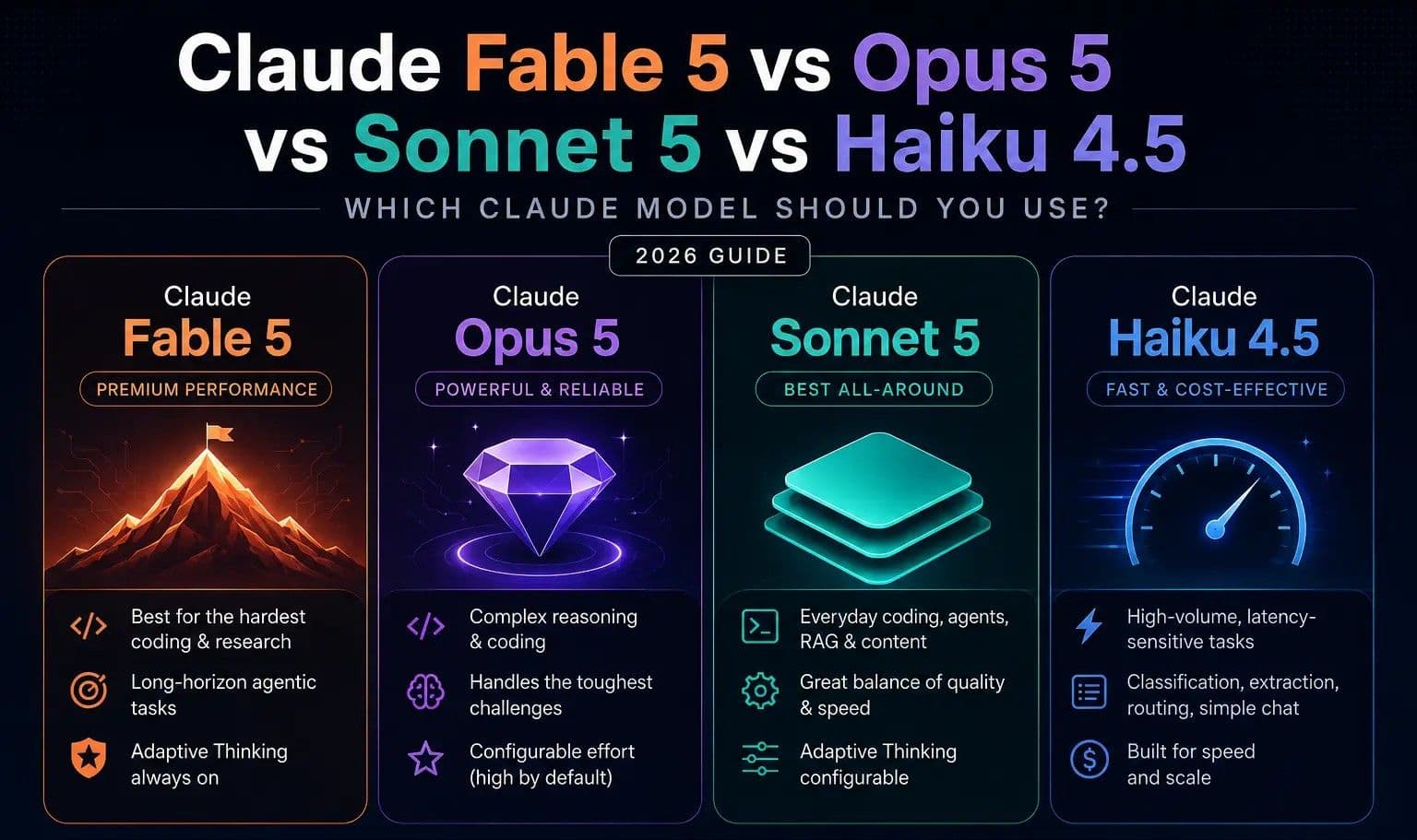
Key Takeaways⭐
- Fable 5 leads, but the numbers are mixed, especially long-horizon coding, but several of Anthropic’s own figures reflect the uncapped Mythos 5 model sitting behind Fable 5’s safety classifiers, not what you’ll get calling the API directly.
- A U.S. export-control order forced Anthropic to suspend both Fable 5 and Mythos 5 worldwide on June 12, 2026. Access was restored on July 1, 2026, the day after Commerce lifted the controls.
- Launched June 30, 2026 at $2/$10 intro pricing (through Aug 31, 2026), Sonnet 5 actually beats the pricier Opus 5 on Terminal-Bench 2.1 and GDPval-AA knowledge work.
- Opus 5 delivers most of Fable 5’s coding capability at half the price, while Haiku 4.5 remains the cheapest option for high-volume, latency-sensitive tasks.
- Mythos 5 isn’t for most developers, it’s the same model as Fable 5 with safety classifiers removed, restricted to organizations approved through Project Glasswing.
Anthropic's Claude lineup got genuinely confusing this summer. In the space of about three weeks, the company shipped Claude Fable 5 and Claude Mythos 5 on June 9, 2026, and had both models pulled offline days later by a U.S. export-control order.
Then it restored access on July 1, the same week it quietly shipped Claude Sonnet 5, too. If you've been half-following the headlines and just want a straight answer to "Which Claude model should I actually use?" that whiplash is probably why you're here.
This isn't a rewrite of Anthropic's press release. It's the comparison we wish existed when Fable 5 launched: what each of the four models Anthropic sells today is.
Haiku 4.5, Sonnet 5, Opus 5, and Fable 5 are actually good at what the benchmark numbers say once you separate Anthropic's own reporting from independently confirmed figures, what a real task costs on each tier, and a decision framework you can apply without reading the rest of the piece.
We'll also cover Claude Mythos 5, the restricted sibling almost nobody reading this can use, and explain why that's the case rather than just gesturing at it.
A quick note on approach before we get into it: a lot of the coverage that ran the week Fable 5 shipped leaned on numbers that turned out to shift once Anthropic's full system card landed or conflated Fable 5's public scores with the uncapped Mythos 5 figures sitting right next to them in the same table.
We've tried to flag where that distinction matters rather than smoothing over it, because it changes the answer to "What will I actually get if I call this API?" which, at the end of the day, is the only question worth answering here.
The Claude Model Family at a Glance
Four Claude models are live right now, priced anywhere from $1 to $50 per million tokens (see the official pricing page for the current rates), and which one is “best” depends far more on what you're asking it to do than on which tier you've defaulted to out of habit.
Here's the full lineup side by side.
| Model | API model ID | Input/Output ($ per MTok) | Context window | Max output | Adaptive Thinking | Best for |
|---|---|---|---|---|---|---|
| Claude Haiku 4.5 | claude-haiku-4-5-20251001 | $1/$5 | 200K tokens | Standard | Not the focus, built for speed over depth | High-volume, latency-sensitive tasks: classification, extraction, routing, simple chat |
| Claude Sonnet 5 | claude-sonnet-5 | $2/$10 intro (through Aug 31, 2026), then $3/$15 | 1M tokens | 128K tokens | On by default; configurable effort, low → xhigh | Default production workhorse: coding, agents, RAG, content generation, computer use |
| Claude Opus 5 | claude-opus-4-8 | $5/$25 | 1M tokens | 128K tokens | Configurable; defaults to high effort | Complex reasoning and the hardest coding jobs when Sonnet isn't enough |
| Claude Fable 5 | claude-fable-5 | $10/$50 | 1M tokens | 128K tokens | Always on, cannot be disabled | The hardest long-horizon coding, research, and agentic tasks where failure is expensive |
Notice who's missing: Claude Mythos 5 isn't in this table, on purpose. Per Anthropic's own model documentation, Mythos 5 shares the same underlying weights as Fable 5, just without the classifiers that occasionally decline or redirect a request.
It's gated behind an approval program called Project Glasswing, not something you can spin up with an API key, so it doesn't really belong on a comparison chart most developers can act on.
Haiku 4.5 is easy to overlook in a piece mostly about the top of the lineup, but it's doing more of the heavy lifting in most production systems than any of the flagship models.
At $1/$5 per million tokens, it's roughly a third of Sonnet 5's standard rate and is suitable for narrow, high-frequency jobs, intent classification, PII redaction, routing a support ticket to the right queue, and summarizing a short document.
It's often indistinguishable from a much larger model in the output a user actually sees. The mistake most teams make isn't underusing Haiku; it's assuming it can't handle anything more involved without testing first.
A fair amount of moderately complex extraction and formatting work that “feels” like it needs Sonnet turns out to run just fine on Haiku once the prompt is tightened up.
What Is Claude Fable 5, and What Makes It Different?
Claude Fable 5 is Anthropic's first “Mythos-class” model made available to the public, a full tier above Opus, launched June 9, 2026, at exactly double Opus 5's price.
Anthropic describes the Mythos-class tier as exceeding anything it has previously shipped for general use, and once you look at the benchmark table below, that's not just launch-day bravado; the gap over Opus is real; it's just uneven across task types.
A handful of things separate Fable 5 from the rest of the lineup beyond the sticker price:
- Adaptive thinking is always on and can't be switched off. On Opus 5 and Sonnet 5, extended reasoning is a configurable effort parameter you dial from low up to high, and you can drop it entirely for latency-sensitive calls.
- Fable 5 doesn't give you that option; pass a thinking disabled parameter, and the API throws an error instead of honoring it. The model decides how much reasoning depth a task deserves every time.
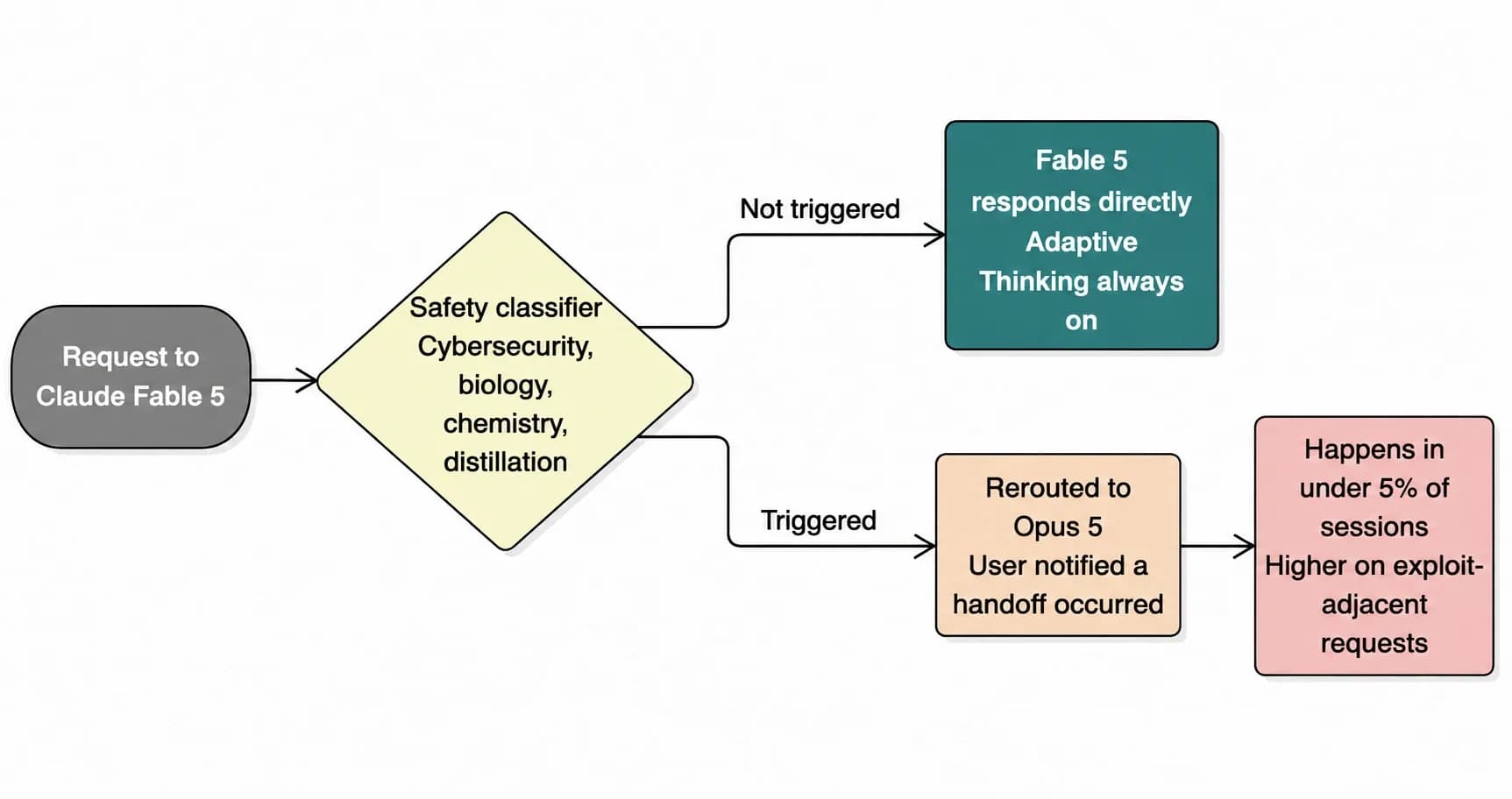
- Safety classifiers fall back to Opus 5 instead of refusing outright. Fable 5 ships with classifiers tuned for cybersecurity, biology, and chemistry and large-scale model distillation.
- When one fires, the request doesn't hit a dead end. It's quietly rerouted to Claude Opus 5, and the response tells you a handoff happened.
- Anthropic says this occurs in under 5% of sessions on average, though the rate climbs on anything that even smells like exploit development.
- A 1M-token context window with 128K max output tokens, identical capacity to Opus 5 and Sonnet 5, so the upgrade is about depth of reasoning, not more room to work with.
- Pricing of $10 input/$50 output per million tokens, double Opus 5's $5/$25, and currently the most expensive tier Anthropic sells at retail.
The rollout itself has been messier than the spec sheet suggests, and it's worth knowing the timeline if you're deciding whether to build on Fable 5 today.
It launched with free access on Pro, Max, Team, and Enterprise plans through June 22, 2026, after which usage moved to standard billing.
Then, on June 12, a U.S. export-control directive forced Anthropic to disable both Fable 5 and Mythos 5 for every user worldwide, subscriptions and API alike.
While every other Claude model stayed up.
According to Anthropic's own account, the order came after external researchers at Amazon reportedly found a way to get Fable 5 to describe exploitable software vulnerabilities, and the government's directive didn't leave room for Anthropic to distinguish domestic from foreign users in real time, so it pulled the model entirely rather than risk non-compliance.
The suspension lasted eighteen days.
The Commerce Department lifted the export controls on June 30, and Fable 5 came back online for everyone the next day, July 1, 2026, with Pro, Max, and Team users getting roughly half their weekly usage limit on Fable 5 at no extra cost through July 7 as a goodwill gesture.
As of this writing, both models have been generally available for over three weeks with no further interruptions.
Anthropic backed the launch with feedback from early-access partners, and a few of those data points travel well beyond the press release.
Stripe reported completing a codebase-wide migration across a 50-million-line Ruby codebase in a single day, work its own engineers had estimated at more than two months for a full team.
Cursor's CEO, Michael Truell, called it the top performer on the company's internal CursorBench and said it opened up a class of long-horizon problems earlier models simply couldn't reach.
Cognition, which built the independent FrontierCode evaluation, reported Fable 5 as the highest-scoring model that the benchmark has seen.
All of that is worth noting, and none of it is independent verification; treat vendor testimonials as a directional signal, then go test the thing on your own repository before you trust it with anything expensive.
Benchmark Comparison: Fable 5 vs Opus 5 vs Sonnet 5
On the figures Anthropic has published, partly confirmed by independent trackers like vals.ai and Artificial Analysis.
Fable 5 leads across nearly every category.
But the size of that lead swings wildly depending on what you're actually asking it to do, and that variance, not the headline number, is the part worth planning around.
| Benchmark | Fable 5 | Opus 5 | Sonnet 5 | What it measures |
|---|---|---|---|---|
| SWE-Bench Pro (agentic coding) | 80.3% | 69.2% | 63.2% | Harder, contamination-resistant version of SWE-Bench; multi-step real-world engineering |
| SWE-bench Verified | 95.0%* | 88.6% | — | Classic single-issue coding benchmark |
| FrontierCode Diamond (Cognition) | 29.3%* | 13.4% | — | Hardest split of an independent, contamination-resistant coding eval |
| Terminal-Bench 2.1 | 88.0%* | 74.6% | 80.4% | Long-horizon command-line and agentic terminal tasks |
| OSWorld-Verified (computer use) | 85.0%* | 83.4% | 81.2% | Operating a real desktop GUI end-to-end |
| GDPval-AA v2 (knowledge work, Elo) | 1,932* | 1,615 | 1,618 | Professional-grade document, research, and analysis tasks |
Figures marked with an asterisk come from Anthropic's Fable 5/Mythos 5 system card and launch materials (see the full breakdown).
On several of these rows, the coding-heavy and cybersecurity-adjacent ones especially. Anthropic's own table is technically reporting the Mythos 5 score, since Fable 5's safety classifiers route a share of those exact queries to Opus 5 before they ever reach the uncapped model.
Read the starred numbers as the ceiling of the underlying model rather than a guaranteed result from calling claude-fable-5 in production.
Independent trackers confirm the SWE-bench. Verified and GDPval-AA figures specifically (see the comparison), but not every row has been reproduced outside Anthropic's own testing.
This benchmark tracker is a good place to watch which numbers pick up third-party backing as more evaluators publish results.
One more thing worth flagging before the numbers: effort level matters more than most benchmark tables let on. Sonnet 5 and Opus 5 expose a configurable effort parameter, and a score reported at high or xhigh effort can look meaningfully better than the same model running at its default setting.
It matters if you're comparing a vendor's best-case number against a model you're calling with default settings in production.
Fable 5 sidesteps this somewhat since Adaptive Thinking is fixed rather than configurable, but it also means you can't dial it down for a quick, low-stakes call the way you can with the other two.
Keep that in mind before treating any single benchmark score as a fixed, comparable constant across models.
Where Fable 5 actually dominates
Coding and long-horizon agentic work are where the premium earns its keep.
An 11-point jump on SWE-Bench Pro (80.3% vs. 69.2%) is a bigger swing than the gap between Opus 5 and most rival frontier models released around the same time, and on Cognition's harder Diamond split the gap more than doubles (29.3% vs. 13.4%).
The pattern repeats on Terminal-Bench 2.1, which rewards a model that can hold a plan across dozens of command-line steps without drifting.
If your workload looks like “hand it a messy repo and a vague ticket and come back in an hour,” this is where the extra spend shows up as extra output, not just a nicer benchmark chart.
Where the gap narrows to almost nothing
Computer use is the clean counterexample. On OSWorld-Verified, Fable 5's 85.0% edges Opus 5's 83.4% by just 1.6 points, and Sonnet 5 isn't far behind at 81.2%.
Clicking through a browser or desktop GUI apparently doesn't reward the extra reasoning depth the way multi-file coding does—so if computer-use agents are the bulk of your traffic, paying twice as much for Fable 5 is hard to defend on the numbers alone.
Where Sonnet 5 punches well above its price tag
Sonnet 5 clearly trails on SWE-Bench Pro (63.2% against Opus 5's 69.2% and Fable 5's 80.3%), so it's not the model for your gnarliest coding tickets.
But on two evaluations, it actually edges out the far pricier Opus 5: Terminal-Bench 2.1 (80.4% vs. 74.6%) and GDPval-AA knowledge-work Elo (1,618 vs. 1,615).
For everyday document analysis, research synthesis, and terminal-driven agent work, Sonnet 5 is delivering Opus-class results (or better) at roughly 40% less cost, per Anthropic's own Sonnet 5 comparison data, which is exactly why standardizing on one Claude model for everything usually leaves value on the table one way or the other.
Pricing Breakdown: Is Fable 5 Worth Twice the Price?
The benchmark gap between Fable 5 and Opus 5 is real. The cost gap is bigger, and it compounds fast once you're running production volume rather than a demo. Here's the arithmetic on two scenarios that show up in almost every team's usage, using the official per-token rates.
Cost per agentic task (200K input + 50K output tokens)
| Model | Input cost | Output cost | Total per task |
|---|---|---|---|
| Claude Haiku 4.5 ($1/$5) | $0.20 | $0.25 | $0.45 |
| Claude Sonnet 5, intro ($2/$10) | $0.40 | $0.50 | $0.90 |
| Claude Sonnet 5, standard ($3/$15) | $0.60 | $0.75 | $1.35 |
| Claude Opus 5 ($5/$25) | $1.00 | $1.25 | $2.25 |
| Claude Fable 5 ($10/$50) | $2.00 | $2.50 | $4.50 |
A single task like this rarely breaks anyone's budget; Fable 5 costs about $2.25 more than Opus 5 per run, and around $4 more than Sonnet 5 at its intro rate.
The real decision shows up at scale once you multiply that gap by every request your product handles in a month, and once you factor in that a 200K/50K-token task is a fairly conservative example.
Long agentic coding sessions on Fable 5 routinely burn through several million tokens across a single overnight run once you count every tool call and file read, at which point the per-task numbers above stop being a rough guide and start being the actual invoice.
Monthly cost at production scale (10M tokens/day, 30-day month)
Assuming a fairly typical agentic mix of roughly 80% input and 20% output tokens, that's 240M input and 60M output tokens across the month:
| Model | Monthly input cost | Monthly output cost | Total per month |
|---|---|---|---|
| Claude Haiku 4.5 ($1/$5) | $240 | $300 | $540 |
| Claude Sonnet 5, intro ($2/$10) | $480 | $600 | $1,080 |
| Claude Sonnet 5, standard ($3/$15) | $720 | $900 | $1,620 |
| Claude Opus 5 ($5/$25) | $1,200 | $1,500 | $2,700 |
| Claude Fable 5 ($10/$50) | $2,400 | $3,000 | $5,400 |
At that volume, the gap between standing up on Sonnet 5's intro rate and defaulting everything to Fable 5 is roughly $4,300 a month, for a benchmark advantage that, per the table above, mostly matters on coding and barely registers on computer use.
That's not an argument against ever using Fable 5. It's an argument against using it as your default.
Two levers change this math meaningfully, and teams evaluating Fable 5 often miss both.
First, prompt caching applies to every current Claude model, Fable 5 included, and knocks roughly 90% off the price of cached input tokens, so an agent reusing a large system prompt or repository context across many turns pays close to a tenth of the standard input rate once the cache warms up.
For long agentic coding sessions specifically, that's often the difference between Fable 5 feeling reasonable and feeling reckless.
Second, the Batch API cuts both input and output pricing by 50% for anything that doesn't need a synchronous response, which is useful for the overnight refactors and bulk document runs where Fable 5's long-horizon strength actually shows up.
The verdict: Fable 5 earns its premium when a task genuinely requires long-horizon reasoning or complex, multi-file coding, the kind of work where a failed overnight run costs far more than the token delta ever could.
For high-volume production traffic, standardizing on Sonnet 5, or routing across tiers by task, is almost always the more economical call, and on several benchmarks that matter for everyday work, it's also the better-performing one.
Which Claude Model Should You Use? Decision Framework
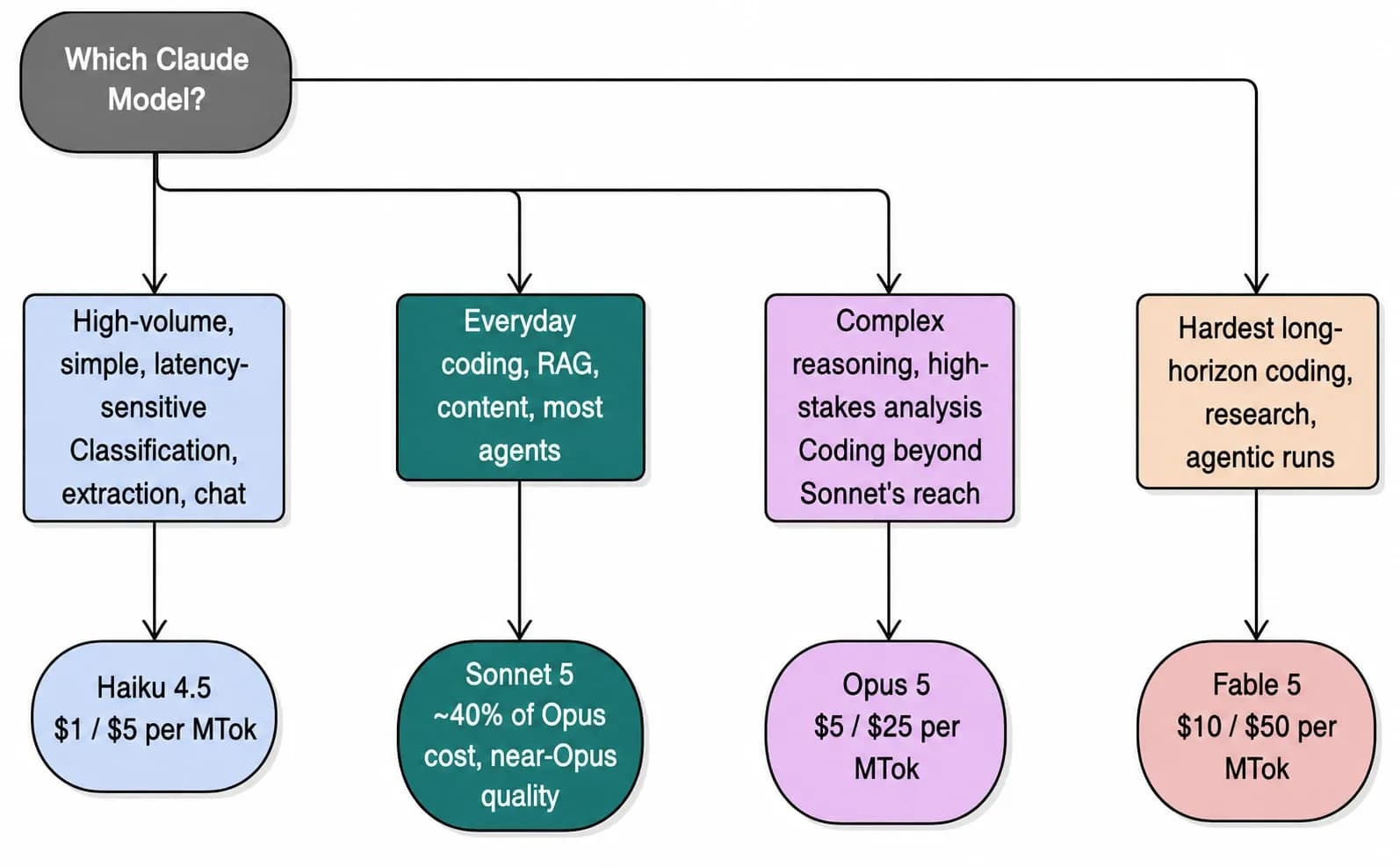
Most teams don't actually need to pick one Claude model and live with it. They need a routing rule they can apply without a meeting. Here's the quick-reference version; if you only read one table in this article, make it this one.
| If your task is… | Use | Why |
|---|---|---|
| High-volume, simple, latency-sensitive (classification, extraction, chat) | Haiku 4.5 | Lowest cost per token; more than enough capability for narrow, repetitive tasks |
| Everyday coding, RAG, content generation, most agents | Sonnet 5 | Near-Opus quality on most evaluations at roughly 40% of the cost, with intro pricing through Aug 31, 2026 |
| Complex reasoning, high-stakes analysis, coding beyond Sonnet's reach | Opus 5 | Clear lead over Sonnet 5 on the hardest coding and reasoning benchmarks, at half of Fable 5's price |
| The hardest long-horizon coding, research, or agentic runs | Fable 5 | State-of-the-art results where task length and complexity reward deeper reasoning, despite the premium |
A few concrete examples of how that plays out, since “task complexity” is a fuzzy phrase until you see it applied:
- A support bot classifying incoming tickets and drafting first-pass replies belongs on Haiku 4.5; the volume is high, the individual decisions are cheap to get slightly wrong, and latency matters more than nuance.
- A coding agent working through your day-to-day PR backlog, writing tests, and answering “why is this failing” questions is squarely Sonnet 5 territory; it's the default for a reason.
- A one-off deep dive, untangling a genuinely confusing distributed-systems bug, or producing a rigorous first draft of a technical strategy doc is where Opus 5's extra reasoning tends to pay for itself.
- A multi-day autonomous migration across a large, unfamiliar codebase, where restarting from scratch after a bad run is expensive, is the case Fable 5 was actually built for.
The routing split most production teams have converged on since Fable 5 shipped looks roughly like this:
- 70–90% of requests → Claude Sonnet 5 (the default for volume)
- Complex reasoning and analysis → Claude Opus 5
- The hardest long-horizon coding and research → Claude Fable 5, used deliberately rather than by default
That split isn't arbitrary; it roughly mirrors the shape of the cost tables above. Sonnet 5, absorbing the bulk of traffic, keeps the blended per-request cost close to Haiku territory even though a chunk of requests are getting Opus-adjacent reasoning.
The failure mode worth watching for is the opposite one: teams that get excited about Fable 5's launch-week numbers and quietly let it become the default model in a shared SDK wrapper, at which point the monthly bill creeps up without anyone deciding it should.
Whatever routing rule you pick, it's worth revisiting every time Anthropic ships a new model; the relative costs and gaps between tiers have moved twice already since June, and there's no reason to expect that to slow down.
Building and maintaining that routing logic yourself means writing model-selection code, watching four separate pricing pages for changes, and re-testing every time Anthropic ships an update, which, based on the last two months, is often.
Platforms like Lorka let teams route prompts across the full Claude lineup, Haiku, Sonnet, Opus, and Fable, from a single interface, so the model behind a given request can change without anyone rewriting application code.


Compare Claude Models in Lorka
Test Claude Fable 5, Opus 5, Sonnet 5, and Haiku 4.5 side by side from one AI workspace.
Try Claude Models in LorkaWhat Is Claude Mythos 5 And Why You Probably Can't Use It
Claude Mythos 5 is the same underlying model as Claude Fable 5, with the same weights and the same training run. What differs is access, not capability.
Where Fable 5's safety classifiers reroute cybersecurity, biology, and chemistry-adjacent requests to Claude Opus 5, Mythos 5 has those specific classifiers lifted for a narrow set of approved users.
It isn't something you request through a support ticket: access runs through Project Glasswing, a program Anthropic operates in coordination with the U.S. government, currently focused on vetted cyber-defense researchers and operators of critical infrastructure, power, water, healthcare, and communications providers who need a model that can find and describe exploitable vulnerabilities without the guardrails everyone else's traffic runs into.
Pricing for Mythos 5 matches Fable 5 exactly: $10 input/$50 output per million tokens. The premium here is for capability, not for the restricted access itself.
Anthropic has also expanded Glasswing access somewhat since launch, including government approval for additional domestic organizations as of late June, alongside a separate release called Claude Science, an AI research workbench that runs on Opus 5 rather than Mythos 5, worth knowing about if you assumed “scientific research access” and “Mythos access” were the same door.
For virtually everyone reading this, Claude Fable 5 is the Mythos-class model you can actually use.
If you think your organization genuinely qualifies for Glasswing, critical infrastructure, or cyber defense, that tier, Anthropic Glasswing has the current application details.
Anthropic hasn't published a timeline for broader availability, so it isn't worth guessing at one here.
FAQs
Yes, for complex coding and long-horizon tasks, Fable 5 scores 80.3% on SWE-Bench Pro against Opus 5's 69.2%.
For most everyday production workloads, though, Opus 5 delivers the large majority of that performance at half the price, and the two models are nearly tied on computer-use tasks, where the gap shrinks to under two points.