
TL;DR
- The best overall for transparent AI-content review and all-in-one writing workflows is Lorka AI.
- The best detector for enterprise teams and multilingual workflows is Copyleaks.
- The best AI detection tool for education-focused review is GPTZero.
- The most reliable AI detector for publishers and SEO content teams is Originality.ai.
- The most useful detectors for quick free checks are Quillbot and ZeroGPT.
- No detector should be the sole basis for academic, employment, or publishing decisions.
What Is an AI Detector?
An AI content detector is a tool you can use to analyze written content for signals that are characteristic of AI-generated text, such as predictability, repeated phrasing, and unusual consistency in sentence structure.
By using a reliable detector, you can get a probability score that tells you if the text is likely AI-generated but does not determine intent or prove that a specific person used a specific AI model. A credible AI content detector should inform review, not replace human judgment.
Important: An AI detection result is a review indication, not evidence of authorship. Apply it in context, with source history and editorial judgment, and direct conversation as appropriate.
How We Evaluated the Best AI Detectors
We assessed each AI detector using a consistent methodology designed to measure both detection ability and responsible use. Our process considers how well tools identify AI-generated patterns while also checking whether they avoid incorrectly flagging human writing.
Key concepts evaluated include:
-
AI-text sensitivity: How frequently a tool recognizes known AI-generated writing as showing AI-like patterns.
-
Human-text specificity: How well a tool avoids incorrectly flagging human-written content.
-
False positive: When human-written content is incorrectly identified as AI-like.
-
False negative: When AI-generated content is not flagged as AI-like.
False positives are a critical metric, as they can affect students, businesses, and more if detection results are treated as proof instead of just a probability score.
| Criterion | What we measure |
|---|---|
| AI-text sensitivity | Whether the tool flags known AI-generated samples as likely AI-written |
| Human-text specificity | Whether it avoids incorrectly flagging human-written content |
| False-positive risk | How often human text receives a high AI-likelihood score |
| Result clarity | Whether it explains scores and highlights detected patterns |
| Ease of use | Scan process, speed, and readability of results |
| Free access | Free limits, trials, and account requirements |
| Paid value | Pricing, credits, team features, and integrations |
| Workflow fit | Collaboration, reporting, file support, and writing tools |
| Responsible-use messaging | Whether it explains uncertainty and encourages human review |
Disclosure: Lorka is included in this comparison and publishes this article. We use the same documented test process for all listed tools and clearly disclose limitations.
The 8 Best AI Detector Tools in 2026
Choosing the best AI writing detector for the content you need checked depends on a lot of factors, like your workflow and how transparent you need the results to be.
Some are better for educational content, others for publishing, enterprise, or quick personal checks.
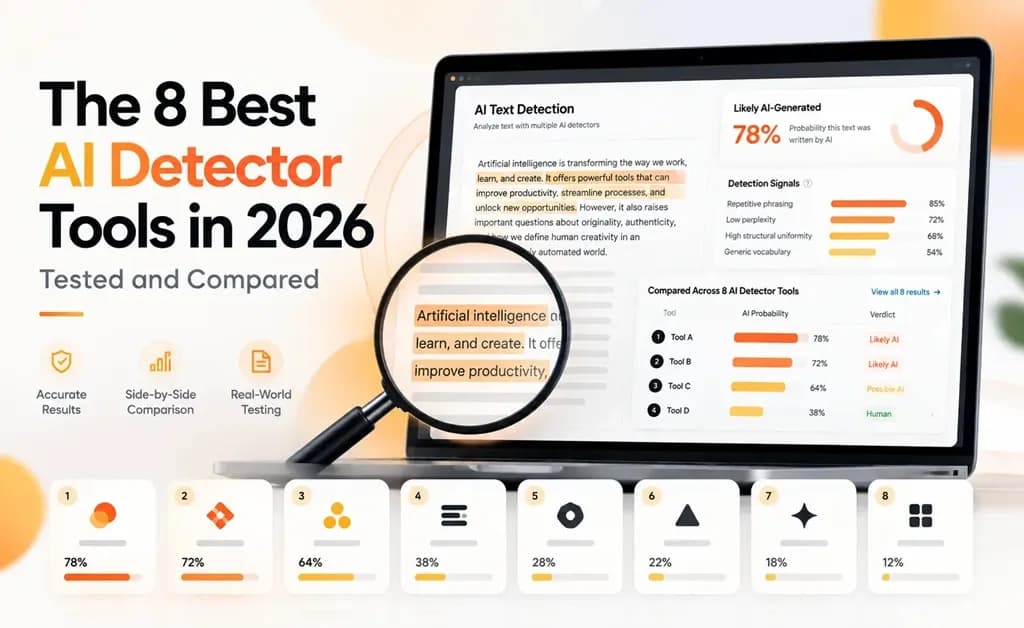
Below are the 8 best AI detection tools that you can use in 2026.
Lorka AI Detector: Best overall for transparent AI content review 🏆
Best for: Educators, editors, marketers, content teams, and users who want clear AI detection insights.
Strengths: Probability-based analysis, pattern explanations, simple online checks, and integration with a wider AI writing workflow.
Limitations: Results are not proof of authorship and should always be reviewed alongside context.
Lorka’s AI Detector stands out by explaining why text may appear AI-generated instead of presenting a simple yes-or-no verdict. It offers an ad-free experience with probability-based insights and analyzes AI-like writing patterns from tools such as models like ChatGPT-6 and Claude Fable 5.1.
As part of the wider Lorka writing workflow, it also connects with AI chat, editing, and humanizer tools. Try Lorka AI's Content Detector to review content responsibly, while keeping in mind that no detector can determine intent, authorship, or the exact source model.
2. Copyleaks: Best for enterprise and multilingual teams 🥈
Best for: Organizations, educational institutions, and businesses managing large content volumes.
Strengths: Enterprise workflows, integrations, multilingual support, and structured reporting.
Limitations: Paid features may be unnecessary for individual users, and teams should validate results on their own content.
Copyleaks’ AI detector is best used when you want a more formal review process of documents and submissions. The enterprise features make it appropriate for organizations, but results should still be interpreted carefully by organizations and not be used as stand-alone evidence.
3. GPTZero: Best known for education-focused review 🥉
Best for: Teachers, academic reviewers, and institutions.
Strengths: Education-focused workflows, document analysis, and probability-style results.
Limitations: False positives should be taken into account before using results in high-stakes situations.
GPTZero’s detector is one of the most recognized AI detection tools among educators. It can help identify writing that shows AI-like patterns, but teachers should combine results with writing history, drafts, sources, and direct conversations before making decisions.
4. Originality.ai: Best for publishers and SEO content teams
Best for: Publishers, agencies, and SEO teams reviewing content before publication.
Strengths: Content-focused workflows and AI detection features designed for professional teams.
Limitations: Subscription costs and credit-based usage may not suit occasional users.
If you are part of a team that needs to review website content and marketing materials, Originality.ai can help identify AI-written content while always reviewing flagged sections in context.
5. Winston AI: Best for document-based review
Best for: Users who need document uploads, reports, and organized review workflows.
Strengths: Document analysis and team-oriented workflows.
Limitations: Users should verify current limits and test performance with their own content.
Winston AI focuses on document review, making it useful for organizations and teams handling multiple files. Like other detectors, remember to treat its results as indicators rather than definitive proof.
6. Pangram Labs: Best detector-focused specialist
Best for: Users looking for a dedicated AI detection platform.
Strengths: Testing methodology and a detector-first approach.
Limitations: Independently validate vendor-reported results with your own samples.
The AI detection tool from Pangram Labs focuses specifically on AI recognition and provides detailed testing information. It can be a strong option if you want specialized detection tools, but independent testing remains important before adoption.
7. Quillbot AI Detector: Best for casual free checks
Best for: Students, writers, and users who need reviews in seconds.
Strengths: Simple interface, accessibility, and integration with the Quillbot ecosystem.
Limitations: Not designed to replace professional review or support high-stakes decisions.
Quillbot’s AI Detector offers a quick way to check whether text contains AI-like patterns. It works well for quick reviews but should not be treated as conclusive evidence of how content was created.
8. ZeroGPT: Best for quick free AI checks
Best for: Users who want a fast and accessible AI text review
Strengths: Simple workflow and quick checks
Limitations: Results should be compared across samples and never used alone for important decisions
For reviewing non-serious work, ZeroGPT gives you initial indications of AI-like writing patterns. However, if you need a tool for serious work or checking educational content, you should consider additional context and not rely on one score.
Best AI Detector Comparison Table
We compared each AI detector using the same evaluation framework, including transparency, workflow fit, usability, accessibility, and responsible-use features.
| AI detector | Best for | Free option | Starting price | Inputs / workflow | Result style | Overall score |
|---|---|---|---|---|---|---|
| Lorka AI detector | Transparent content review and all-in-one AI workflow | No | $29.99/month (included in All-in-one AI plattform) | Paste text / online analysis | Probability-based patterns and explanations | 9.6/10 |
| Copyleaks | Enterprise and multilingual teams | Yes | $16.99/month | Documents, integrations, and organization workflows | AI likelihood scores and reports | 9.2/10 |
| GPTZero | Education-focused review | Yes | $12.99/month | Document uploads and academic workflows | Probability-style results with analysis features | 9.0/10 |
| Originality.ai | Publishers and SEO teams | No | $14.95/month | Content scanning and editorial workflows | AI detection reports and content insights | 8.6/10 |
| Winston AI | Document-based review | Yes | $18/month | File uploads, reports, and team workflows | Detection reports and review summaries | 8.2/10 |
| Pangram Labs | Detector-focused testing | Yes | $20/month | Dedicated AI detection workflows | Detection scores and methodology-focused reporting | 8.1/10 |
| Quillbot AI detector | Casual free checks | Yes | $19.95/month | Quick text checks through QuillBot ecosystem | AI likelihood indicators | 7.5/10 |
| ZeroGPT | Free quick checks | Yes | $9.99/month | Simple text scanning | AI likelihood scores | 7.1/10 |
Pricing note: AI detector plans frequently change, and some providers offer different prices depending on monthly vs. annual billing, credits, or usage limits. Always check the provider’s current pricing page before purchasing.


Try Lorka’s AI Detector
Review text with probability-based AI detection, clear pattern explanations, and a writing workflow built for responsible use.
Try Lorka AI DetectorCan AI Detectors Really Tell if Text Was Written by AI?
AI detectors can detect patterns that could be considered AI-generated writing. But they cannot 100% prove authorship every single time.
It's important to understand that human writing can sometimes appear predictable, while AI tools can produce increasingly varied outputs. Results can also change depending on the language, text length, prompt, editing level, and the AI models used.
An AI detector result is a signal for review, not a definitive answer. Tools should help users identify content that may need closer attention rather than replace human judgment.
| Things AI detectors can help with | Things AI detectors cannot do with 100% accuracy |
|---|---|
| Flag text that may need closer review | Prove a person used AI |
| Identify patterns associated with AI writing | Identify the exact AI model with certainty |
| Support editorial and academic review | Replace human judgment |
| Prioritize content for review | Determine intent or misconduct |
| Compare outputs across drafts | Guarantee 100% accuracy |
Use AI Detection Responsibly Since AI detectors work best as review tools, not automatic decision-makers, you should also consider the following before making judgments:
-
Writing history, drafts, source notes, and version changes
-
Citations, research materials, and the context of the work
-
A conversation with the writer or student when appropriate
To use AI detectors responsibly, you should not use them for surveillance or punishment without a detailed human review.
On the other hand, if you use AI to generate text, it's key to understand how to avoid AI detection in writing by focusing on authentic voice and responsible use. It's also important to always review a provider’s privacy policy before uploading sensitive content.
Best AI Detection Tools: FAQs
The best overall choice is Lorka's AI detector. However, no AI detector can 100% prove authorship with certainty or guarantee that text was created by AI.