


Key Takeaways ⭐
- Only 78 women use generative AI for every 100 men, indicating a persistent adoption gap by gender
- According to expert Azahara Corrales, just one in five experts surfaced by neutral AI search prompts are women, showing a bias in current systems
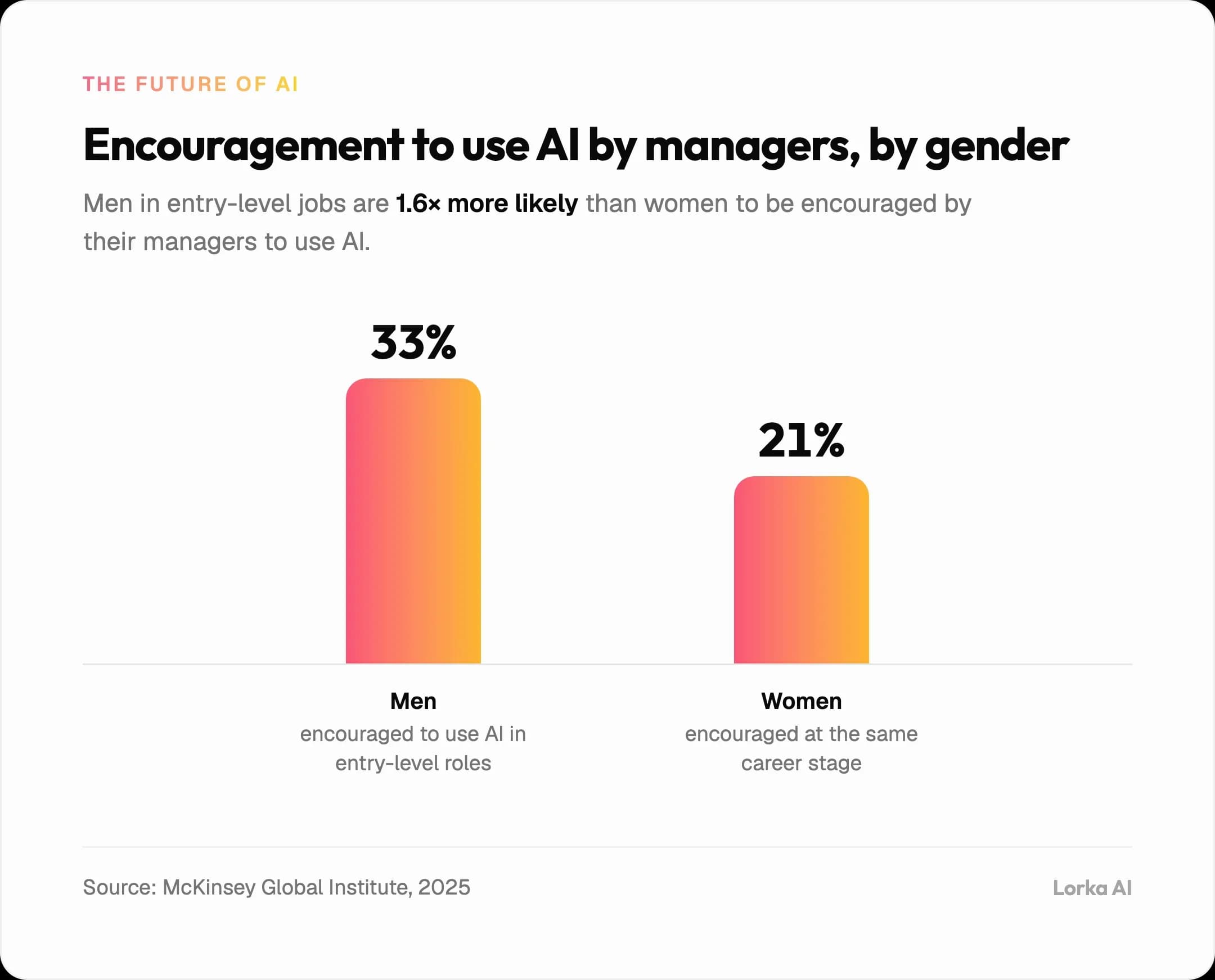
- Women in entry-level roles are far less likely than men to be encouraged to use AI, 21% versus 33%
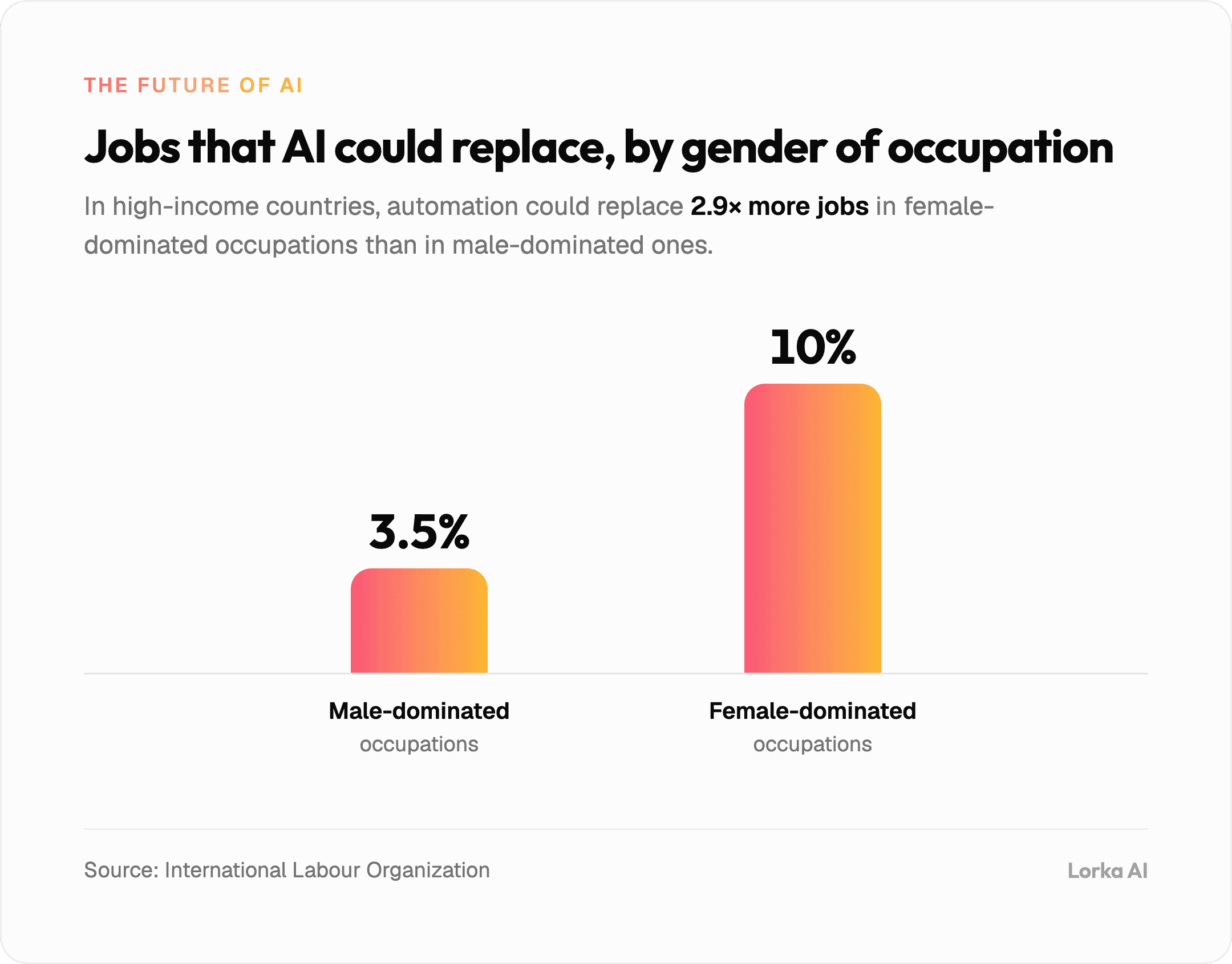
- Automation threatens 10% of jobs in female-dominated fields compared to just 3.5% in male-dominated ones
We Asked AI Expert Azahara Corrales for Answers
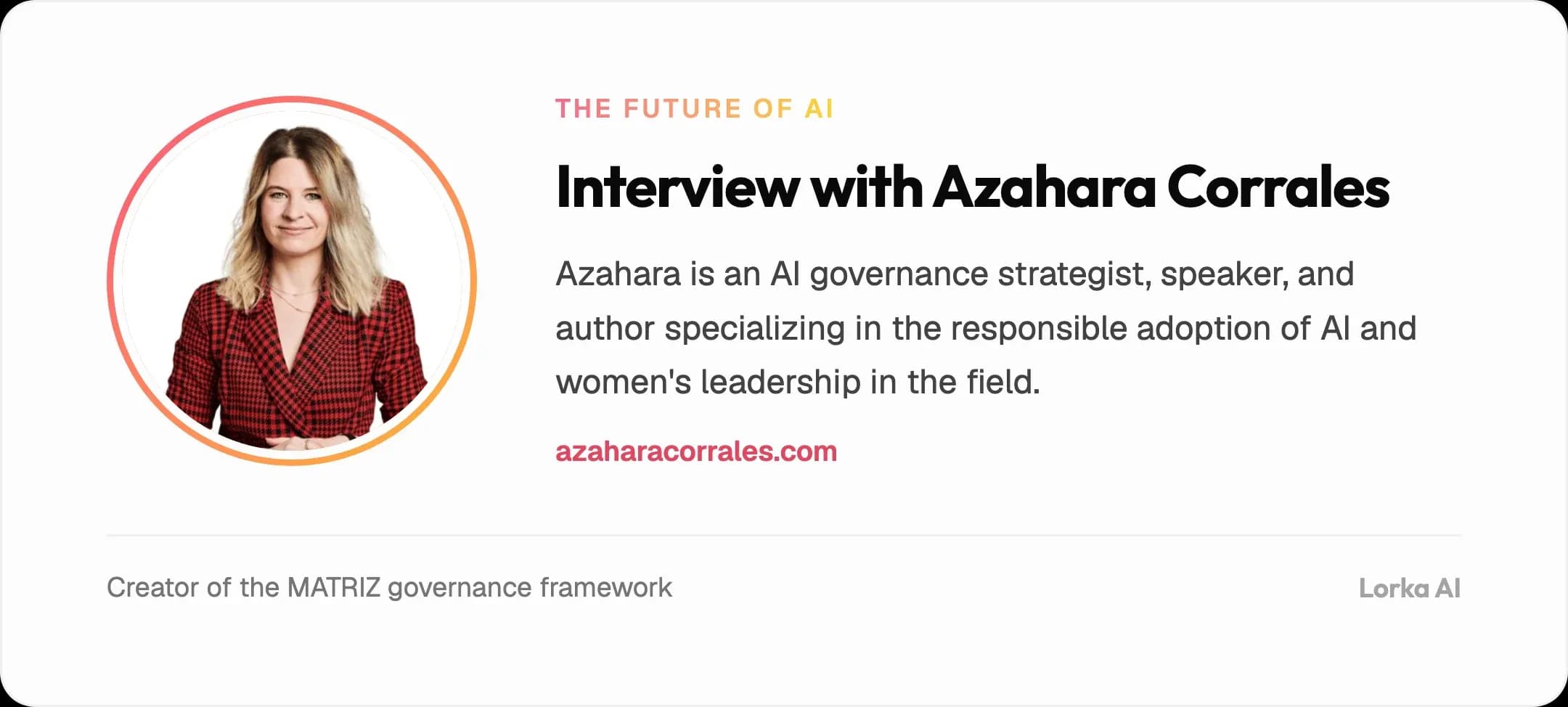
To understand what this gap means for AI’s future, Lorka AI spoke exclusively with Azahara Corrales, an AI governance strategist, speaker, and author specializing in responsible adoption and women’s leadership in AI.
Creator of the MATRIZ governance framework (Mindset, Assessment, Targeted Use Cases, Responsibility, Integration, Z-Value), Corrales also researches how AI search systems surface women’s expertise.
She sees the issue as more than a diversity problem: “If only one part of society is using them, that is the only part of the world they will reflect.” Who participates now will help determine whom AI serves later.
The AI Gender Gap by the Numbers
As previously mentioned, women’s lower participation in generative AI is already measurable. The workplace may be reinforcing that divide. The McKinsey Global Institute found that 33% of men in entry-level roles are actively encouraged by their managers to use AI. That’s compared with just 21% of women at the same career stage.
“That gap alone is striking, and then there are the more familiar barriers: imposter syndrome, lack of confidence, and the fact that so many so-called AI experts use unnecessarily complicated language that makes the whole field feel technical and unapproachable,” Corrales says.
Encouragement affects who experiments, who develops confidence, and whose feedback reaches the teams designing AI tools. The imbalance can then reproduce itself.
In her own analysis of AI search results, Corrales found that only about one in five experts surfaced by a neutral prompt were women.
This means an alarming feedback loop is happening: women encounter fewer avenues for AI interaction.
Consequently, their unique needs, perspectives, and expertise are less likely to inform the design of emerging systems. This current deficit in adoption risks transforming into a significant deficit in influence tomorrow.
Watch a video interview with Azahara here:
Why Risk Awareness May Be Driving the AI Gender Gap
It is easy to assume women use artificial intelligence less than men, simply because they are not as interested in technology, which is misguided. In Corrales’s view, that explanation overlooks the possibility that women may be more alert to what can go wrong when using AI.
“Women are not less interested; they are more cautious. And that is not a weakness,” she says.
While on the face of it, it seems like a negative, that caution could improve development in artificial intelligence, as the industry needs people who ask hard questions and demand safeguards before new tools enter everyday life.
If these users keep avoiding using these tools, their concerns are less likely to shape the products being built.
Closing the gap should not mean telling women to worry less. It should mean building trust and making sure their perspective helps guide where AI goes next.


The Stakes for Tomorrow’s Jobs in AI
The gender gap in AI use is growing at the same time that women face greater exposure to automation.
As Corrales warns, “…they will be excluded from the jobs of the future, not because they are not capable, but because nobody made sure they had the same opportunity to get there.” Closing the gap today helps build a fairer workforce tomorrow.
The International Labour Organization’s research backs up Corrales’ warning, as they’ve found that automation could replace around 10% of jobs in female-dominated occupations in high-income countries. That is compared with only 3.5% of jobs in male-dominated fields.
As routine tasks change, knowing how to work with AI will increasingly shape who can move into new roles, take on higher-value work, or influence how jobs are redesigned. Without training, encouragement, and opportunities to experiment, women risk being left behind instead of leading the transition.
Azahara Corrales on the Decade’s Biggest AI Decision
Corrales believes the central mistake in today’s AI debate is focusing on the technology while overlooking the people around it. Regulation tends to ask what systems can do and where limits should apply. Far less attention goes to who helps build them, who receives training, who is encouraged to experiment, and who has a voice when they are introduced.
Treating participation and access as governance issues, not side issues. That’s what thoughtful implementation means, in her opinion. Diversity must be built into the entire process.
“I would make diversity mandatory at every stage, in who builds the technology, who trains it, who reviews it, who uses it, and who decides what data goes in,” she says. “What one person misses, another will catch. We are all different, not only because we are individuals but because we come from different backgrounds, cultures, genders, and experiences.”
For Corrales, this is not diversity for appearance’s sake. It is how developers catch blind spots before they become part of systems used at scale. “That diversity of perspective is our collective superpower. The more of it we can bring to the development of this technology, the more it will reflect the full complexity of the world it is supposed to serve.”
Without that shift, AI may become safer in theory while its benefits and influence remain unevenly shared. This is why Corrales calls equal participation “the most consequential policy question of our generation.” Today’s choices will decide whose knowledge AI reflects in the years ahead.
What Artificial Intelligence Needs for a Better Future
While most would agree that artificial intelligence should be a tool that supports human judgment, creativity, and productivity, not a replacement for the people using it. That contrast matters because fear of being replaced can keep workers from experimenting, while overconfidence can weaken human oversight.
The people most aware of those risks should be part of shaping the technology, not left outside.
For Corrales, that requires more than inviting different voices into the room once decisions have already been made. “I would make diversity mandatory at every stage, in who builds the technology, who trains it, who reviews it, who uses it, and who decides what data goes in.”
The Proof This Future Is Possible
A more inclusive AI future is not an abstract goal, and even now it is already being built. Corrales points to a project in South Africa where “…a woman created an AI community tool where women in danger can log in… and receive immediate safety resources.”
The example shows what changes when people closest to a problem help shape technology meant to solve it. AI becomes more relevant, more responsive, and better connected to human needs.
At the heart of Lorka AI’s conversations with the people shaping artificial intelligence is a simple question: What kind of future are we building, and who gets to help build it? Corrales’s answer is clear.
The future of AI will not be decided by technology alone. It will be decided by who has the access and opportunity to shape what that technology becomes.
Key stats:
- For every 100 men, only 78 women use generative AI.
- 61% of Americans plan to increase or maintain AI use next year.
- 33% of men in entry-level roles are encouraged to use AI.
- 21% of women in entry-level roles are encouraged to use AI.
- Only one in five experts surfaced by neutral prompts are women.
- AI could replace 10% of jobs in female-dominated occupations.
- AI could replace 3.5% of jobs in male-dominated occupations.
Methodology:
Corrales designed the study to test whether a neutral AI search for experts produces a balanced result or behaves more like a search specifically requesting men or women. She created 42 expert-discovery questions across eight sectors, including technology, finance, medicine, leadership, and AI governance.
- Prompt design: Each question had three versions: neutral, women-specified, and men-specified.
- Controlled testing: All versions were tested across ChatGPT, Google AI Overviews, Google AI Mode, Perplexity, Gemini, and Microsoft Copilot in the United States during the same period in late May 2026.
- Source review: Every cited source was recorded. Identifiable authors were classified using declared pronouns where available, followed by name-based inference. Company, organizational, anonymous, and unattributable sources were excluded from the gender comparison.
- Analysis: Results were compared by prompt version, platform, sector, and LinkedIn content type. Representation was also separated from prominence within the answer.
Because AI outputs can vary and not every prompt produced usable results, the findings represent patterns observed under controlled conditions, not guaranteed outcomes. Without sector-level data on LinkedIn authorship, the study also cannot confirm whether AI reflects or amplifies an existing visibility gap.