

Key Takeaways⭐
- If you want tighter definition, machine learning is a method of building software that gets better at a task as it sees more data
- Machine learning means computers figuring out patterns from examples, instead of someone writing every rule by hand.
- ML is a slice of AI. Deep learning is a slice of ML. Yes, that does mean deep learning is technically AI too.
- There are three main flavors worth knowing: supervised, unsupervised, and reinforcement learning. Each solves a different kind of problem.
- You’ve almost certainly used ML today. Netflix picks, spam being where it belongs, your bank flagging that weird charge, and Maps knowing about that pileup before the radio does.
- Whenever someone says “the model", they mean the finished thing that came out of training. Like the recipe you end up with after a hundred attempts at sourdough
When Netflix surfaced a show you ended up actually watching, that was ML doing the surfacing. When your email quietly buried a sketchy-looking message before you ever saw it, ML did that too. Google Maps catching a traffic jam that hasn’t hit the news yet? Same thing. It’s tucked into the seams of more software than most people realize.
And yet the term still trips a lot of smart people up. Is it the same as artificial intelligence or different? Where does deep learning fit in? And, while we’re at it, what does machine learning actually do that regular software can’t?
Those are good questions, and the honest answer is that a lot of writing on this subject makes it harder than it needs to be. The core ideas aren’t that complicated. The jargon just gets in the way.
One thing worth flagging upfront: ML isn’t just growing. It’s accelerating. Every connected device, every app, every sensor is generating data, and computers keep getting cheaper. Work that took an entire research lab a decade in the 2010s now takes a small engineering team a few months.
What Does "Machine Learning" Actually Mean?
Here’s the short version. Machine learning, or ML for short, is a chunk of artificial intelligence. The whole idea: get a computer to learn from examples, instead of feeding it a fixed list of rules. Sounds small. Turns out to be huge.
Consider how a toddler figures out what a dog is. Nobody sits them down with a rulebook (four legs, fur, wags tail, barks, occasionally licks faces). They just see a bunch of dogs over a few months, and one day the recognition just… happens.
Machine learning runs on basically the same principle. Throw enough examples at the system, and patterns start emerging on their own. Data does the work that lived experience does for the kid.
If you want a tighter definition: machine learning is a method of building software that gets better at a task as it sees more data, without needing a developer to rewrite it for every new scenario. IBM phrases it as software that learns and improves from experience, which is a fair way to put it.
Traditional programming goes like this. Someone writes the rules, the computer runs them, and the results come out. ML basically flips that around. You hand it the data and the answers you want, and it works out the rules itself. Whatever set of rules it ends up with, that’s what people mean when they say "model".
Look, the easiest way to feel the difference is with a contrast. Say you’re building a weather alert. A traditional program might say, "If humidity goes above 80 percent, warn the user.” Easy. Now imagine you want a real forecasting model that predicts whether it’ll actually rain tomorrow. Try writing every rule for that by hand. You can’t. There are too many variables, too many subtle interactions. But hand a decade of weather data to an ML system, and it can find those patterns itself. That’s the kind of problem ML was built to solve.
How Does Machine Learning Actually Work?
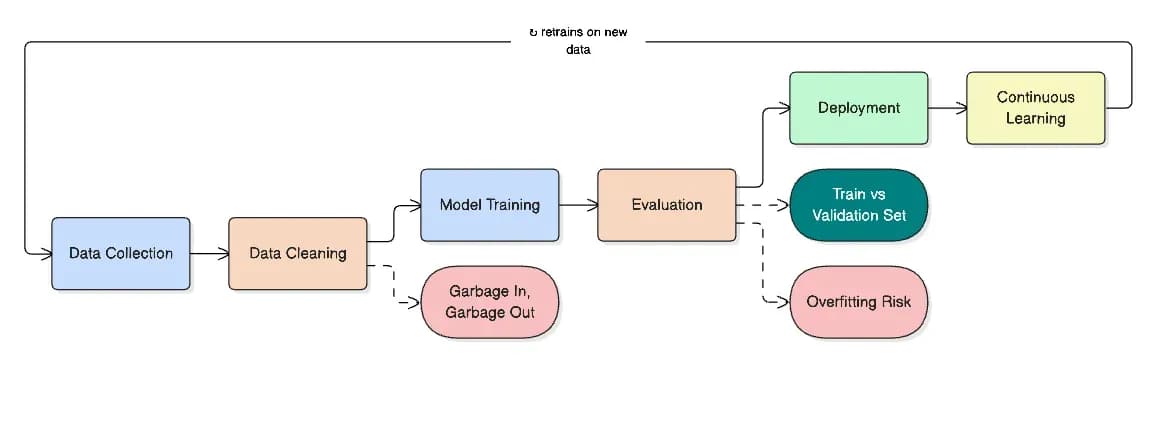
At a high level, it’s a loop with three big steps: gather the data, train the model, then use it to make predictions. Here’s what each step actually looks like in practice.
Step 1️⃣: Get the Data Ready
Data first, and almost always a lot of it. A decent spam filter wants thousands of labeled emails to learn from. A house price tool wants historical sales records, each tagged with details like size, location, condition, and whatever else might matter. The quantity and quality of that dataset basically set the ceiling for everything that comes after.
There’s a phrase you’ll hear constantly in ML circles: garbage in, garbage out. Feed a model bad data, and it cheerfully learns the wrong lessons.
Honestly, in real projects, cleaning and preparing the data eat up more hours than the actual training does. Engineers spend ages handling missing values, deduplicating records, catching mislabelled rows, and making sure the dataset isn’t skewed in ways that’ll bite them later. It’s not glamorous work. It’s also the most important step.
Ehsanullah Baig
Technical AI Writer
Honestly, in real projects, cleaning and preparing the data eat up more hours than the actual training does. Engineers spend ages handling missing values, deduplicating records, catching mislabelled rows, and making sure the dataset isn’t skewed in ways that’ll bite them later. It’s not glamorous work. It’s also the most important step.
Step 2️⃣: Train the Model
This is the part everyone gets excited about, and fair enough, this is where the actual learning happens. The algorithm chews through the prepared data and slowly adjusts its internal dials (called parameters or weights) to make fewer and fewer mistakes. Think of it like learning a sport. The first hundred swings are awful. By the thousandth, you’re a different player.
During training, engineers usually run two checks in parallel. One uses the training set, which is data the model has already seen. The other uses a validation set, which is data it doesn't have.
Doing well on the first set doesn’t mean much on its own. The second set is what matters. If a model nails the training data but flops on new examples, that’s called overfitting. It memorized instead of actually learning the pattern. Dealing with overfitting is one of the constant headaches of building real ML systems.
Step 3️⃣: Ship It, Then Keep Improving It
Once a model performs well enough on both sets, the team puts it into production. Now it’s making real decisions on real inputs, in real time.
But here’s the thing: a lot of systems don’t actually stop learning at that point. New data keeps streaming in, and the model can keep retraining on it. That’s the reason your streaming recommendations tend to feel sharper six months into using a service than they did during your first week. The thing is genuinely getting better at predicting you.
A concrete example: spam filtering. An email provider sits on millions of past messages. Each one is labeled either spam or not spam. An ML algorithm goes through them, picks up on the patterns that consistently show up in spam (specific words, sender behaviors, weird formatting, suspicious links), and bakes those patterns into a model.
From then on, that model scores every new incoming message in milliseconds. Nobody wrote a rule for each individual spammer trick. The model figured out the tricks on its own. And it keeps figuring out new ones, because the training never really stops.
What Separates a Good Dataset From a Bad One?
Not all data is created equal. The best training datasets share four qualities, and skipping any of them tends to cause expensive problems later.
- Big enough. You need enough examples to reflect the variety the model will face in the real world. Not just the easy cases. All of them.
- Representative. The dataset has to cover the edges and weird situations, too. A model trained only on clean, neat examples will faceplant the moment it meets a messy one.
- Labeled correctly. Supervised learning hinges on accurate labels. Wrong labels are arguably worse than no data; the model actively learns the wrong thing.
- Not full of harmful bias. Bias in, bias out. A diagnostic ML tool trained on data from one narrow patient demographic will fail on everyone else, sometimes dangerously. This isn’t a hypothetical problem. It’s happened.
That last point deserves more space than it usually gets. Data quality is a technical concern, sure, but it’s also an ethical one. The people building these systems carry real responsibility for the choices their models end up making at scale.
Machine Learning vs AI vs Deep Learning
People use these three terms interchangeably all the time. They’re not the same thing, and the confusion matters because it gets in the way of figuring out what a product is actually doing under the hood.
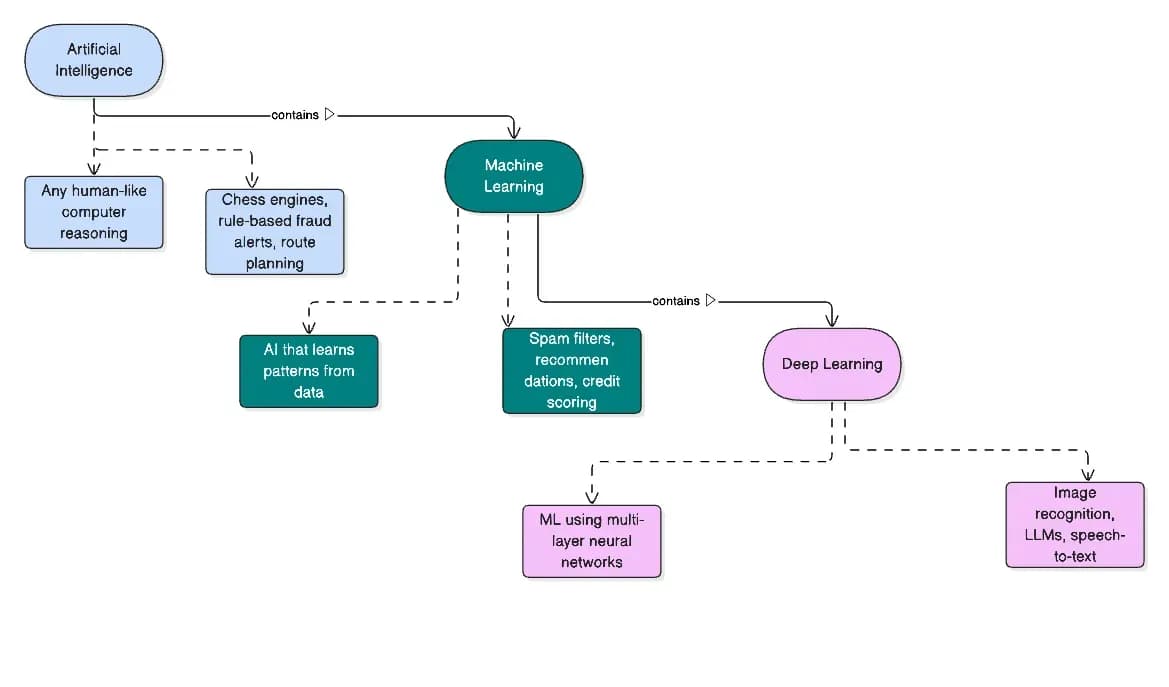
Artificial intelligence (AI) is the umbrella. It covers any technique that gets a computer to do something that would normally require human reasoning. Playing chess, translating languages, and recognizing what’s in a photo. All of that counts as AI, whether or not there’s any learning involved.
Machine learning is one specific way of doing AI. Instead of hand-coding every behavior, you let the system learn its patterns from data. UC Berkeley describes it as giving computers the ability to learn without being explicitly programmed for every situation, which is about as clean a phrasing as you’ll find. ML lives inside the AI umbrella.
Deep learning is a specific kind of ML that uses big, multi-layer neural networks loosely modeled on how the brain works (very loosely, but the metaphor stuck). It’s the technology behind image recognition, voice transcription, and the large language models you’ve been hearing about. Deep learning sits inside the ML circle.
| Term | What it covers | How it learns | Where you’ll see it |
|---|---|---|---|
| Artificial Intelligence | Any approach that lets a computer reason or act in a human-like way | It could be rules, logic, search, or learning from data | Chess engines, fraud alerts, translation, and route planning |
| Machine Learning | AI that learns patterns from data on its own | Statistical patterns picked up from training data | Recommendations, spam filters, price predictions, and credit scoring |
| Deep Learning | ML using deep, multi-layer neural networks | Layered feature learning across vast amounts of data | Image recognition, speech-to-text, large language models |
Easiest way to keep it straight: every ML system counts as AI, but plenty of AI systems aren’t ML. An old-school rule-based chess engine? AI, yes; ML, no. A system that taught itself chess by playing millions of games? Both.
The difference becomes really important the moment someone tries to sell you something “powered by AI". That label tells you almost nothing without follow-up questions.
The Main Types of Machine Learning
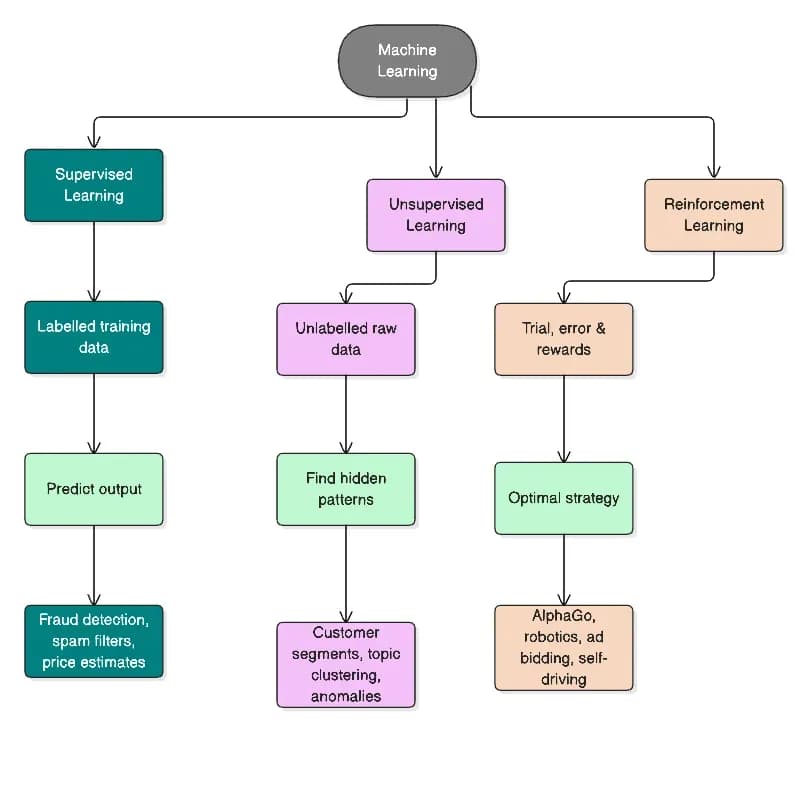
ML isn’t one thing. There are three main approaches, and each one fits a different kind of problem. Google Developers has a deeper breakdown if you want to go further. Which approach you pick basically comes down to what data you’ve got and what you’re trying to find out.
Supervised Learning
This is by far the most common type in actual commercial use. The setup: every training example comes with the correct answer attached. The algorithm chews through the examples, makes guesses, gets corrected, and gradually learns to match inputs to outputs.
Example: A bank wants to spot fraudulent card transactions before the customer notices anything. Engineers feed a supervised algorithm millions of past transactions, each one tagged as fraud or not.
The algorithm zeroes in on the patterns that fraudulent transactions share. Maybe it’s the unusual location, maybe the sudden large amount, maybe the odd hour. It packages all that into a model, and from then on, the model scores every new transaction in real time. Fast enough that the alert hits your phone before the receipt finishes printing.
You’ll find supervised learning behind email spam filters, medical scan diagnostics, customer churn predictions, house price estimates, and document categorization, among many other things.
Unsupervised Learning
Unsupervised learning is the weirder cousin. The data has no labels at all. Nobody tells the algorithm what to look for. It just gets handed the raw data and asked to find whatever structure happens to be in there. Natural groupings, recurring patterns, hidden relationships that nobody knew to ask about.
Example: A retailer wants to understand its customers better but doesn’t actually know how many meaningful groups exist. An unsupervised clustering algorithm sifts through purchase history, browsing behavior, and demographic data. It surfaces distinct segments on its own.
Maybe price-sensitive shoppers cluster one way, premium-brand loyalists another, and occasional deal hunters a third. None of those categories was predefined. The algorithm just found them sitting in the data.
Other places you’ll find it: detecting anomalies in network traffic, grouping news stories by topic without preset categories, and reducing complex datasets down to their most important features.
Reinforcement Learning
Reinforcement learning works completely differently from the other two. There’s no fixed dataset. Instead, an “agent” interacts with an environment, takes actions, and gets rewards or penalties based on how things turn out. After enough trial and error (and we mean a lot of trial and error), it works out which strategies pay off.
Example: Google's DeepMind used reinforcement learning to build AlphaGo, an AI that plays the board game Go. The agent played millions of games against itself, racking up points for wins and losing them for defeats. Nobody scripted its moves. It developed its own strategy from scratch and ended up beating the strongest human players who’d ever lived. That was a big moment.
Beyond games, reinforcement learning shows up in robotic motion training, data center energy optimization, personalized ad bidding, and parts of self-driving car systems.
A Quick Look at Common Algorithms
Each type of ML has a handful of go-to algorithms underneath it. You don’t need to understand the maths behind them to use them. Tools like scikit-learn and TensorFlow implement the whole lot and make them accessible from a few lines of code. Here’s a quick reference for the ones you’ll hear about most.
| Algorithm | Type | What it does, in plain terms |
|---|---|---|
| Linear and Logistic Regression | Supervised | Predicts a number or a category using a weighted mix of input features. Simple, fast, and the easiest to explain to a non-technical stakeholder. |
| Decision Trees and Random Forests | Supervised | Builds a branching tree of if-then questions from the data. Random Forests stack lots of trees together to get more stable, more accurate results. |
| Support Vector Machines (SVM) | Supervised | Finds the best dividing line between two classes of data. A solid choice for classification tasks where the dataset isn’t huge. |
| K-Means Clustering | Unsupervised | Splits data into a chosen number of groups based on similarity. Commonly used for customer segmentation and document grouping. |
| Neural Networks | Supervised and Reinforcement | Stacked layers of connected nodes that learn highly complex, non-linear patterns. The technology behind deep learning and many modern AI breakthroughs. |
Real-World Machine Learning Applications and Examples
ML is not a future technology. It’s already running today inside software that most people use without a second thought. Coursera makes the point well: part of what makes ML so transformative is that it usually works invisibly, baked into tools people already rely on. You don’t notice it because you’re not meant to.
Here are eight specific examples that show what that looks like in practice.
| Application | How ML is driving it |
|---|---|
| Streaming recommendations (Netflix, Spotify) | The platform studies what you watch or listen to, finds people who behave like you, and predicts what you’ll go for next. Netflix has said roughly 80 percent of what people actually watch comes through its recommendation engine, not active searches. |
| Email spam filters | The filter classifies every incoming message as spam or legit based on patterns it has picked up from billions of previously flagged emails. Unlike old-school rule-based filters, modern ones keep adapting as spammers change their tricks. |
| Credit card fraud detection | The system flags transactions that look weird compared to your normal spending and alerts you in real time, sometimes before you’ve even left the shop. Every major bank now runs one of these systems 24 hours a day. |
| Search engine ranking (Google) | Google ranks billions of pages against your specific query, and keeps refining that ranking based on which results people click, dwell on, and bounce away from. No team could write rules for every possible search. ML handles that scale. |
| Voice assistants (Siri, Alexa, Google) | Your spoken words go through speech recognition, then natural language understanding, then response generation. Each step is its own ML model, all chained together inside about a second. |
| GPS navigation (Google Maps, Waze) | The app pulls movement data from millions of devices, uses it to predict travel times, spots traffic incidents the moment they happen, and rebuilds your route around them. All in real time. |
| Medical image diagnosis | ML models scan X-rays, MRIs, and pathology slides looking for signs of disease. In several published studies, they’ve matched or even outperformed specialist accuracy on specific diagnostic tasks, particularly in radiology and oncology. |
| Predictive text and autocorrect | Your keyboard guesses your next word and fixes your typos using language patterns it learned from enormous text datasets. Every smartphone keyboard worth using runs an ML model trained on billions of messages. |
Wrapping Up: ML Is Already in Your World
Machine learning isn’t a futuristic thing waiting to arrive. It’s already woven into the daily digital infrastructure that most people pass through without thinking. It shapes what you watch, looks out for your money, helps doctors spot disease earlier, and quietly handles millions of small decisions that used to need a human in the loop.
And the good news is that understanding it doesn’t require a computer science degree. The big ideas are genuinely accessible: systems learn from patterns instead of rules, they improve with exposure, and different approaches suit different problems. The maths underneath can get gnarly. The concepts themselves don’t have to.
As ML keeps pushing into healthcare, education, climate research, and pretty much every other field, even a basic grasp of how it works puts you in a much stronger position. You’ll see through the hype faster. You’ll ask better questions about the automated systems that affect your life. And you’ll be able to actually follow the conversations shaping the next decade of technology.
If you want to get hands-on with what modern ML models can actually do, Lorka's multi-model workspace lets you run the same prompt across multiple AI models in one window and compare what they each produce. It’s a practical way to see the differences without juggling separate accounts or wrangling any setup.


Put Machine Learning into Practice
Compare responses from Claude, GPT, Gemini, and other leading AI models in one workspace. See how different models handle the same prompt and deepen your understanding of machine learning.
Try Lorka AIFAQs About Machine Learning
It’s a branch of AI where computers learn from data and get better at a task over time, without anyone needing to script every rule by hand. The system spots patterns in past examples and uses them to make predictions about new ones.