


Key Takeaways ⭐
- AI bias is what happens when an AI system keeps producing unfair results for the same people. Not by accident. In a pattern you can see and predict.
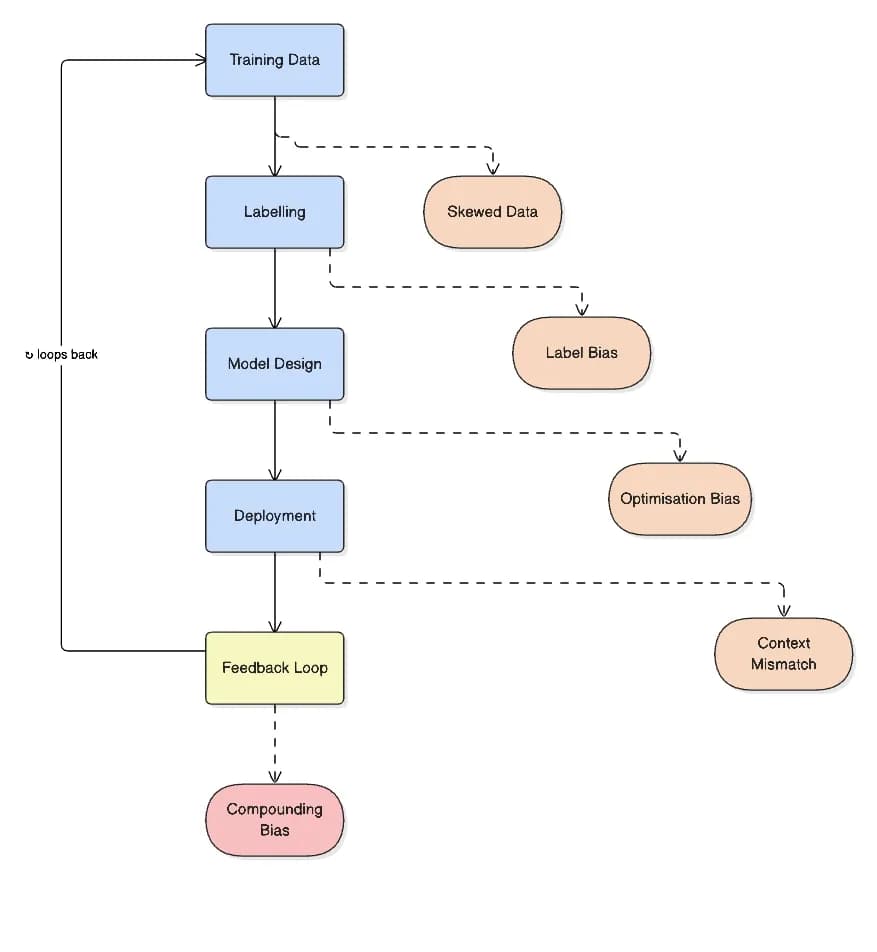
- It sneaks in through skewed training data, biased labels, design choices that ignore fairness, deployment context, and feedback loops that compound over time.
- It shows up where it hurts most. Hiring decisions. Medical diagnoses. Student grades. The content AI tools generate by default.
- Fixing it isn’t a one-time job. You need technical work (auditing data, testing across groups) and organizational work (diverse teams, real human oversight). Neither alone is enough.
- And no, you can’t actually eliminate bias. The honest target is reducing harm, monitoring continuously, and making sure errors don’t keep landing on the same vulnerable groups.
What Does "AI Bias" Actually Mean?
Here’s the simplest way to think about it. AI bias is when a system keeps producing unfair outcomes for the same group of people. Not once in a while. Consistently. In a direction you can predict before you even look.
Think about what that means in practice. A photo recognition app might work perfectly for most users. But if it mislabels people with darker skin tones at ten times the rate it mislabels everyone else, that’s not a glitch you can dismiss. That’s a pattern. And patterns are what bias looks like once you start measuring.
A landmark MIT study published in 2018 found exactly that. Researchers Joy Buolamwini and Timnit Gebru tested three commercial facial analysis tools. Error rates for darker-skinned women came in at 34.7 percent. For lighter-skinned men, the same tools were less than 1 percent (0.8%). That 33-point gap is what bias looks like when someone bothers to actually measure it.
People throw around “AI bias", “algorithmic bias", and “data bias” as if they’re the same thing. They’re related, but they’re not the same, and the distinction actually matters when you’re trying to fix something that’s broken.
| Term | What it means | Where it lives |
|---|---|---|
| Data bias | The training data itself is skewed, incomplete, or doesn’t reflect the real population the system will serve. | In the dataset that trained the model |
| Algorithmic bias | The model’s own structure, goals, or decision logic produces unfair results, even with reasonably clean data. | In the model’s design and training objective |
| AI bias | The umbrella term. Any systematic unfairness in a deployed system’s outputs, wherever the root cause sits. | Data, algorithm, deployment, or some mix of all three |
Why does the difference matter? Because cleaning up your training data won’t help if the real problem is in the algorithm. Likewise, fixing the algorithm won’t mean much if you’ve deployed it somewhere it was never designed to go. Each layer needs its own attention. Skip one, and you’ll keep wondering why the problem won’t go away.
How Does Bias Sneak Into AI Systems?
It almost never enters through one door. That’s part of what makes it so hard to catch. Bias in AI systems tends to seep in across multiple stages of development and deployment. Here’s where to look.
Biased or Unrepresentative Training Data
AI learns from examples. When the examples don’t reflect the full range of people a system will eventually meet, the model develops blind spots it doesn’t even know it has.
The Gender Shades project at MIT Media Lab made this painfully visible. When researchers tested commercial face analysis tools, every single one performed dramatically worse on darker-skinned women than on lighter-skinned men.
Nobody had designed those tools to fail on those groups. But the photographic archives they’d been trained on were heavily skewed toward lighter-skinned faces, and the models had absorbed that skew faithfully.
Voice recognition runs into the same issue. Systems trained mostly on American English accents struggle with regional dialects, international accents, and speakers with any kind of speech difference. The model isn’t broken in some fundamental way. It just learned from a narrow slice of the world, and now it works worse on everyone who wasn’t in that slice.
Biased Labels and Historical Decisions
A lot of training data arrives pre-labeled. Someone, somewhere, at some point, marked certain outcomes as good and others as bad. When those labels came from human decisions, they carry every human prejudice that went into them, often in ways that are invisible from the outside.
Loan approval data is a classic example. If a bank’s human loan officers historically approved more applications from white applicants than Black applicants at similar income levels, an AI trained on that data will simply learn to replicate that disparity. It doesn’t need race as an explicit input. It’ll find correlated signals (zip code, surname, school attended) and use those instead.
The bias hides inside the historical record. It looks like legitimate pattern recognition to anyone who isn’t paying close attention.
Medical data has the same problem, and it runs deep. When doctors historically underdiagnosed pain in women compared to men, AI diagnostic tools trained on those clinical records absorb and reproduce that exact gap. The model inherits every bias that was already baked into its training material. There’s no escape hatch.
Model Design and Optimization Targets
Every AI model is built to optimize for something. It has to be. You can’t train a model without defining what “good” looks like. The trouble is that “good” often gets defined too narrowly, and fairness rarely makes the list.
Take a recommendation engine built to maximize engagement. Years of research now show that maximizing engagement reliably means pushing more extreme, more sensational, more emotionally provocative content. That’s not a bug in the system. That’s the optimization target doing exactly what it was asked to do. The bug, if you want to call it that, was in the goal itself.
Accuracy metrics can hide the same kind of problem. A model can hit 95 percent accuracy overall while performing dramatically worse for minority groups. That headline number sounds great. It isn't whether the 5 percent of errors is concentrated almost entirely on one demographic.
Deployment Context
A model that was built carefully for one context can turn into a source of real harm the moment someone deploys it somewhere else.
A medical AI trained on patient data from a large urban teaching hospital in the United States may not generalize reliably to a rural health clinic in Kenya. The model itself might be technically sound. But it was built for one specific population in one specific healthcare context. Expecting it to work everywhere is a choice, and usually a bad one.
And it’s not just about geography. A model designed to assist a human decision-maker can cause completely different kinds of harm when organizations decide to use it to replace the human decision-maker entirely. That shift in context changes everything about what bias means and how it operates.
Feedback Loops
This is the one that gets missed most often, partly because it takes time to become visible.
A predictive policing tool flags certain neighborhoods as high-risk. Police concentrate their patrols there. Arrests go up in those neighborhoods, naturally. That arrest data then feeds back into the model as evidence of elevated crime. The model flags those neighborhoods even more heavily next time. More patrols. More arrests. More data.
The original bias compounds with every cycle, and it looks like the model is just “getting better".
Recommendation systems do the same thing in a quieter way. A platform makes stereotyped assumptions about a new user early on and starts serving narrower content. When the user keeps engaging with that content (because there isn’t much else being offered), the model reads that engagement as confirmation. The loop tightens. The user ends up trapped in a narrower and narrower information environment, and the system thinks it’s doing a great job.
Real-World Examples of AI Bias
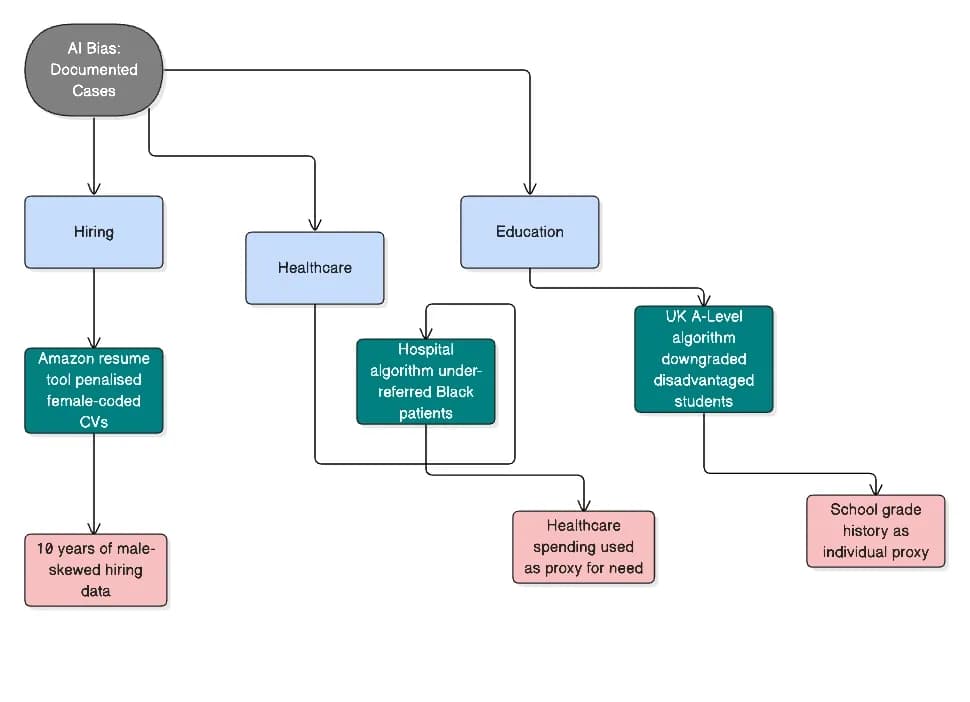
Abstract explanations only get you so far. Here are documented cases from three industries where AI bias caused real harm to real people, sometimes thousands of them.
AI Bias in Hiring
Amazon’s case is the one that got most of the attention. In 2018, Reuters reported that the company had quietly shut down an internal AI recruiting tool after realizing it was consistently penalizing resumes that contained the word "women's". As in “women’s chess club” or “women’s rugby team".
It also downgraded graduates of two all-women’s colleges. The tool had been trained on a decade of Amazon’s own hiring decisions. Most of those hires had been men. The model just learned to prefer male-associated signals, not because anyone told it to, but because that’s what its training data rewarded over and over.
AI bias in hiring isn’t one company’s problem, though. Resume screening tools across industries learn from records of past hires who got promoted or stayed around. If those people disproportionately came from certain universities, certain neighborhoods, or certain demographic backgrounds, the tool will quietly prefer future candidates who match that exact profile.
Some tools penalize employment gaps, which research consistently shows affects women at higher rates because of caregiving responsibilities. Others favor particular ways of phrasing experience that correlate more with socioeconomic background than with actual competence. The model isn’t being malicious. It’s being precise, in exactly the wrong direction.
What’s really damaging about hiring bias is that it operates almost invisibly. The candidate who didn’t get a callback usually has no idea why. The employer usually doesn’t either.
AI Bias in Healthcare
In 2019, a team of researchers published findings in Science about an algorithm widely used in US hospitals on millions of patients. The system was significantly less likely to flag Black patients for additional care, even when those patients had the same level of medical need as white patients who did get flagged.
The algorithm had used healthcare spending as a stand-in for healthcare need. On the surface, that sounds logical. Sicker people cost more, right? Except it ignored a critical fact. Black patients, because of decades of systemic barriers to care, had historically spent less on healthcare. Lower spending didn’t mean those patients were healthier. It meant they had less access. The model had encoded that inequality and was now using it to ration care to people who already had less of it.
AI bias in healthcare doesn’t stop with one algorithm. Dermatology AI tools trained almost entirely on images of light-skinned patients perform much worse on patients with darker skin. That gap really matters because these tools are being deployed in clinics where the actual patient population doesn’t look anything like the training set.
Mental health risk assessment tools often don’t generalize across cultural contexts at all. A tool calibrated for one population assigns risk scores that mean something completely different in another cultural setting. Clinical trial data, which underpins much of medical AI, has historically underrepresented women, elderly patients, and minority populations. Every AI model built on that data quietly inherits all those gaps.
AI Bias in Education
When the UK canceled its A-Level exams in 2020, officials used an algorithm to predict grades for hundreds of thousands of students. The BBC reported that students at historically lower-performing schools got lower predicted grades than their teachers had given them. Students from disadvantaged backgrounds took the biggest hits.
The algorithm had factored in a school’s historical grade distribution as one of its inputs. That single design choice effectively punished individual students for their school’s past performance, not for their own ability or effort. It became one of the clearest public demonstrations of AI bias in education we’ve seen yet. The public outcry was so loud that the government reversed the decision.
Automated essay-scoring tools have their own version of this. These systems learn to reward specific writing conventions, often the ones common in Western academic traditions. Students from different cultural or linguistic backgrounds who write equally well, just differently, can end up with lower scores.
Not because their thinking is weaker, but because their style doesn’t match what the training set rewarded.
Adaptive learning platforms compound this kind of problem over time. Early judgments about a student’s ability shape what material gets served to them next. A student who underperforms in week one for any reason (anxiety, illness, just not yet comfortable with the software) gets routed to easier content.
The system reads their continued performance on that easier content as confirmation of the original assessment. It’s a loop that can be genuinely hard to escape.
AI Bias in Generative AI
Generative AI adds a whole new dimension to this problem. Large language models write. Image generators create visuals. Audio models synthesize speech. And all of them learned from data that reflects the world as it has been, not as it should be.
The internet is enormous, and Generative AI models have been trained on huge chunks of it. But enormous doesn’t mean balanced. Decades of cultural production heavily over-represent certain groups, certain perspectives, and certain aesthetics. When a model learns from that, it learns those imbalances too. And then it produces content at a scale no individual human creator ever could.
Generative AI Bias: Real Examples
-
Ask many image generators to depict “a CEO", and you’ll get a man in a suit. Ask for “a nurse", and you’ll get a woman. No demographic instructions required. The training data quietly did the work.
-
Language models consistently associate certain professions with one gender more than probability would suggest. Research from Stanford and other institutions has documented this pattern across all the major models. It’s not subtle, and it’s not random.
-
Translation tools encode stereotypes directly into their output. Feed many translation systems “The nurse said…” in a gender-neutral source language, and they’ll produce a female pronoun in English. “The engineer said…” gets a male pronoun. The tool isn’t confused. It’s doing exactly what its training taught it.
-
Text generators produce more negative associations when generating content about certain ethnic names compared to others. This has been tested and documented repeatedly. The problem is the training data, which reflects negative associations already present across the text of the open internet.
-
When asked to depict scenes from non-Western cultures, image tools often reach for the most stereotyped visuals available in their training set. The results can range from inaccurate to actively harmful.
-
Code-generation tools trained on public repositories have been shown to reproduce insecure coding patterns at significant rates. The patterns exist in the training data because insecure code is unfortunately common across the open internet. The model learned them the same way it learned everything else.
Scale is what makes this especially serious. A single biased human author produces biased content once. A generative AI model produces biased outputs millions of times a day, often in ways users can’t easily detect or push back against.
Strategies to Reduce AI Bias
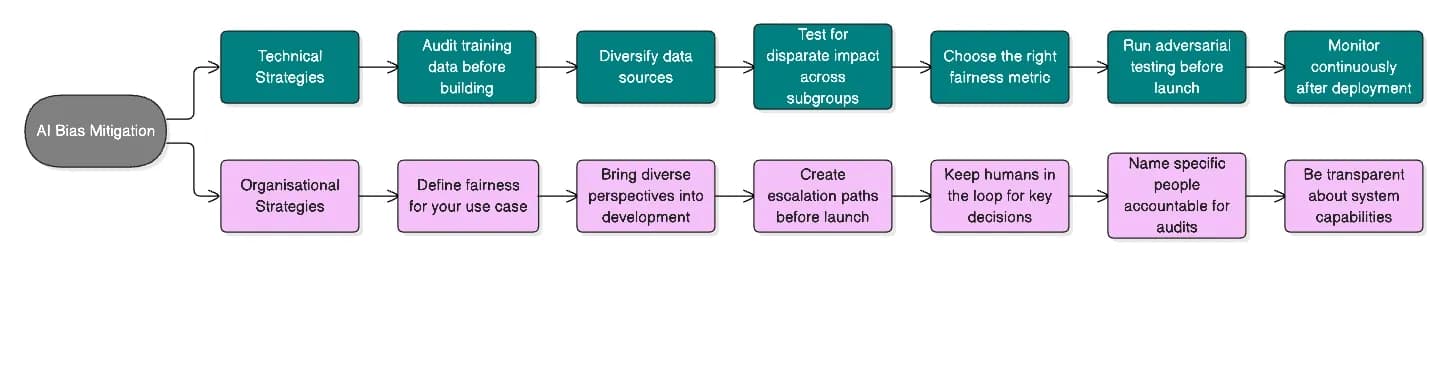
There’s no switch to flip on this. Reducing AI bias requires real work across both technical and organizational dimensions, and that work doesn’t end when a system launches. It becomes part of how you run and maintain the system every day after that.
Technical Strategies
-
Audit your training data before you start building. Who’s in it? Who isn’t? What historical decisions are baked into the labels? Gaps in your data reliably predict gaps in fairness. It’s a lot cheaper to find them now than after deployment.
-
Diversify your data sources. A dataset that reflects one type of user produces a model that works best for that type of user. Broadening the data isn’t optional if you want the system to work equitably across a broader population.
-
Test for disparate impact across subgroups before you ship anything. Measure accuracy, false positive rates, and false negative rates separately for different demographic groups. Don’t just report the headline aggregate. Tools like IBM AI Fairness 360 and Google's What-If Tool exist precisely for this kind of pre-deployment testing.
-
Think hard about which fairness metric you’re using. Equal accuracy, equal error rates, and equal opportunity are all legitimate fairness goals, and they sometimes conflict with each other. There’s no universal right answer. The choice has to come from genuinely understanding the stakes in your specific context.
-
Run adversarial testing before launch. Give people the specific job of trying to surface biased outputs. They’ll find things automated testing won’t, because they bring the kind of creative, contextual thinking that scripted checks just don’t have.
-
Set up continuous monitoring after deployment. Bias doesn’t always show up on day one. Data drifts. User behavior changes. What passed a pre-launch audit can fail six months later. Build monitoring into your operations, not just into your launch checklist.
Organisational Strategies
-
Define what fairness actually means for your use case before any building starts. Sounds obvious. Almost never gets done. “Fairness” doesn’t define itself. It means different things in different contexts, and the working definition has to come from people with real domain knowledge and from those most affected by the system’s decisions.
-
Bring diverse perspectives into the development process, not just as reviewers at the end. Organizations like the Algorithmic Justice League publish frameworks and resources for building more inclusive practices into AI development from the very beginning.
-
Create escalation paths before something goes wrong. When a model produces a harmful output, someone needs the authority to pause the system, escalate it for review, and trigger a fix. If that process doesn’t exist before launch, it definitely won’t exist when you actually need it.
-
Keep humans in the loop for high-stakes decisions. Hiring. Medical care. Credit. Parole. Benefits eligibility. These decisions affect people’s lives in ways that are hard to undo. Automated recommendations are fine. Fully automated final decisions, on those topics, really aren’t.
-
Name specific people accountable for bias auditing. Not a team. People. With review dates and documentation requirements attached. Vague mandates don’t get executed. Clear ownership does.
-
Be transparent about what your systems can and can’t do. Anthropic's model cards and research offer a useful template for what thoughtful capability documentation looks like in practice. Users who understand a system’s limitations are in a much better position to catch and report its failures.
Perfection isn’t the goal here. Every model carries some level of error. What actually matters is that errors don’t fall disproportionately on the people who are already most vulnerable and least positioned to push back.
Want to See How Different AI Models Handle Sensitive Topics?
AI bias isn’t evenly distributed across models. Different systems handle the same prompt differently, and you can see those differences clearly the moment you put them side by side. Lorka's multi-model workspace lets you run the exact same prompt across several AI models in one window and compare how each one responds. It’s a practical way to test how different systems handle bias-sensitive topics without setting up separate accounts or wrangling APIs.


Test How AI Models Handle Bias
Run the same prompt across multiple AI models to compare how they respond to sensitive topics, identify bias, and make more informed AI decisions.
Try LorkaAI Bias Explained
It’s when an AI system keeps producing unfair results for the same group of people. Not occasionally. In a predictable, repeating pattern. The system isn’t choosing to be unfair, of course. It’s just reflecting what it learned from its training data, its design goals, or the context where it’s being used.