


Key Takeaways⭐
- Deterministic AI guarantees identical outputs from identical inputs. Fixed rules, decision trees, and mathematical formulas. No randomness, no hallucination risk.
- Probabilistic AI (including all generative AI) operates on statistical sampling. Creative and adaptable, but variable and prone to fabricating information.
- Enterprise compliance demands predictable systems. In finance, healthcare, and regulated industries, tracing and reproducing every AI decision is a legal requirement.
- Hybrid architecture is where the industry is headed. Probabilistic models handle natural language understanding; deterministic systems handle execution. The best AI agents already work this way.
- This is a design decision, not a quality judgment. Match the tool to the task. Creative work gets probabilistic AI. Safety-critical execution gets deterministic AI.
Deterministic AI vs. Generative AI
Modern AI systems like ChatGPT and Claude are highly capable, but they're completely probabilistic. Such behavior is terrible for environments where a mistake could cost millions.
To better understand why deterministic systems still run the machine world, even after years of innovation into generative AI, let's consider the biggest constraint: hallucinations. A hallucination happens whenever a generative AI system confidently produces false or senseless responses.
The flexibility and creativity that make large language models (LLMs) so powerful also limit their adoption in legacy software systems.
Last year, I watched a client's vibe-coded AI agent draft a refund policy that didn't exist.
They hired a developer to wire up ChatGPT to their customer support workflow. A customer asked for a refund on a subscription, and the chatbot, confident as can be, cited a "30-day satisfaction guarantee" the company had never offered.
The customer took a screenshot and threatened to contact their attorney if they didn't receive a full refund. The whole thing cost more to clean up than the subscription was worth.
Now imagine this scenario, but on much larger scales. If randomness in responses will cost you or your company money, then you should explore deterministic AI solutions instead of generative AI.
What Does "Deterministic" Actually Mean in AI?
A deterministic AI system is one where identical inputs always produce identical outputs. Providing the same data today, tomorrow, or any other time from now will yield the same answer. Every time. No variation.
This conclusion sounds obvious until you realize that most of the AI people talk about today works the opposite way.
When you ask ChatGPT the same question twice, you get two slightly different answers. Ask it 100 times and you’ll notice just how wide the variance in responses can be.
That's by design. Large language models are probabilistic; they predict the statistically most likely next word, and small variations in that prediction cascade into meaningfully different outputs.
Deterministic AI has none of that ambiguity. It operates on hard-coded logic paths: IF/THEN rules, decision trees, fixed mathematical formulas, and lookup tables. There is no "interpretation." There are no hallucinations. The system does exactly what its rules say to do. Nothing else.
So is AI deterministic? It depends on which type of AI you mean.
The expert systems that powered early AI research in the 1970s and 1980s were entirely deterministic. A medical diagnosis system would follow explicit rules: if the patient has symptom X and lab result Y, then the probable diagnosis is Z. Same symptoms, same diagnosis, every time.
Modern large language models are the opposite. GPT-5.4, Claude, and Gemini are all probabilistic. They generate responses by sampling from probability distributions (e.g., choosing from long tables of numbers), which means their outputs are inherently variable.
You can push an LLM toward deterministic behavior by setting the temperature parameter to zero and fixing a random seed, but even then, infrastructure-level variations (floating-point arithmetic and batch processing order) can produce subtle differences (OpenAI, 2024).
The simplest way to think about the distinction: a calculator is deterministic AI. A chatbot is probabilistic AI.
Both process information. One gives you the same answer every time. The other gives you a plausible answer that might be different tomorrow.
Deterministic vs. Probabilistic AI: Breaking It Down
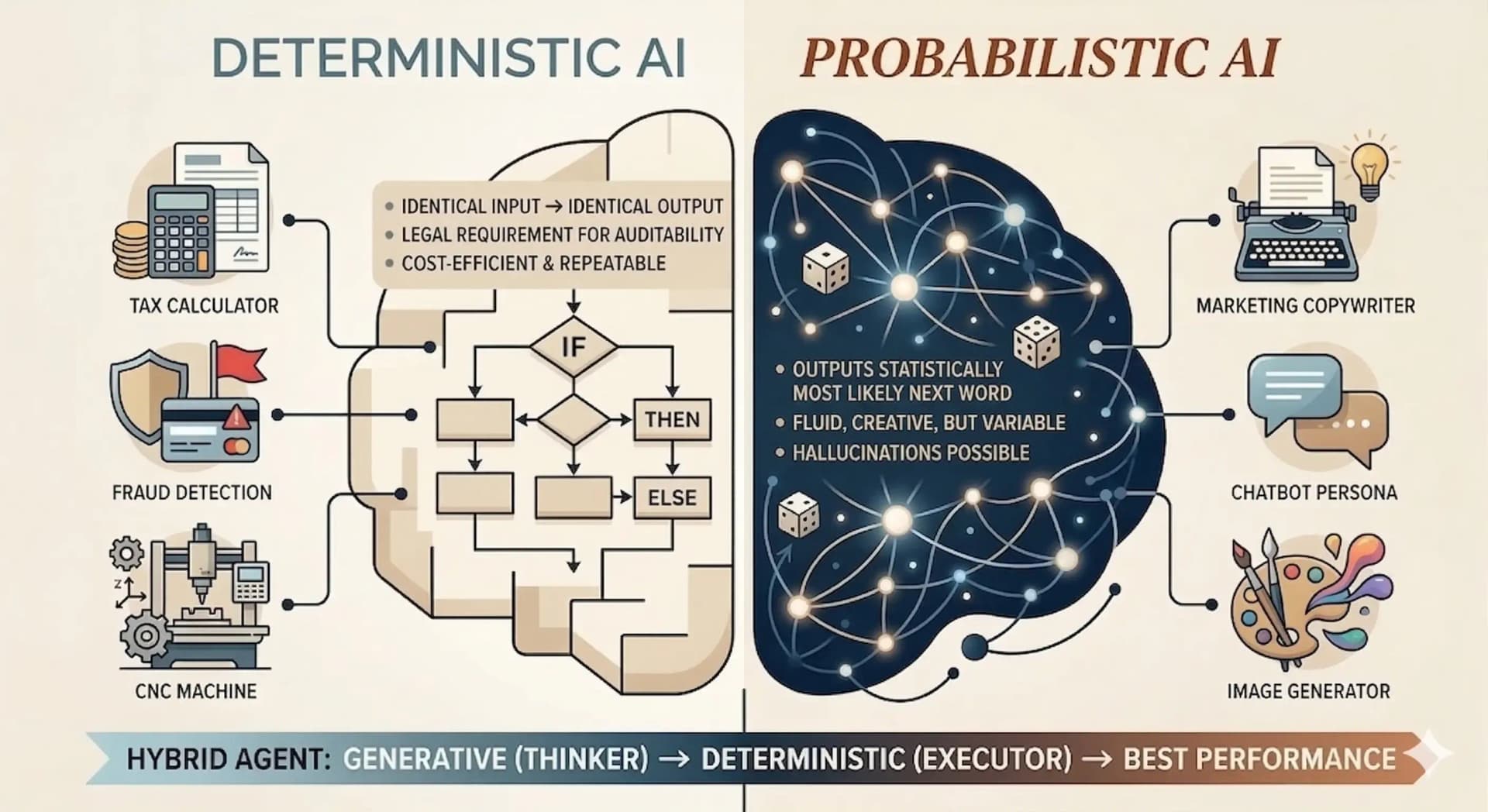
Probabilistic AI models uncertainty.
It doesn't compute a single correct answer; it computes a distribution of possible answers and picks one. Every large language model you've used (ChatGPT, Claude, Gemini) works this way.
When you type a prompt, the model calculates the probability of each possible next word and samples from that distribution. The result is fluid, creative, and different every time.
This is why the same prompt produces different outputs for the same question. The model is rolling weighted dice at every token.
Deterministic AI has no dice. The same input triggers the same logic path, which produces the same output. Every time.
Examples of deterministic AI:
●     Spam filter flagging specific keywords

●      Fraud detection blocking high-value transactions from new accounts

●      Rules-based chatbot matching questions to FAQ responses

●      Inventory system auto-reordering at set thresholds

●      Access control granting/denying entry based on credentials
The logic is fixed. The outcome is predictable.
You'll also see the term "stochastic" used in this context. In statistics and engineering, "stochastic" means "randomly determined." Deterministic vs stochastic is the same distinction, just borrowed from a different field.
If someone describes a model as stochastic, they mean its outputs involve randomness.
The term non-deterministic AI sometimes appears interchangeably with probabilistic AI, though technically "non-deterministic" has a more specific meaning in computer science (a system that can follow multiple computation paths simultaneously).
In practice, when people say "non-deterministic AI," they mean AI whose outputs vary even with the same input.
Here's how the two approaches compare across the dimensions that matter most to anyone deploying AI in production:
| Dimension | Deterministic AI | Probabilistic AI |
|---|---|---|
| Output consistency | Identical output every time | Different output each time |
| How it works | Fixed rules, decision trees, lookup tables | Statistical sampling from probability distributions |
| Creativity | None. Follows instructions exactly | High. Generates novel combinations |
| Risk of hallucination | Zero. Cannot invent information | Significant. Can fabricate plausible-sounding content |
| Auditability | Complete. Every decision is traceable | Difficult. Internal reasoning is opaque |
| Adaptability | Low. Requires manual rule updates | High. Learns patterns from data |
| Best for | Compliance, safety-critical systems, automation | Content generation, conversation, analysis |
| Examples | Fraud detection, algorithmic trading, drone navigation, factory IoT, Kubernetes autoscaling | ChatGPT, Claude, Gemini, DALL-E |
Neither approach is better. They solve different problems.
You wouldn't use a probabilistic model to calculate payroll taxes. You wouldn't use a deterministic system to draft marketing copy. The tool matches the task.
Consider a CNC laser cutter on a factory floor. The machine receives coordinates and cuts the same part identically every time. That's deterministic. Now consider asking an AI to design the part. Two different prompts produce two different shapes. That's probabilistic.
The factory needs both: creative design up front and precise execution on the floor.
Why Generative AI Alone Isn't Enough
If you've been reading the Lorka Knowledge Hub, you know that generative AI is inherently probabilistic.
Models like Deepseek, Perplexity, and Gemini 3.1 Pro generate new content by predicting statistically likely sequences. That's what makes them powerful for writing, coding, brainstorming, and conversation. This is also why they are dangerous in situations where "close enough" isn't good enough.
I ran into this firsthand when building an automated reporting pipeline.
The generative model was supposed to extract financial figures from quarterly reports and format them into a summary table. It worked beautifully about 95% of the time.
The other 5% rounded numbers slightly differently, occasionally swapped Q3 and Q4 figures, and once invented a line item called "Adjusted Synergistic Revenue" that appeared nowhere in the source document.
95% accuracy sounds impressive at first, but in finance this could lead to massive capital losses.
Think of it this way: imagine that a kitchen chef was improvising during a franchise audit. The dish may look good, but if it wasn't meant to be on the menu, corporate will be upset!
Alternatively, a deterministic system processing the same financial data would extract the exact same numbers every time. It follows explicit extraction rules. No inference. No probability. Just the numbers on the page.
Here’s the practical lesson and core mental model to follow: Generative AI is the thinker. Deterministic AI is the executor. You want the generative model to understand what the user is asking for. You want the deterministic system to actually do it.
Why Enterprise Businesses Need Deterministic AI Models
Three words keep coming up when I talk to enterprise teams about AI adoption: compliance, auditability, and safety. These are the reasons deterministic AI models dominate in regulated industries.
Compliance and auditability
When a regulator asks why your system made a specific decision, you need a clear answer. With a deterministic system, you can trace every output back through the exact logic path that produced it.
Input A triggered Rule B, which applied Condition C, which generated Output D.
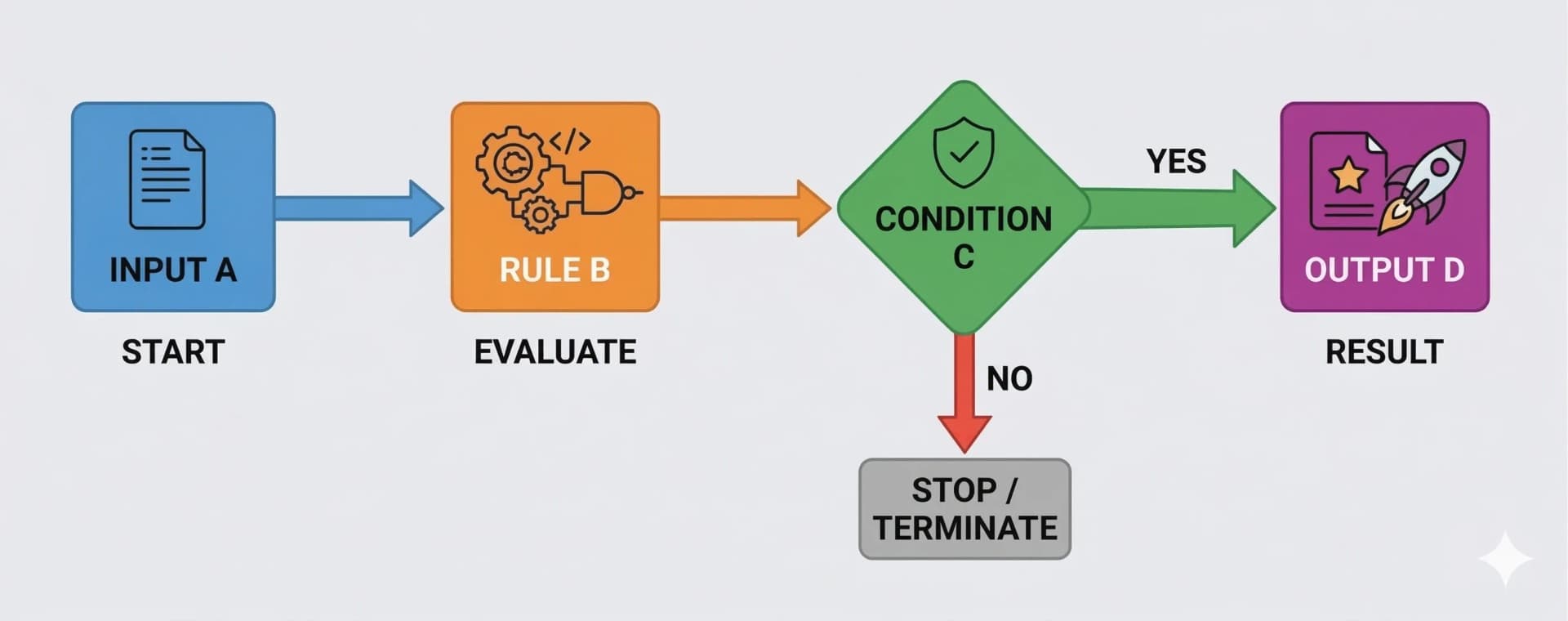
The chain is complete, transparent, and reproducible.
Try doing that with a probabilistic model. "The model predicted this output with 73% confidence based on patterns in its training data" doesn't satisfy a financial auditor or a healthcare compliance officer.
Compliance Noteℹ️
Zero hallucinations
Deterministic systems cannot hallucinate. They can be wrong (if the rules are wrong), but deterministic systems cannot invent information. A deterministic tax calculator will never spontaneously create a deduction that doesn't exist in the tax code.
This is vital for mission-critical tasks such as healthcare diagnostics, financial ledgers, and legal document processing. In these domains, a plausible-sounding wrong answer is worse than no answer whatsoever, because people act on it.
Cost and operational efficiency
Deterministic systems are often computationally cheaper and faster to run. They don't require massive GPU clusters or trillions of parameters. A rule-based fraud detection system can evaluate thousands of transactions per second on an ancient server still running COBOL, while a probabilistic model requires significant inference compute for each decision.
This matters at scale. When you're processing millions of daily transactions, API calls, or user requests, the cost difference between deterministic and probabilistic systems compounds quickly. Deterministic logic also eliminates the need for constant model retraining and version management that comes with probabilistic AI.
Deterministic AI Examples and Use Cases
Deterministic AI is everywhere. It rarely gets headlines, but it carries enormous weight. Here are the most common deterministic AI examples across industries.
💳 Finance and accounting
Fraud detection is one of the clearest examples. When your bank blocks a transaction, it's usually because of a deterministic rule: a transaction over $5,000 from a new device in a foreign country within 24 hours of a password change. The rule is fixed. The threshold is fixed. Every matching transaction is flagged. Every time.
Transaction routing, tax calculation engines, and anti-money laundering (AML) screening all run on the same principle. The IRS or your local tax authority won’t accept "the AI was feeling creative" as an explanation for a tax miscalculation.
🏭 Manufacturing and IoT
A CNC machine on a factory floor doesn't guess where to cut. It receives exact coordinates and executes the same operation on every part.
Deterministic AI controls the whole production process: quality control sensors that identify problems at set limits, robotic arms that follow the same welding routes, and inventory systems that order more supplies when they reach specific amounts.
When a laser cutter needs to make a precise incision on an aircraft component, there's no room for statistical likelihood.
📈 Algorithmic trading
Rule-based trading systems execute fixed strategies: if the 50-day moving average crosses below the 200-day average, sell the position. The same market data triggers the same trade. Every time.
Hedge funds and market makers rely on this predictability because a system that "creatively reinterprets" a stop-loss order can wipe out a portfolio in seconds.
My favorite deterministic AI model is XGBoost. It’s dominated data science competitions and is the gold standard for financial risk scoring and technical signal detection across most quantitative trading desks.
🏦 Insurance and lending
When a loan application hits an underwriting system, deterministic rules evaluate it: credit score above 680, debt-to-income ratio below 43%, and employment verified for 24+ months.
The same applicant profile produces the same decision. Regulators require it. An underwriting model that approved the same application on Monday and denied it on Friday would trigger an audit.
💬 Customer support workflows
Here's where both types work together. A customer writes "I want to return my order" in natural language. A generative AI model (probabilistic) interprets the intent. But the actual return process, checking eligibility, generating a return label, and issuing a refund, runs on deterministic workflows.
Fixed steps, fixed rules, fixed outcome.
Remember the chatbot that invented a refund policy from my opening story? The mistake that they made was that they let the generative model handle both understanding and execution.
The fix was simple: let the LLM understand the request, then hand it off to a deterministic workflow that follows the actual refund policy.
If you want to explore how different AI models handle the same prompts for different industries, Lorka AI provides you with access to all of the best models and prompt tools under a single affordable subscription. It's the fastest way to see probabilistic AI in action and understand where deterministic guardrails can support your use case.


Combining Deterministic AI and Generative AI
The best-performing innovations right now are hybrid architectures that use both deterministic and generative AI systems.
Here’s how I look at hybrid systems:
“A probabilistic model sits at the front, understanding human intent in natural language. A deterministic system sits at the back, executing the action safely.”
*The generative model translates. The deterministic model executes. *This is the best approach to get the best agentic AI systems' performance.
AI agents from companies like Salesforce, Microsoft, and Google use large language models to parse complex user requests, plan multi-step workflows, and decide which tools to invoke. But the tools themselves (the API calls, database writes, system commands) execute deterministically.
The agent might "decide" to process a refund, but the refund workflow follows fixed, auditable steps.
Think of it like a restaurant.
The waiter (probabilistic AI) understands your order even if you say, "I'll have whatever that table is having, but without the onions." The kitchen (deterministic AI) follows the recipe exactly.
You want the waiter to be flexible. You want the kitchen to be precise.
Generative AI handles the messy, ambiguous, human part. Deterministic AI handles the precise, repeatable, auditable part. Together, they cover the full range.
It's obvious in hindsight, but many teams I speak with are still treating generative models as if they were a silver bullet or magic wand.
The client with the invented refund policy eventually resolved the problem. They kept the generative model for understanding customer messages but routed every action (refunds, account changes, escalations) through deterministic workflows with explicit rules and quality-control gates.
The AI agent still sounds conversational and helpful. But when it processes a refund, it follows the same steps every time: verify the purchase date, check the return window, confirm item eligibility, generate a label, and issue credit. Same input, same output. Every time.
To learn more about how to bring out the best performance with AI models, check out Lorka AI. There, you can test all of the latest models for the price of just one affordable subscription.
Switch between models like ChatGPT, Claude, and Gemini to see how different probabilistic models interpret the same prompt, and notice how the variation in their responses illustrates exactly why deterministic guardrails matter for anything beyond conversation.
FAQs
It means the system always produces the same output for the same input. There is no randomness in the decision-making process. The AI follows fixed rules or algorithms, so its behavior is completely predictable and reproducible. This is the opposite of how large language models like ChatGPT work, where responses vary each time.