

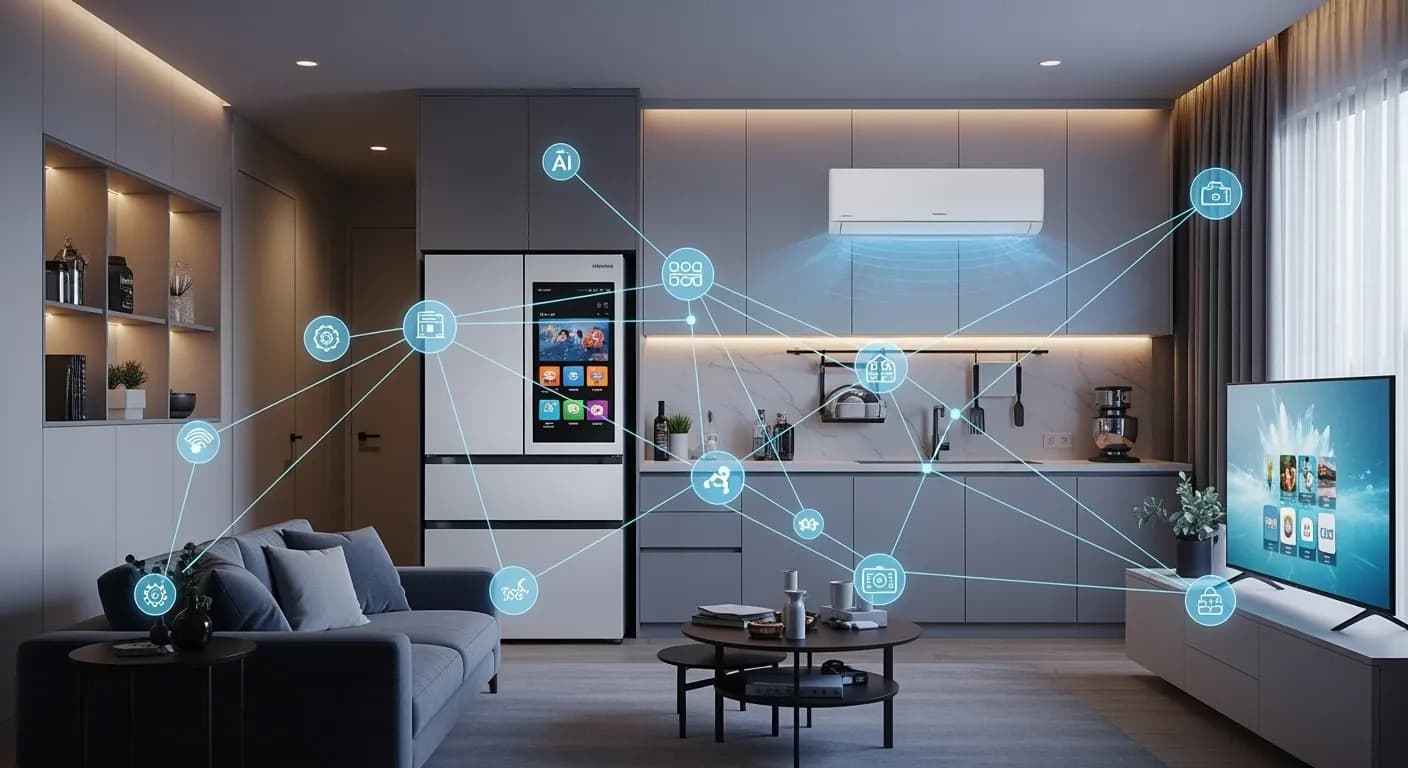
Key Takeaways⭐
- Ambient AI operates in the background without prompts. It senses the environment through microphones, cameras, and IoT sensors, processes context, and acts automatically.
- Healthcare is the breakthrough use case. Ambient writers can reduce documentation time by 30% and restore the doctor-patient relationship.
- The technology runs on the same models as chatbots. The difference is the trigger: typed commands vs. environmental sensing.
- Privacy is the primary challenge. Continuous data collection creates continuous exposure. Healthcare has HIPAA; consumer applications need clearer standards.
- Ambient and prompt-based AI are complementary. Reactive AI for creative tasks and ambient AI for monitoring, documentation, and environmental response.
Ambient AI is artificial intelligence that, when activated, senses what is happening around it and acts on its own. Working quietly in the background instead of waiting for you to type a prompt.
Think of it like the tipping system. The best bartender I ever worked with consistently made more money from tips than most bankers make from their annual bonus.
He taught me that the difference between a good bartender and a great one comes down to one skill: accurately reading the room without being asked.
Many of the best nightlife professionals develop this sixth sense for working with people.
A great bartender clocks body language from twenty feet away. They notice the guy nursing his drink, who wants to be left alone. They spot the group whose energy has just shifted and needs some attention. They remember that the regular at the end of the bar switches from bourbon to water around 11 pm.
This is ambient intelligence in its purest form. The bartender who constantly monitors the environment, builds a contextual model over time, and acts without waiting for explicit instructions.
Nobody flags them down and says, "I would like you to now assess my emotional state." The great bartenders just know automatically. The room is the interface. Behavior is the input. The right action at the right moment is the output. This concept applies to many environments.
That same pattern is now running on computer chips. Ambient AI operates exactly like that bartender: it watches, listens, processes context, and acts, all in the background, all without prompts or chat windows.
Ambient AI: Definition and Meaning
Ambient AI refers to AI systems designed to operate invisibly in the background, sensing context and taking helpful actions without waiting for you to type a prompt or press a button.
The word "ambient" does the heavy lifting. In audio engineering, ambient sound is the background noise of an environment:
●      the hum of an air conditioner


●      distant traffic at a busy intersection


●      birds outside the window.
These are all sounds that you register subconsciously, and they shape your experience of the space.
Ambient AI works the same way. It uses intelligent systems that take actions around you without demanding your direct attention.
This practice is a real departure from how most people interact with AI today. When you use ChatGPT, Claude, or Gemini, you open an interface, type a prompt, and wait for a response. These models are reactive: the AI does nothing until you tell it what to do.
It’s easier to think of ambient AI in terms of traditional hardware. A microphone picks up a conversation. A camera reads body language. A sensor tracks temperature, movement, or location. The AI processes those inputs continuously, builds a model of what's happening, and acts when the context calls for it.
The system comes to you. Ambient AI removes friction and simply acts upon certain conditions.
The concept has roots in ambient intelligence (AmI), made popular by researchers at the European Commission's ISTAG in 2001 (Aarts & Wichert, 2009). The original vision described environments saturated with sensors that respond to human presence. Twenty-five years later, the hardware and AI models have finally caught up.
Your nervous system is the best analogy.
Right now, your body is regulating heart rate, adjusting breathing, maintaining balance, and processing peripheral vision, all without conscious effort. Ambient AI aims to be the technological equivalent: intelligence that works in the background so you can focus on the task in front of you.
Ambient AI vs. Traditional Generative AI
Most AI tools today are reactive. You open a chat window, type a question, and get an answer back.
On the other hand, ambient AI is proactive. It monitors the environment and acts when the situation calls for it.
Think of the difference between a search engine and a smoke detector.
Google is incredibly powerful, but it does nothing until you type a query. But a smoke detector monitors the air continuously and alerts you when conditions change. You'd never want a smoke detector that required you to press a button and ask, "Is there smoke?" every five minutes.
One responds when prompted. The other responds when the environment demands it.
| Dimension | Traditional Generative AI | Ambient AI |
|---|---|---|
| Interaction | Reactive: user types a prompt | Proactive: system senses and acts |
| Common Inputs | Text, images, files uploaded by the user | Sensors, microphones, cameras, IoT devices |
| User Effort | High: requires active engagement | Low: operates in the background |
| Awareness | Single conversation context | Continuous environmental context |
| Best for | Creative tasks, analysis, Q&A, coding | Documentation, monitoring, environmental control |
| Examples | ChatGPT, Claude, Gemini | Medical scribes, smart thermostats, AI meeting tools |
Generative AI and ambient AI are complementary systems. Many ambient AI systems use generative AI models under the hood.
An ambient medical scribe uses a large language model to convert raw speech into structured clinical notes. The generative model does the language processing. The ambient layer handles the "when" and "how" of triggering that processing without human intervention.
With platforms like Lorka AI, you work with the reactive side: choosing any of the latest models, writing prompts, and generating content. This allows you to test multiple AI tools under one affordable subscription to make any AI solutions.
Ambient AI is the next frontier, where those same models start working automatically, triggered by context rather than keystrokes.
How Does Ambient AI Work?
Every ambient AI system runs on the same three-stage loop: sense, understand, and act.
Stage 1️⃣ : Sensors and ambient listening
The "sense" layer is where ambient AI meets the physical world. This could be a wide variety of systems. Here are some examples.
- Microphones that capture speech
- Cameras that capture movement.
- IoT sensors that capture temperature, humidity, and light
- Wearable devices that capture heart rate and sleep patterns.
Ambient listening AI refers to systems using microphones to capture and process spoken conversation in real time. This is increasingly common in healthcare. A microphone can sit in a doctor's office, always passively listening during a defined session, capturing audio without anyone pressing "record."
Voice assistants like Alexa or Siri activate based on a trigger phrase and listen for a single command. Ambient listening is different in that it captures continuous, natural conversation and processes the entire context. The scope of awareness and associated capabilities are fundamentally different from previous-generation voice assistants.
AI recording companies like Fireflies or Fathom are used to provide similar ambient expertise for business meetings by answering questions live during the meeting.
Stage 2️⃣: Context awareness and processing
Raw data is extremely noisy by itself. The intelligence of these systems comes from the processing layer that transforms background noise into programmatic understanding.
For example, in healthcare, an AI system identifies who is speaking, recognizes medical terminology, maps symptoms to diagnostic categories, distinguishes between a current complaint and medical history, and structures output into clinical formats like SOAP notes (subjective, objective, assessment, and plan).
Pre-2020 transcription tools could convert speech to text but had zero contextual understanding.
They'd transcribe "the patient's heart is racing" identically whether the patient described anxiety or reported a cardiac event. Today's ambient AI models are learning to understand the difference because they process meaning, not just words, using modern information retrieval technology.
Stage 3️⃣: Automated action
The example AI system then acts on its understanding. Perhaps for healthcare, it generates clinical documentation or records. Or in a smart home, it adjusts the thermostat.
The key principle is that ambient AI acts within predefined boundaries. A medical scribe generates a draft that the doctor reviews. A smart thermostat adjusts within the ranges the homeowner sets.
The human is still involved in final decisions and actions.
Ambient AI in Healthcare: The Biggest Breakthrough
Healthcare dominates ambient AI search results for good reason. Ambient AI scribes are solving one of the most expensive, demoralizing problems in modern medicine: documentation burden.
What is an ambient AI medical scribe?
An ambient AI scribe listens to the conversation between doctor and patient during a clinical visit and automatically generates structured medical documentation. The doctor speaks naturally. The AI captures the conversation, identifies clinically relevant information, and produces a draft note.
Companies like Abridge and Suki lead this space. Following 2025 coverage by The Wall Street Journal and Stat News of its $5.3 billion valuation, Abridge secured a 2026 Series E extension, raising ~$778 million total (Abridge, 2025). Now serving 150+ health systems, Abridge earned consecutive #1 Best in KLAS titles through February 2026.
The doctor walks into the exam room, the system activates, and the AI listens for the duration of the visit. By the time the appointment ends, a structured note is waiting for review.
Why it matters: the numbers
Physicians spend an average of 15.5 hours per week on documentation, according to Medscape's 2024 survey. Physicians spend nearly two full workdays every week typing instead of treating patients. Burnout from documentation costs the U.S. healthcare system an estimated $4.6 billion annually (Annals of Internal Medicine, 2019).
Early studies show that ambient scribes reduce documentation time by 50-70%.
Some additional industry fun facts:
- At Kaiser Permanente in Northern California, an ambient AI scribe was credited with saving physicians the equivalent of 1,794 working days in a single year, close to five years of work hours (Permanente Medicine).
- The American Medical Association reported a large health system saving 15,000 hours of documentation time (AMA).
- A UCLA Health study found scribes** cut documentation time per patient encounter by roughly 30 percent against clinicians' own baseline** (UCLA Health).
But the biggest impact lies in the harder-to-quantify benefits: doctors spend more time looking at their patients. The physician stops splitting attention between notes and documents, and instead, conversations can flow naturally again. Documentation happens in the background. Ambient scribes restore the original human roles of the job description.
Limitations and Concerns
While there are plenty of documented wins, it’s worth accounting for survivorship bias and looking at the challenges and trade-offs. Here are a couple of the main ones.
The notes can sometimes be inaccurate
In a UCLA-linked trial, physicians reported that AI-generated notes occasionally contained clinically significant inaccuracies, most often omissions of information or pronoun errors, and one mild patient-safety event was reported during the study (24x7). A 2025 trial published in the Journal of General Internal Medicine counted 19 medical errors in the AI-scribe arm against 9 in the control arm, though patients were not negatively affected overall (J Gen Intern Med).
This situation is exactly why the human stays in the loop and will continue to for the foreseeable future. The AI scribe is there to write the draft. The clinician is still responsible for catching the omission or the flipped pronoun before it becomes part of the record.
From "burnout solution" to "revenue engine"
Ambient scribes were first sold as a cure for clinician burnout.
In 2026, the marketing approach has shifted. Vendors increasingly emphasize revenue: better coding, fewer missed charges, and stronger documentation to support billing. Remember Abridge's flagship recognition, the #1 KLAS ranking for ambient AI in revenue cycle management. The tool that started as "give the doctor their evening back" now also measures how much money it helps a health system capture.
Payers are pushing in the other direction
While health systems use AI to document more, insurers use their competing algorithms to pay less. Payers, including Cigna, have faced criticism for using software to auto-downcode or deny claims at scale, the subject of investigative reporting and ongoing pushback from physician groups (ProPublica). The result is an algorithmic tug-of-war: AI writing the case for payment on one side, AI arguing it down on the other, with the clinician caught in the middle.
Consent is an open legal question
Recording a private conversation raises consent questions, and the law is still catching up.
Wiretapping and consent theories from earlier lawsuits over website tracking are now being extended to ambient recording tools, with early class actions appearing in states that require all parties to consent to a recording. This issue is an emerging legal question (not a settled law), but it remains live, and it may hint at where things are heading. Any organization deploying these tools should treat patient consent as a feature, not an afterthought.
Ambient scribes are a real technology with real tradeoffs. The wins and the costs are both real, and a clinic that adopts one should walk in expecting both.
Ambient AI Examples in 2026: Beyond Healthcare
Healthcare gets the headlines, but ambient AI shows up wherever continuous monitoring and automatic response create value.
Smart homes and consumer IoT
A Nest thermostat that learns your schedule and adjusts<span style="text-decoration:underline;"> </span>the temperature before you arrive home is ambient AI. Smart lighting adjusts brightness based on the time of day. Sleep trackers adjust bedroom temperature based on your sleep stage. All ambient systems sense, process, and act with no prompts required.
The consumer IoT market is projected to reach $338.28 billion by 2030 (Fortune Business Insights, 2024).
Enterprise security
Security is a natural fit because the discipline is built on continuous, passive observation with automatic escalation. Modern ambient AI platforms combine video feeds, access control logs, and behavioral analytics. The system recognizes patterns: an employee badging into a restricted area outside normal hours, a vehicle lingering in a loading zone.
Traditional security required human operators watching banks of screens. Ambient AI surfaces only the anomalies that need human attention. The shift from "watch everything" to "watch what matters" catches threats human monitors miss during the sixth hour of a twelve-hour shift.
Sales and marketing call analysis
Sales and marketing are natural fits because they continuously capture conversations and automatically assess quality.
Traditional quality control required managers to manually review random call samples. Ambient AI surfaces coaching opportunities across 100% of conversations. The shift from "spot-checking a few calls" to "analyzing every interaction" catches performance gaps and best practices that managers miss when reviewing five calls per month per rep.
Meeting transcription tools like Otter.ai, Fireflies.ai, and Fathom are moving toward ambient operation. They join meetings automatically, capture conversations, identify action items, and distribute summaries.
The Privacy Question: Is Ambient AI Safe?
If ambient AI works by listening, watching, and sensing continuously, who else has access to that data?
The always-on problem
The fear is that these systems are always recording. In practice, most are session-activated, not always-on. An ambient medical scribe does not run all day.
The clinician opens the app and activates the scribe at the start of a visit, and it captures audio during the active session only. A security system does monitor continuously, because gaps create vulnerabilities. The right answer depends on the system, and "always listening" is the wrong default assumption for most of them.
🛡️ How serious platforms protect the data
- Encryption in transit and at rest, so audio and notes are unreadable if intercepted or stolen.
- Role-based access controls and single sign-on ensure that only those who need to access a record can do so.
- Audit logs that record who accessed what and when, making misuse traceable.
- Business Associate Agreements (BAAs) that contractually bind the vendor to HIPAA and keep customer data segregated.
- Consent workflows, so the patient is informed that the scribe is active and can opt out.
- Tight retention limits, deleting or strictly limiting raw audio once the note is generated.
These are the standards that vendors market and commit to in writing (TMLT). While it’s impossible to make any system risk-free, these solutions are evolving and improving as the technology sector matures.
Consumer devices are a softer target
Consumer IoT is less regulated. Your smart speaker, thermostat, and doorbell feed data to cloud services governed by terms of service, not healthcare law. Amazon's Alexa has faced repeated scrutiny over how it stores and accesses voice recordings (Bloomberg, 2019). The technology is outpacing the policy, so a good guideline is to treat ambient sensors in your space with the same care you would give your most sensitive data.
The Room Is the Interface
The bartender who reads the room. The doctor whose scribe handles the notes. The thermostat adapts to your schedule automatically. The security system that watches so you don't have to. The pattern is the same everywhere: intelligence that senses, understands, and acts without being asked.
The best tech lets you focus on doing the work you were trained for. Doctors document visits without typing. Security teams monitor without staring at screens. Meeting participants listen without scribbling notes.
Whether ambient AI lives up to its full vision, I'm genuinely not sure yet. The privacy questions are real, and the technology is still early. But the underlying principle is proven. Any bartender who's worked a busy Friday night already knows it works.
If you want to explore the AI models powering this shift, Lorka AI provides you with access to ChatGPT, Claude, Gemini, and more through a single subscription. The fastest way to build hands-on understanding of the models that make ambient AI possible.


Try Lorka AI
Compare ChatGPT, Claude, Gemini, and more in one platform to explore the AI models powering ambient AI.
Try LorkaFAQs
A traditional medical scribe is a human who sits in the exam room and takes notes. An ambient AI scribe does the same job using artificial intelligence: it listens through a microphone and automatically generates structured clinical documentation.
The AI version works in the background without a dedicated person in the room and can process visits faster and more consistently than most human scribes.