
Key Takeaways⭐
- AI agent orchestration manages more than one specialized agent in order to solve complex tasks that a single model cannot handle alone.
- The system uses task decomposition and state management to break down larger goals and keep using the same memory across workflows.
- Adaptive routing improves general performance and can reduce costs by matching specific sub-tasks to their suitable AI models.
- Orchestration provides more resilience via self-correction and autonomous decision-making in order to prevent entire processes from failing.
What is AI Agent Orchestration?
An AI agent orchestration platform is a software environment that allows developers to do the following with multiple autonomous AI agents.
- Design
- Deploy
- Monitor
The agents are working together towards a shared objective.
Orchestration enables dynamic routing, self-correction, and stateful collaboration between specialized agents. This is unlike basic prompt chaining, where output from Model A simply feeds into Model B in a linear sequence.
The Orchestra Analogy
Consider an analogy where an LLM is a virtuoso musician. This musician is capable of brilliant solo performances. Orchestration is the conductor ensuring every instrument plays the right notes at the right time.
- A single violinist (GPT-5.5) might handle melody
- The percussion section (Claude Sonnet 4.6) maintains rhythm
- The brass (Gemini 3.1 Pro) adds depth
The conductor (orchestrator) doesn't play an instrument. It coordinates timing. It also manages transitions and adapts performance based on real-time feedback.
Agentic Workflows vs. Autonomous Orchestration
Not all multi-step AI systems qualify as true orchestration.
Basic agentic workflows follow predetermined loops:
Generate draft → Review → Revise → Publish
These are essentially fancy if-then statements.
Autonomous orchestration, by contrast, employs dynamic reasoning. An orchestrator might analyze intermediate results. Then, it decides: "The code generation failed because the API schema is outdated. Route this task to a web search agent first, then retry code generation with updated context."
This distinction matters.
Effective orchestration requires three core capabilities listed below:
- Task decomposition (breaking goals into sub-tasks)
- State management (persistent memory across steps)
- Adaptive routing (selecting the optimal model or tool for each sub-task).
In production environments, this translates to self-sufficient systems. Such systems can recover from failures. They can also optimize resource allocation and maintain context (across extended workflows spanning hours or days).
The difference between a basic chain and true orchestration is resilience. The entire process halts if step 3 of a 10-step chain fails.
An orchestrated system does the following:
- Diagnoses the failure
- Attempts remediation
- Routes around the problem
- Escalates to human intervention (based on predefined policies)
Orchestration vs. Standard LLM Chains: The Evolution of AI Architecture
To understand why orchestration represents an architectural evolution, let’s compare traditional chaining to modern agentic systems:
| Feature | Basic Chaining (Sequential) | Agentic Orchestration |
|---|---|---|
| Logic Flow | Linear (A → B → C) | Dynamic/Cyclic (Re-routing based on output) |
| Error Handling | Hard-coded failover | Self-correction and reflection |
| Task Complexity | Single-domain | Cross-functional (e.g., code + research + email) |
| User Input | Start only | Human-in-the-loop (HITL) support |
| Memory | Context window only | Persistent state management |
| Model Selection | Fixed per step | Dynamic routing based on task requirements |
The main difference is adaptability.
In a basic chain, if Step 3 fails, the entire pipeline halts. In orchestration, a supervisor agent can diagnose the failure. It can then spawn a debugging agent and modify the task plan. The agent can also resume execution without human intervention (unless HITL checkpoints are configured).
This shift reflects evolution from monolithic applications to microservices. Specialized components (agents) communicate via APIs (messages). This communication is coordinated by a service mesh (orchestrator).
Let’s consider a real-world scenario of automated financial reporting.
A basic chain might execute the following:
Fetch data → Analyze → Generate report → Email stakeholders
If the analysis step encounters an unexpected data format, the entire process fails.
An orchestrated system handles this differently. When the Analysis Agent encounters malformed data, it triggers a Data Validation Agent.
That agent identifies the issue, logs it, and applies transformations. Then it passes the cleaned data back to Analysis. The workflow continues without human intervention.
This resilience is critical for production systems. These systems are where uptime and reliability matter more than simplicity. You can refer to the following diagram to view the Basic chaining vs Agentic Orchestration workflows:

The Mechanics: How AI Agents Coordinate
Understanding orchestration requires examining three foundational mechanisms. These mechanisms separate functional multi-agent systems from glorified prompt chains.
1. Task Decomposition
Consider a scenario where a user submits a complex goal.
Example:
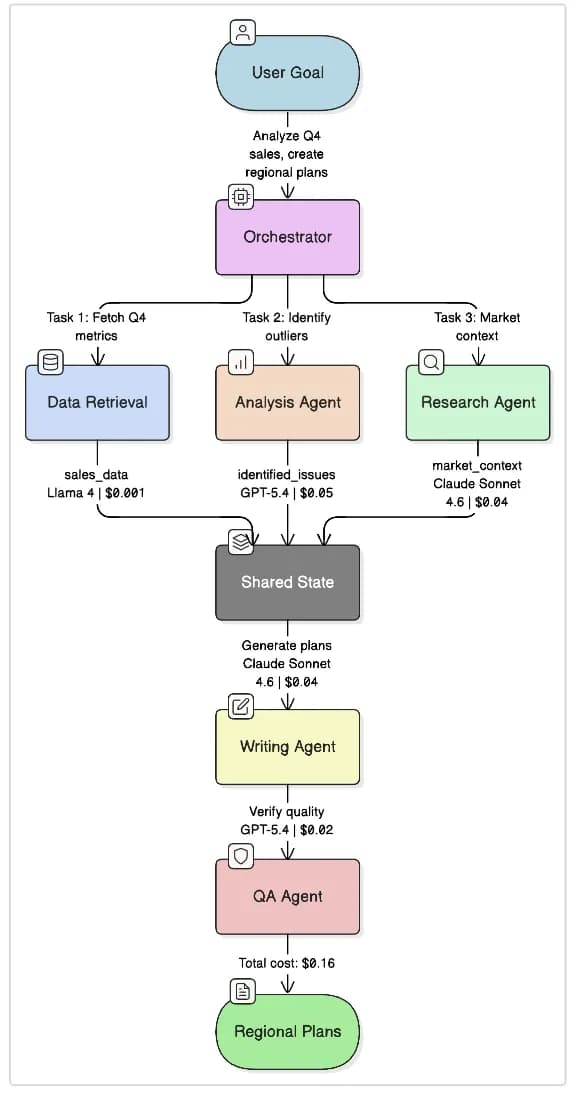
"Analyze our Q4 sales data. Identify underperforming regions. Moreover, draft personalized improvement plans for each regional manager."
An orchestrator doesn't hand this wholesale to a single model. Instead, it performs task decomposition:
- Data Retrieval Agent: Query the sales database for Q4 metrics
- Analysis Agent: Statistical processing to identify performance outliers
- Research Agent: Gather context on market conditions in underperforming regions
- Writing Agent: Generate personalized recommendations based on analysis + research
- QA Agent: Verify factual accuracy and tone consistency
Each sub-task is assigned to the most appropriate agent.
A lightweight model like Llama 4 handles database queries (structured, deterministic). The Claude Sonnet 4.6 has a 400K context window. Leveraging that, it synthesizes analysis across multiple data sources.
Task decomposition makes the problem easier to solve. It transforms an intractable prompt into a directed acyclic graph (DAG) of executable steps.
The orchestrator also determines dependencies. The Writing Agent cannot execute until both Analysis and Research are complete.
But those two can run in parallel, reducing wall-clock time. This parallel execution is impossible in sequential chains.
Advanced orchestrators use dynamic decomposition. Rather than predefining all steps upfront, they use a Planning Agent to generate the task graph based on the specific request.
For "Analyze Q1 vs Q4 sales," the planner might add a Comparison Agent that wasn't needed for variations of similar tasks without manual reconfiguration.
2. State Management & Memory
The "shared whiteboard" problem: How does Agent D know what Agents A, B, and C discovered without re-reading the entire conversation history?
State management solves this through structured memory stores.
In LangGraph, the state is an explicit Python object that gets updated after each agent action:
Simplified LangGraph state example
class WorkflowState(TypedDict):
sales_data: pd.DataFrame

identified_issues: List[str]

drafted_plans: Dict[str, str]

current_step: str
When the Analysis Agent completes, it writes the findings to identified_issues.
The Research Agent reads this list to know which regions require market research.
The Writing Agent accesses both identified_issues and sales_data to draft plans. This persistent state prevents context dilution, the enemy of long-running workflows.
Advanced systems implement hierarchical memory: short-term (current task context), working (session data), and long-term (user preferences, historical outcomes).
Enterprise orchestration frameworks emphasize this layered approach for deployments where agents might work on multi-day tasks.
State management also enables checkpointing.
The orchestrator doesn't restart from scratch if a workflow fails at step 7 of 15. It resumes from the last saved state. Thus, it reruns only the failed step after remediation.
This is particularly valuable for expensive workflows.
Imagine a legal document review where steps 1-6 cost $50 in API calls, analyzing a 500-page contract. If step 7 fails due to a transient API error, checkpointing saves that $50 by resuming from step 7 rather than restarting.
Memory persistence across sessions is another critical feature.
Consider a customer service agent. This agent can interact with the same user over multiple days. It can also recall previous conversations, preferences, and resolved issues. An agent can do all this without embedding the entire history in every prompt.
3. Agent Handoffs & Routing
The routing logic determines which model handles which sub-task. This is arguably the most critical design decision in orchestration architecture.
Static Routing: Predefined rules ("Always use GPT-5.5 for code and Claude Sonnet 4.6 for writing"). Simple but inflexible.
Semantic Routing: Analyze the task description and route. This is based on keyword matching or embedding similarity. Better, but still brittle.
Dynamic Routing with LLM-as-Judge: A meta-agent evaluates intermediate results. It then selects the next specialist.
Example:
The code generation produces a syntax error. Flow starts from a debugging agent before proceeding to testing. This is where orchestration becomes truly autonomous.
In 2026, frontier models like GPT-5.5 offer native function-calling capabilities that streamline routing.
The orchestrator can present available agents as "tools" and let the model decide, "To solve this math problem, I'll call the Wolfram Alpha agent rather than attempting calculation myself."
Cost Optimization Through Routing
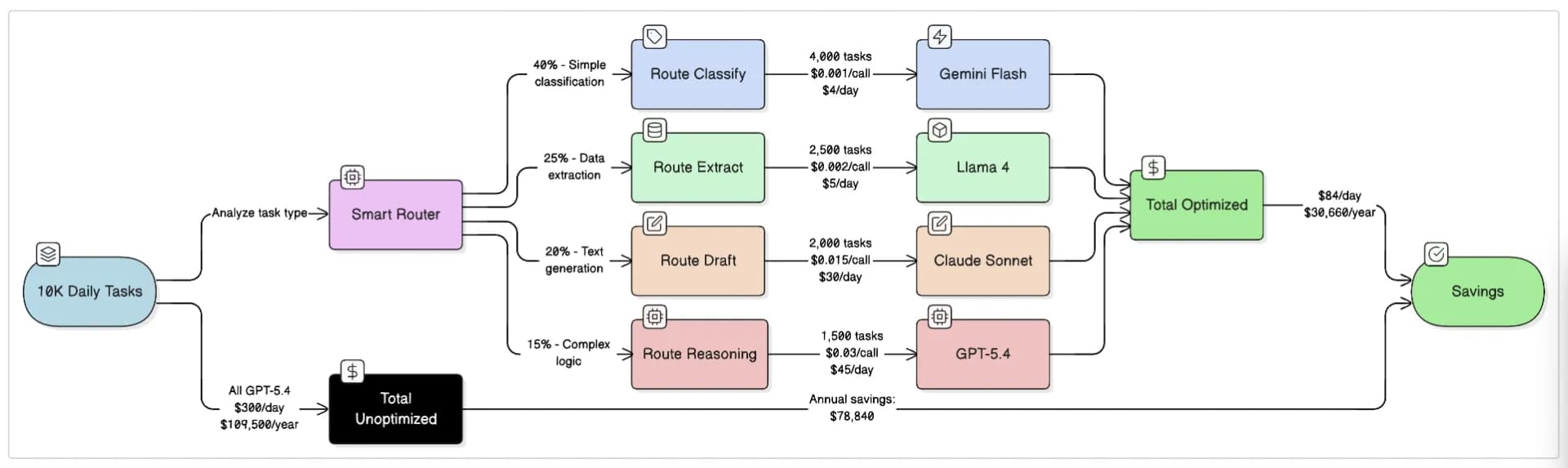
Smart routing also controls expenses.
A well-designed orchestrator uses cheaper models (Gemini 3.1 Flash) for repetitive tasks and reserves expensive frontier models (Claude Opus 4.5) for complex reasoning.
According to benchmarks, this hybrid approach reduces API costs by 60-70. This is in comparison to using premium models for all steps.
Consider a customer support workflow that processes 10,000 tickets daily.
- Every step uses GPT-5.5 at $0.03 per call.
- Each ticket requires 5 agent invocations.
- Daily cost is $1,500.
With smart routing:
- Ticket classification: Gemini 3.1 Flash ($0.001 per call)
- Context retrieval: Vector DB (no LLM cost)
- Response drafting: Claude Sonnet 4.6 ($0.015 per call)
- Quality check: GPT-5.5 ($0.03 per call)
- Total per ticket: $0.046 vs $0.15
This reduces daily costs from $1,500 to $460. This leads to saving over $380,000 annually. All this while maintaining quality.
Routing isn't just about cost. It's about matching capabilities to requirements.
GPT-5.5 excels at structured reasoning and code. Claude Sonnet 4.6 handles nuanced writing and long-context synthesis. Gemini 3.1 Pro processes multimodal inputs (images and charts).
The orchestrator leverages each model's strengths rather than forcing one model to handle everything. Below is an example use case of the smart router flow:
Top AI Agent Orchestration Frameworks & Tools (2026)
Choosing the right AI agent orchestration framework depends mainly on one thing. That is, your “control-vs-autonomy requirements”.
Here's how the leading AI agent orchestration tools compare:
| Framework | Architecture | Best For | Learning Curve | Control Level |
|---|---|---|---|---|
| LangGraph | State machines with DAGs | Enterprise auditing, deterministic flows | High | Explicit |
| CrewAI | Role-based agents | Process automation, team hierarchies | Medium | Automatic |
| AutoGen | Conversational multi-agent | Research workflows, collaborative solving | Medium | Balanced |
| n8n | Visual drag-and-drop | Citizen developers, standard patterns | Low | Limited |
LangGraph (by LangChain)
Architecture: State machine with explicit edges and nodes. Workflows are directed graphs where each node is an agent or function.
Best For: Enterprise systems requiring auditable, deterministic logic.
If you need to explain to a compliance team exactly why Agent X is called Agent Y, LangGraph's explicit graph structure provides that paper trail.
Key Features:
- Cyclic graphs: Unlike basic chains, agents can loop back for self-correction
- Persistence: Built-in checkpointing for long-running workflows
- Human-in-the-loop: Pause execution for approval before critical actions
Trade-offs: Higher learning curve.
You're writing Python code to define graphs. Means you are not dragging boxes in a UI. But this verbosity equals control. Every decision point is explicit.
Use Case Example: A legal document review system. In the system, Agent A extracts clauses. Agent B flags risks. The Agent C (a human lawyer) approves changes before Agent D generates revisions.
The cyclic graph allows Agent B to re-review after Agent D's edits.
LangGraph shines in regulated industries where auditability matters.
Financial services, healthcare, and legal tech require transparent decision trails. When an AI system denies a loan application or flags a medical risk, you must explain why.
LangGraph's graph structure makes this trivial. Each edge represents a decision. Each node logs inputs, outputs, and reasoning.
Regulators can inspect the exact sequence of agent invocations that led to any outcome.
The framework also supports conditional edges. An edge from Agent A to Agent B might only be activated in one case.
Example case:
“If a specific condition is met (e.g., "confidence score < 0.8").”
This enables sophisticated branching logic that adapts to intermediate results.
CrewAI
Architecture: Role-based agents with conversational coordination. Inspired by organizational hierarchies where managers delegate to specialists.
Best For: Process automation teams who think in terms of job roles. "I need a researcher, a writer, and an editor working together."
Key Features:
- Role definitions: Agents have goals, backstories, and tools (like job descriptions)
- Task delegation: Senior agents can spawn junior agents dynamically
- Memory sharing: Agents have built-in short-term and long-term memory
Trade-offs: There is less control over exact execution paths.
The framework handles routing automatically. This is convenient until you need to debug why the "Researcher" agent made an unexpected API call.
Use Case Example: Content production pipeline
A Manager Agent assigns topics to Researcher Agents. It also consolidates findings and briefs Writer Agents. Then routes drafts to an Editor Agent for final polish.
Learn more in the CrewAI documentation.
CrewAI's strength is rapid prototyping.
You can define a multi-agent workflow in 50 lines of code by specifying roles rather than low-level logic.
The framework handles the following:
- Task distribution
- Memory management
- Inter-agent communication automatically.
This makes CrewAI ideal for business process automation where workflows mirror human organizational structures.
Say your company already has defined roles (analyst, writer, reviewer). CrewAI lets you translate that directly into agent architecture.
The downside is opacity. When an agent makes an unexpected decision, tracing the root cause requires digging through framework internals.
For non-critical applications, this is acceptable. For high-stakes systems, LangGraph's explicit control is preferable.
Microsoft AutoGen
Architecture: Conversational multi-agent framework emphasizing agent-to-agent dialogue.
Best For: Research-heavy workflows and collaborative problem-solving. Multiple agents debate solutions before executing.
Key Features:
- Group chat: Multiple agents participate in threaded conversations
- Code execution: Built-in sandboxed environments for running generated code
- Teachability: Agents learn from user corrections across sessions
Trade-offs: Conversation threads can become token-heavy.
A 5-agent debate might consume 10K tokens before producing output.
Use Case Example: Data science exploration
A Statistician Agent proposes analysis methods. A Coder Agent implements them. A Critic Agent reviews results. An Explainer Agent translates findings for non-technical stakeholders. Explore AutoGen on GitHub.
AutoGen excels at exploratory tasks where the solution path isn't predetermined.
Traditional orchestration works well when you know the steps: retrieve data, analyze, report. AutoGen handles scenarios where discovering the right approach requires iterative exploration.
The group chat feature enables multi-agent brainstorming.
Before writing code, agents
- discuss the problem
- propose approaches
- critique each other's ideas
- converge on a solution.
This mimics human collaborative problem-solving.
The code execution sandbox is particularly powerful for data science workflows.
An agent can propose a statistical test. It can also write Python code to execute it. Then it runs the code in the sandbox and examines the results. According to that, it refines the approach based on output.
This tight loop between reasoning and execution accelerates iteration compared to manual workflows.
n8n & Visual Orchestration Tools
Architecture: Low-code/no-code drag-and-drop workflow builders with AI node integrations.
Best For: Operations teams and citizen developers who need orchestration without writing code.
Key Features:
- Visual flow design: Connect AI nodes with API calls, databases, and business tools
- Pre-built templates: Common patterns like "summarize emails → extract action items → create Jira tickets."
- Hybrid workflows: Combine AI agents with traditional automation (webhooks, schedulers)
Trade-offs: Limited flexibility for complex conditional logic.
Visual tools excel at linear or moderately branched workflows, but struggle with recursive self-reflection patterns.
Use Case Example: Customer support automation where incoming emails trigger a Sentiment Analysis Agent → Route to appropriate department → Draft response with context from CRM → Human approval → Send reply.
Check out n8n's AI workflows.
Visual orchestration platforms democratize AI automation.
Non-developers can build functional multi-agent workflows by connecting pre-built nodes.
This is valuable for operations teams that understand business processes but lack coding skills.
n8n integrates with hundreds of business tools (Slack, Gmail, Salesforce, and Jira).
This makes it easy to build AI-augmented workflows that span your entire tool stack.
For example: "When a Slack message mentions 'urgent bug' → Trigger GPT-5.5 to summarize the conversation → Create Jira ticket → Assign to on-call engineer → Post update to Slack."
The limitation is complexity.
Visual tools become unwieldy when workflows require the following:
- sophisticated conditional logic
- state management
- custom transformations
At that point, code-based frameworks like LangGraph are more maintainable.
Critical Design Patterns in Orchestration
Industry-standard design patterns have emerged that solve common orchestration challenges. Here are the most critical ones:
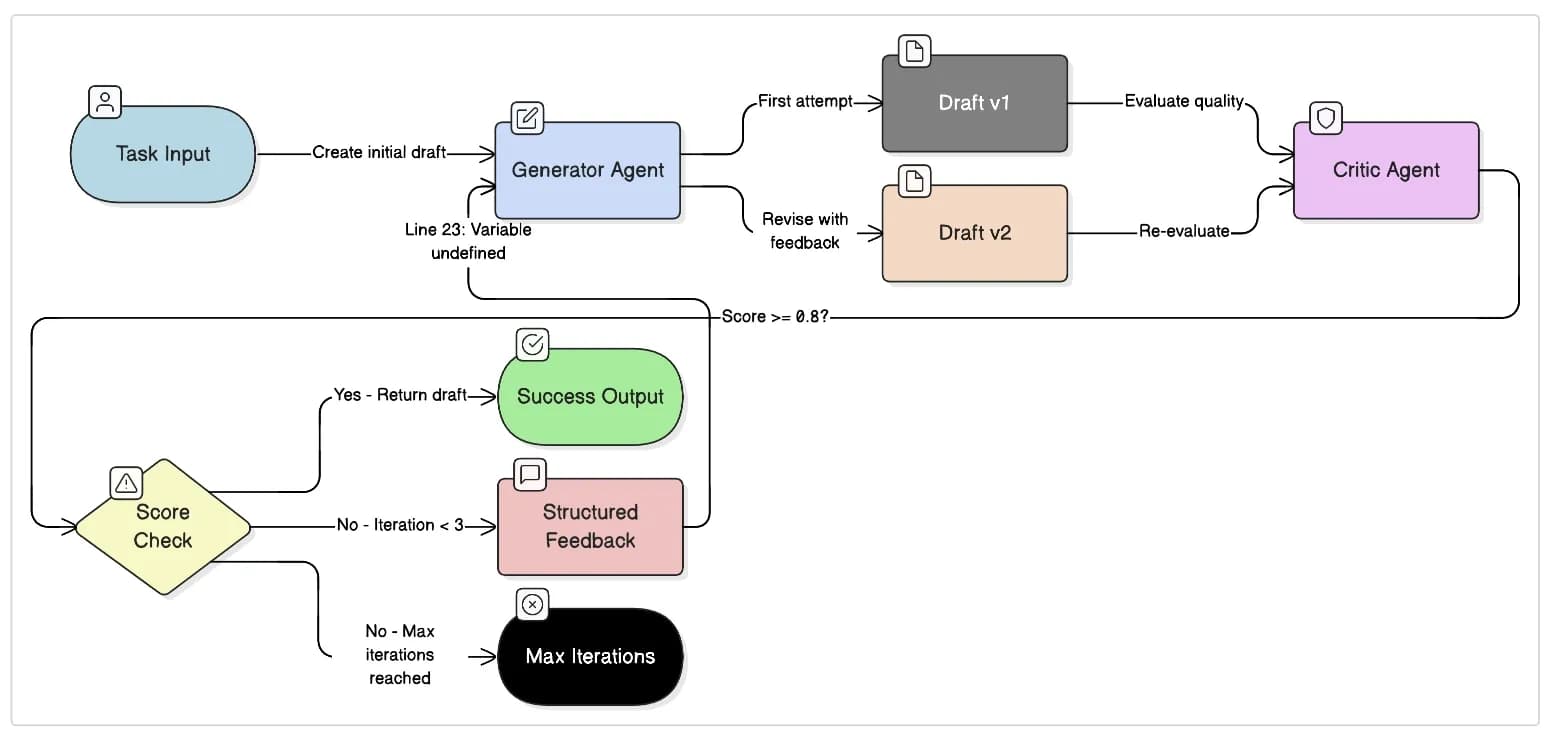
Self-Reflection Pattern
Problem: AI-generated outputs often contain errors, inconsistencies, or hallucinations.
Solution: Agent A (Generator) produces output → Agent B (Critic) evaluates against quality criteria → If defects found, return to Agent A with specific feedback → Repeat until passing score.
Implementation:
Simplified self-reflection loop
def self_reflection_loop(task, max_iterations=3):
for i in range(max_iterations):

    draft = generator_agent(task)

    critique = critic_agent(draft, criteria)

    if critique['score'] >= threshold:

        return draft

    task = f"{task}\n\nPrevious attempt failed: {critique['feedback']}"

return draft
Real-World Use: Code generation where a Coding Agent writes functions and a Testing Agent runs unit tests.
Failed tests trigger revision with error context.
Caution: Set iteration limits. Without guardrails, reflection loops can spiral into infinite refinement, burning API budgets.
Self-reflection dramatically improves output quality.
In benchmarks, code generated with self-reflection passes unit tests 85% of the time versus 45% for single-pass generation.
The pattern works because the Critic Agent has a different objective than the Generator.
The Generator optimizes for completing the task. The Critic optimizes for quality, correctness, and adherence to requirements.
This separation of concerns catches errors that the Generator overlooks.
Effective implementation requires a structured critique.
Rather than the Critic returning vague feedback like "This code has issues", it should return specific, actionable guidance: "Line 23: Variable 'user_id' is undefined. Line 45: "Function returns string, but type hint specifies int."
The Generator uses this structured feedback to make targeted fixes rather than rewriting everything.
Planning Pattern
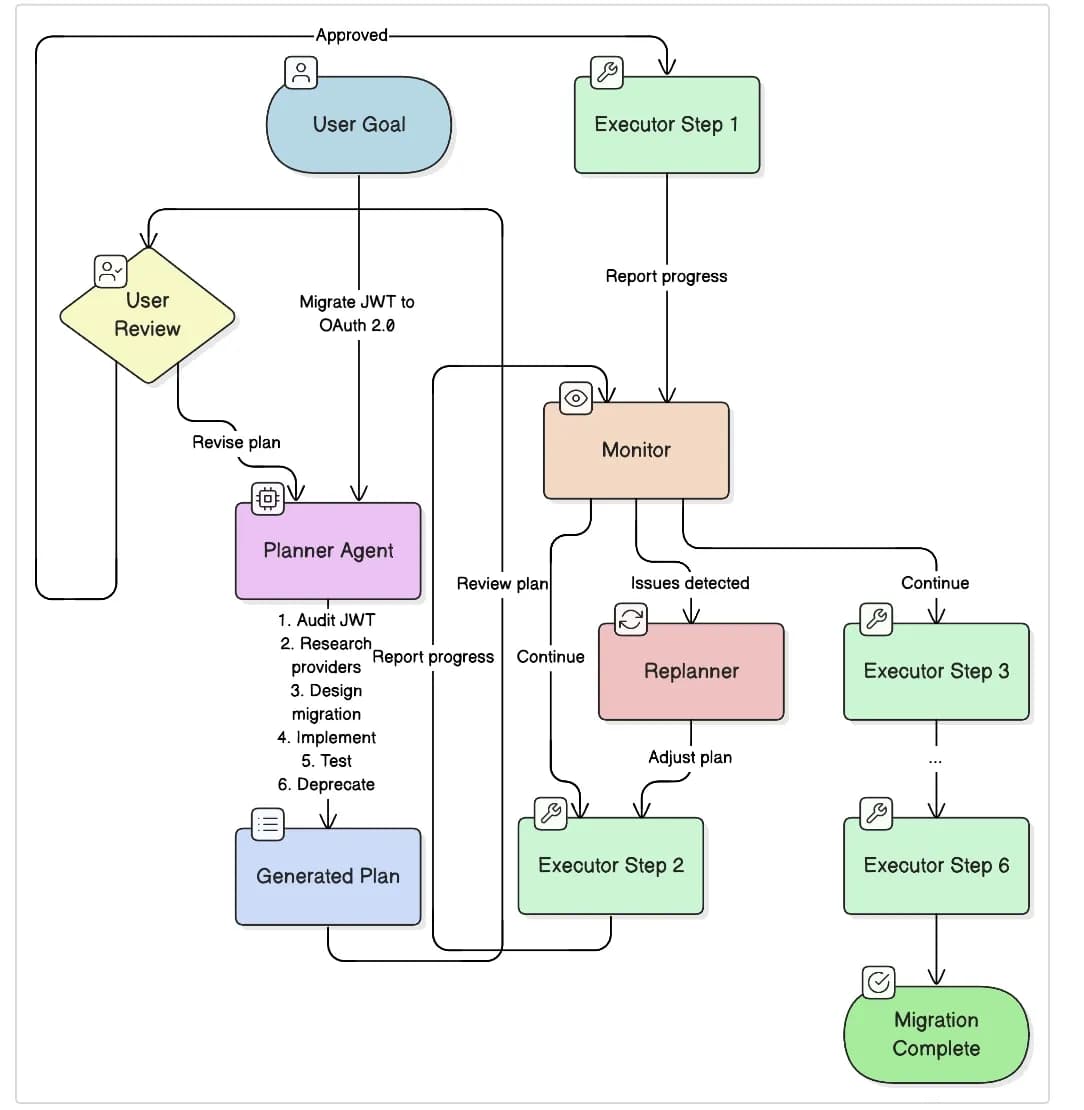
Problem: Complex tasks require foresight. Diving straight into execution leads to dead ends.
Solution: A Planner Agent creates a step-by-step roadmap. The agent does this before executing any tools. Executor Agents follow the plan, reporting back to adjust if conditions change.
Workflow:
- User provides goal: "Migrate our auth system from JWT to OAuth 2.0."
- Planner Agent outputs:
- Step 1: Audit current JWT implementation
- Step 2: Research OAuth 2.0 provider options (Auth0, Okta, custom)
- Step 3: Design a migration path with a zero-downtime strategy
- Step 4: Implement OAuth endpoints
- Step 5: Parallel run JWT + OAuth for testing
- Step 6: Deprecate JWT
- Executor Agents tackle each step, with Planner monitoring progress
Advantages:
- Reduces wasted effort.
- Agents don't code before understanding requirements.
- Provides transparency, allowing users to review the plan before committing resources.
Framework Support: LangGraph's graph structure naturally supports this (Planning node → Execution nodes). CrewAI implements it via Manager agents.
Planning is particularly valuable for open-ended tasks where the full scope isn't known upfront.
The Planner can also adapt the plan mid-execution.
Say Step 2 reveals that a custom OAuth implementation would take 3x longer than expected. The Planner might revise the plan to use Auth0 instead.
This dynamic replanning based on discovered information is impossible in static workflows.
Hierarchical vs. Sequential Organization
Sequential (Flat): All agents are peers. Task A → Task B → Task C. Simple but unscalable. Adding complexity means rewriting the entire chain.
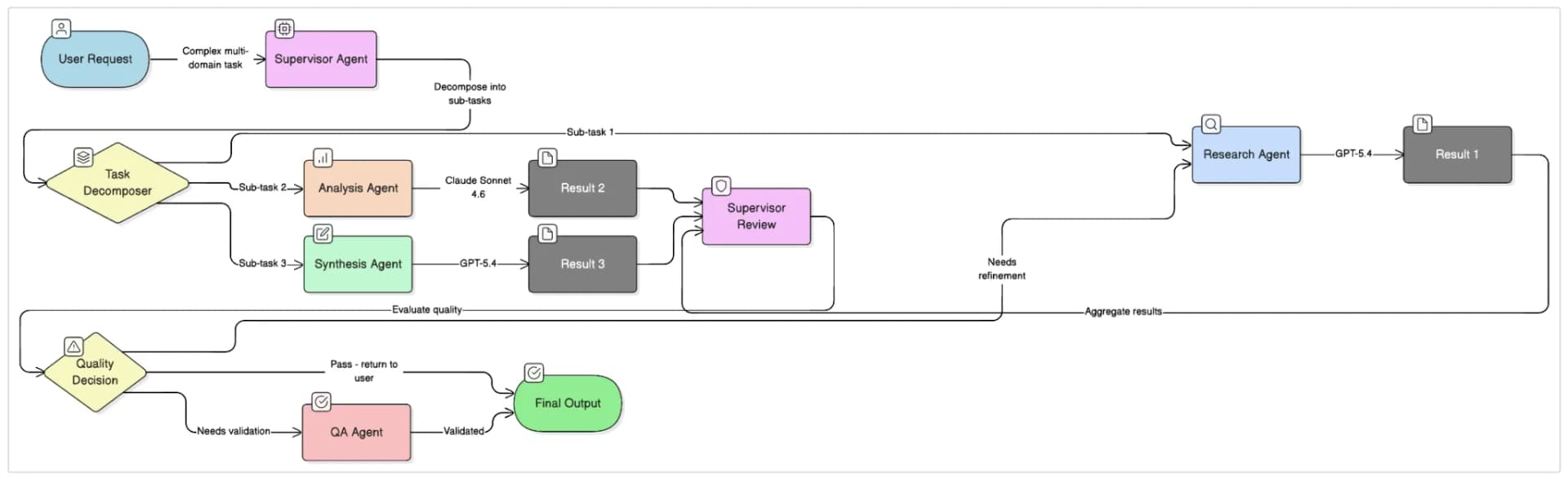
Hierarchical (Supervisor/Worker): A Supervisor Agent receives the user goal. It then decomposes it into sub-goals. Then assigns sub-goals to Worker Agents. Lastly, it aggregates results and decides next steps.
Example Architecture:
User Request
↓
Supervisor Agent
├→ Research Agent (finds information)

├→ Analysis Agent (processes data)

└→ Synthesis Agent (creates deliverables)

↓
Supervisor reviews and either:
- Returns result to user, or

- Spawns QA Agent for validation, or

- Loops back with refinement instructions
When to Use Hierarchical: Multi-domain tasks (research + coding + design), dynamic task lists (number of sub-tasks unknown upfront), or when you need a single point of control for auditing.
When Sequential Suffices: Well-defined pipelines with fixed steps (e.g., "Extract → Transform → Load" data workflows).
Hierarchical organization scales to complex workflows that sequential chains cannot handle.
The Supervisor Agent acts as a traffic controller. It monitors progress and identifies bottlenecks. It also reallocates resources as needed.
Example:
The Research Agent is blocked, waiting for an API response. The Supervisor can instruct the Analysis Agent to start processing already-retrieved data rather than idling.
This parallel execution and dynamic resource allocation are very efficient. These two significantly reduce total workflow time compared to rigid sequential execution.
The Challenges: How to Troubleshoot AI Agent Orchestration Issues
Orchestration introduces failure modes that don't exist in single-model prompting. Here's how to identify and fix them.
Token Spirals
Symptoms: Workflow hangs, burning through thousands of tokens without producing output.
Root Cause: Agents stuck in conversational loops. Agent A asks Agent B for clarification → Agent B requests more context from Agent A → infinite ping-pong.
Solution:
- Set maximum loop iterations at the orchestrator level
- Implement timeout limits (if a sub-task exceeds 30 seconds, escalate or abort)
- Use structured outputs (JSON schemas) instead of free-form text to reduce ambiguity
Debugging Tool: LangSmith's trace viewer shows exactly where loops occur by visualizing message chains.
Token spirals often result from ambiguous task definitions.
Say A's output doesn't clearly satisfy Agent B's input requirements. So, they enter a negotiation loop trying to reach a consensus.
Structured outputs solve this.
If Agent A must return {"status": "success", "data": {...}} rather than free-form text, Agent B knows exactly what to expect.
Schema validation catches mismatches immediately rather than allowing agents to debate format.
Context Window Dilution
Symptoms: Later agents produce irrelevant or confused outputs despite earlier agents succeeding.
Root Cause: Too much conversation history. By Agent 7, the context window contains 200K tokens of intermediate reasoning, burying the original user request.
Solution:
- Summarization agents: Periodically compress conversation history
- Hierarchical memory: Store task results in a structured state, not raw conversation logs
- Context pruning: Keep only the last N messages + critical system prompts
Example: A document analysis workflow processes 50 PDFs.
Instead of appending each PDF's summary to the message history, store summaries in a vector database.
The final synthesis agent queries this database for relevant excerpts. Instead of scrolling through 50K tokens of history.
Context window dilution is the silent killer of long-running workflows.
Early agents succeed because the context is clean. Later agents fail because critical information is buried under pages of intermediate reasoning.
The solution is aggressive state management.
After each agent completes it, extract only the essential information (results, decisions, key facts) and discard verbose reasoning.
Think of it like HTTP:
- Agents should be stateless
- Agents should rely on shared state storage rather than conversational memory.
Given below is the flow diagram of the problem and solution for context window dilution:

Debugging Multi-Agent Failures
Problem: "The workflow failed at step 14 of 22. Why?"
Traditional debugging (print statements, stack traces) doesn't translate to multi-agent systems. You need specialized observability tools:
| Tool | Purpose | Best For |
|---|---|---|
| LangSmith | Trace agent invocations, I/O, latency | LangChain/LangGraph workflows |
| Weights & Biases | Track metrics, success rates, and costs | ML ops teams |
| Custom Logging | Structured JSON logs with agent metadata | Any framework |
Best Practice: Tag each agent action with metadata:
Example logging structure
{

  "timestamp": "2026-04-13T10:23:45Z",

  "agent_id": "research_agent_3",

  "task_id": "competitor_analysis",

  "action": "web_search",

  "input": "ai agent orchestration platforms 2026",

  "output_summary": "Found 12 results, top 3 indexed",

  "tokens_used": 1250,

  "cost_usd": 0.015,

  "success": true

}
When step 14 fails, grep your logs for that task ID and reconstruct the full decision chain.
Effective debugging requires distributed tracing.
Each agent action is a span in a trace tree. When a workflow fails, you examine the trace to see:
- which span failed
- what inputs it receive
- What outputs it produced.
This is analogous to debugging microservices with tools like Jaeger or Zipkin.
Model Inconsistency
Problem: Agent A (using GPT-5.5) produces output format X. Agent B (using Claude Sonnet 4.6) expects format Y. Workflow breaks.
Solution:
- Standardize on JSON schemas for inter-agent communication
- Use format enforcement (function calling, constrained decoding) rather than hoping prompts work
- Test cross-model compatibility explicitly. Don't assume all models interpret instructions identically
Lorka AI Use Case: Before building your orchestration pipeline, test how different models handle the same task using Lorka AI's side-by-side comparison.
If GPT-5.5 consistently formats dates as "MM/DD/YYYY" but Claude uses "YYYY-MM-DD", you'll discover this in the interface before it breaks production.
Model inconsistency is a hidden cost of heterogeneous orchestration.
The benefit is leveraging each model's strengths. The cost is ensuring compatibility.
Always use strict schemas for inter-agent messages.
JSON Schema, Pydantic models, and Protocol Buffers enforce a structure that prevents format mismatches.
Test every model pair in your workflow.
Say Agent A (GPT-5.5) feeds Agent B (Claude Sonnet 4.6). Validate that Agent B correctly parses Agent A's output across multiple examples before deploying.
Why Lorka AI is the Perfect Sandbox for Orchestration Strategy
Building a production AI agent orchestration platform requires significant upfront decisions.
Which models handle which tasks? How should the state be structured? Where do HITL checkpoints belong?
Making these choices in a deployed system means costly rewrites when assumptions fail.
Lorka AI bridges the gap between experimentation and production.
Model Comparison at Scale
Orchestration's core promise is optimal model routing. Using GPT-5.5 for reasoning, Claude Sonnet 4.6 for writing, and Gemini 3.1 Pro for multimodal tasks.
But which model truly excels at your specific sub-task?
Lorka AI provides side-by-side comparison across all frontier models in a single workspace.
Submit your "code review" prompt to GPT-5.5, Claude Sonnet 4.6, Gemini 3.1 Pro, and Llama 4 simultaneously.
Within seconds, you see which model identifies the most bugs, provides the clearest explanations, or runs the cheapest.
This is manual orchestration routing. The human-in-the-loop version of what your automated system will do.
You can build an evidence-based routing strategy. This can be done by testing model performance on representative tasks.
| Task Type | Best Model | Accuracy | Cost vs. GPT-5.5 |
|---|---|---|---|
| Data extraction | Gemini 3.1 Pro | 95% | 60% cheaper |
| Legal analysis | Claude Sonnet 4.6 | 92% | 30% cheaper |
| SQL generation | GPT-5.5 | 97% | Baseline |
| Text summarization | Llama 4 | 88% | 85% cheaper |
This data-driven approach eliminates guesswork.
You know exactly which model to route each task type to for an optimal cost/quality tradeoff.
Rapid Prototyping of Task Decomposition
Before writing LangGraph code to decompose "Analyze competitor pricing", test the decomposition manually in Lorka AI:
- Prompt: "List the top 5 competitors for [product]" → Compare model outputs
- For each competitor, prompt: "Extract pricing tiers from [competitor website]" → Test extraction reliability
- Prompt: "Compare our pricing to [competitor data] and recommend changes" → Evaluate recommendation quality
This workflow is executed in 20 minutes with Lorka AI. It also validates whether your task decomposition strategy is sound.
If models struggle with step 2 (website data extraction), you can add a web scraping tool to your orchestration pipeline before starting development.
Manual testing reveals edge cases that architectural diagrams miss.
You find competitors using inconsistent pricing formats. Some list monthly prices, others annual. Some hide pricing behind "Contact Sales".
These real-world complications inform your orchestration design.
You might add a Normalization Agent to standardize pricing formats. Otherwise, route "Contact Sales" competitors to a different workflow entirely.
Discovering these requirements during prototyping is cheap. Discovering them in production after building the full orchestration pipeline is expensive.
Cost Modeling Before Commitment
Orchestration costs compound.
A 10-step workflow where each step calls GPT-5.5 might cost $0.50 per execution. At 1,000 executions/day, that's $15,000/month.
Lorka AI's usage analytics show per-model costs for your actual prompts.
Test your workflow steps with various models, calculate total cost, and optimize:
Before Optimization (all GPT-5.5): Step 1: $0.05 | Step 2: $0.08 | Step 3: $0.12 | ... | Total: $0.50
After Optimization (hybrid): Step 1 (Llama 4): $0.002 | Step 2 (Gemini Flash): $0.015 | Step 3 (Claude Sonnet): $0.08 | ... | Total: $0.18
64% cost reduction, validated before writing a single line of orchestration code.
Cost modelling is critical for scaling.
A workflow that costs $0.50 might seem reasonable during development with 10 executions/day. But at production scale (10,000 executions/day), that's $150,000/month.
Use Lorka AI to test every step with multiple models.
Identify where expensive models are truly necessary versus where cheaper alternatives suffice.
Often, you'll find that 70% of steps can use budget models, with frontier models reserved for the 30% that require advanced reasoning.
This hybrid approach maintains quality while slashing costs.
Value Proposition
For $19.99/month, Lorka AI provides unlimited access to all frontier models.
That's less than 50 API calls to GPT-5.5 at production pricing.
Before committing to infrastructure, databases, and AI agent orchestration frameworks, spend a week in Lorka AI mapping out your strategy.
Which models to use, how to structure state, and where errors occur. All discovered in a low-risk sandbox.
Say you're ready to build with LangGraph or CrewAI. You'll have a battle-tested routing matrix and validated task decomposition. You'll also have cost projections using Lorka AI's benchmarking tools.
That's the difference between guessing and engineering.
Real-World Orchestration Use Cases
To ground these concepts, here are three production architectures solving different complexity tiers.
🎧 Tier 1: Customer Support Automation
Goal: Route support tickets, generate draft responses, and escalate complex issues.
Orchestration Flow:
- Classifier Agent (Gemini 3.1 Flash): Categorize ticket (billing, technical, sales). 0.5 sec, $0.001
- Context Agent (Vector DB query): Retrieve user history and past tickets. 0.2 sec, $0
- Response Generator (Claude Sonnet 4.6): Draft personalized reply using context. 2 sec, $0.04
- QA Agent (GPT-5.5): Check for policy violations, ensure tone. 1 sec, $0.02
- HITL Checkpoint: Human approves or edits draft
- Sender Agent: Delivers response via ticketing API
Why Orchestration?: Single-model approach fails because:
- classification requires speed (Gemini Flash)
- response quality needs Claude's nuance
- compliance checking benefits from GPT-5.5's instruction-following.
Total cost: $0.061/ticket vs. $0.12 with all-GPT-5.5.
This system processes 5,000 tickets daily at $305/day versus $600/day with a single-model approach.
Annual savings: $107,650.
The HITL checkpoint is crucial.
While agents draft responses automatically, a human reviews them before sending. This catches edge cases. Those are the cases where the agent misunderstood the context or suggested inappropriate actions.
Over time, as confidence grows, you can lower the HITL threshold to only escalate low-confidence responses (score < 0.8) rather than reviewing everything.
🪙 Tier 2: Financial Research & Reporting
Goal: Analyze earnings reports, market data, and news sentiment; generate investment memo.
Orchestration Flow:
- Supervisor Agent: Receives company ticker, breaks into research domains
- Data Agent: Pulls financial statements from API (deterministic, no LLM)
- Document Agents (parallel):
- Agent A: Summarize 10-K filing (Claude Sonnet 4.6, 400K context)
- Agent B: Analyze competitor filings (same model)
- Agent C: Aggregate news sentiment (Gemini 3.1 Pro multimodal for charts)
- Synthesis Agent (GPT-5.5): Combine all research into an investment thesis
- Fact-Check Agent: Cross-reference claims against source documents
- Formatter Agent: Convert to PDF with charts (traditional tooling, no LLM)
Why orchestration?: Parallel processing reduces wall-clock time from 10 minutes (sequential) to 3 minutes.
Specialized models optimize cost and quality. News analysis with multimodal Gemini, long documents with Claude's context window.
The Fact-Check Agent is the critical quality control.
Investment memos must be accurate. The Fact-Check Agent verifies every claim by tracing it back to source documents, flagging any unsupported assertions.
This reduces hallucination risk from 15% (single-model generation) to under 2% (orchestrated with fact-checking).
🧑🏻💻 Tier 3: Software Development Copilot
Goal: Given a feature request, generate code, tests, documentation, and deployment config.
Orchestration Flow:
- Planner Agent: Create implementation roadmap (files to modify, dependencies to add)
- Code Generation Agents (parallel, one per file):
- Each agent uses GPT-5.5 for code, Claude Sonnet 4.6 for inline documentation
- Integration Agent: Ensure new code interfaces correctly with the existing codebase (static analysis)
- Test Agent: Write unit tests and run them in a sandbox
- Self-Reflection: If tests fail, the Debugging Agent analyzes errors, proposes fixes, and loops back to the Code Agents
- Documentation Agent: Generate README updates, API docs
- Review Agent: Format all changes as a GitHub PR with a summary
Why orchestration?: A monolithic prompt ("Write feature X with tests and docs") produces inconsistent results.
Decomposition with self-reflection loops catches bugs before human review.
An estimated 70% of PRs pass CI/CD without revision vs. 30% with single-model generation.
The self-reflection loop is key to quality.
Initial code generation might have 5-10 bugs. The Test Agent catches them. The debugging agent fixes them. The second iteration typically passes all tests.
This automated debugging saves developer time.
Rather than manually fixing AI-generated code, the orchestration system delivers production-ready PRs.
Conclusion: Orchestration as AI's Operating System
AI agent orchestration represents the maturation of large language models from experimental tools into reliable infrastructure.
The frameworks available in 2026 (LangGraph, CrewAI, AutoGen) provide the primitives for building everything from customer support automation to autonomous software development.
But infrastructure alone doesn't guarantee success. The difference between functional orchestration and expensive failure lies in evidence-based decision-making.
This is why platforms like Lorka AI exist. To derisk those decisions before you commit to production architecture.
Test your routing strategies, validate task decomposition, and model costs accurately. Then build with confidence.
The next-generation AI operating system is being written now. The question isn't whether orchestration will become standard. It's whether you'll master it before your competitors do.


Build Smarter AI Agent Workflows
Compare GPT, Claude, Gemini, and other leading models to test routing strategies, optimize costs, and validate multi-agent orchestration before deployment.
Try LorkaFAQs
Multi-agent orchestration is the systematic coordination of multiple specialized AI agents. The purpose is to solve complex tasks that exceed single-LLM capabilities. It involves task decomposition, state management, dynamic routing and error handling for autonomous, multi-step execution.