


Key Takeaways⭐
- Use AI as a collaborator, not a replacement: The strongest content comes from human-led thinking combined with AI-assisted drafting, editing, and organization.
- Follow a human-in-the-loop workflow: Start with your ideas, use AI to structure and refine them, then perform a final human review to restore voice and verify facts.
- Prompt specificity drives quality: Detailed prompts with clear constraints, personas, and examples consistently produce better results than generic requests.
- Protect your unique writing voice: Use seed sentences, writing samples, and style guidelines to ensure AI expands your ideas rather than replacing them with generic language.
- Match AI tools to the task: Different models excel at different jobs, from creative writing and editing to technical documentation and research-heavy content.
- Always fact-check and edit AI output: AI can improve productivity, but human oversight remains essential for accuracy, credibility, and quality.
Beyond the “Generate” Button: Why AI Help with Writing Requires a New Skill Set
There is a meaningful and consequential difference between AI writing and AI-assisted writing. One is a vending machine. The other is a collaborative editorial process. Understanding which one you are doing, at every step, is the entire game.
AI writing is what happens when someone types “write me a 1,000-word blog post about content marketing” and publishes whatever comes out. The output is technically coherent, semantically accurate, and deeply forgettable.
Every sentence is average because average is what language models are statistically trained to produce. There is no insight, no specific point of view, no voice. It reads like it was written by someone who has read everything and experienced nothing.
AI-assisted writing is what happens when a skilled writer uses a model to remove friction at specific, chosen points in their process: structuring fragmented thinking before committing to an outline, flagging passive constructions in a draft, proposing two alternatives to a transition they know is weak, or generating counterarguments to stress-test a claim. The human provides the thinking. The AI handles the mechanical work. The output retains authorial voice because authorial judgment was present at every critical decision.
The uncanny valley of generic AI prose is well-documented by practitioners and researchers alike. Surface-level tools like Hemingway Editor and ProWritingAid can identify sentence-level issues.
However, the deeper problem, the strangely even rhythm, the transitional clichés, and the absence of a genuine perspective only emerge when writers outsource the thinking alongside the drafting. The model fills the space you leave with a statistical average. Leave it all in space, and you get all the averages.
You can refer to the following infographic to understand the spectrum from AI writing to AI-assisted writing:
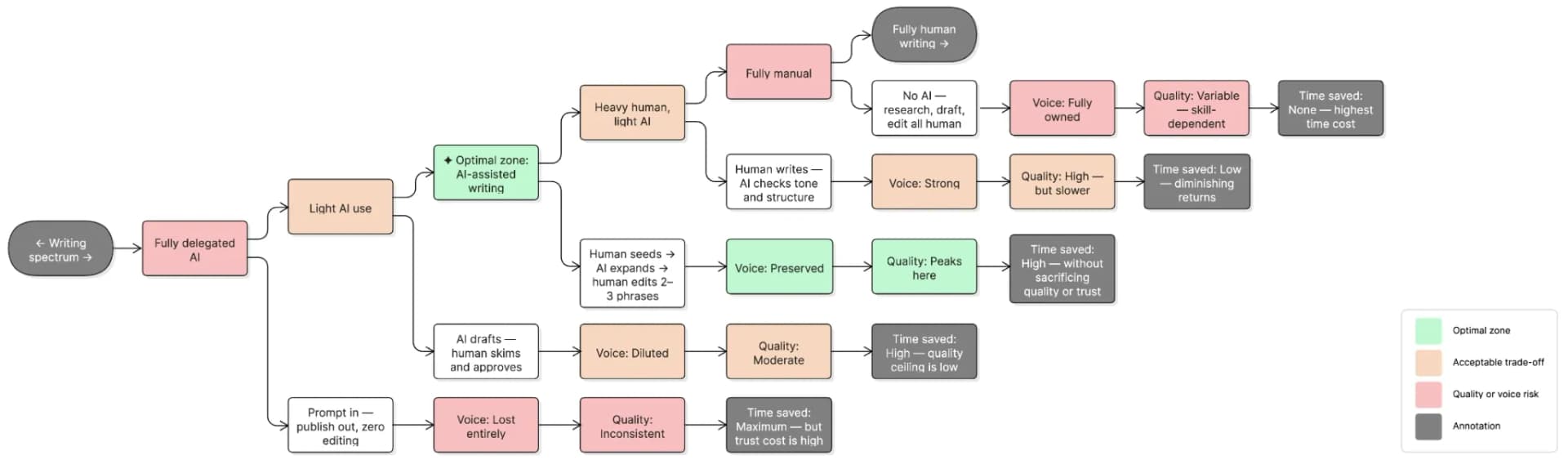
The Content Marketing Institute’s research on AI writing adoption consistently shows that the highest-quality AI-assisted output comes from writers who treat models as editors, not authors. The thinking stays human. The execution gets faster.
The Core Distinction to Internalizeℹ️
AI writing = prompt in, publish out. Fast, flat, forgettable.
AI-assisted writing = human thinking + AI execution + human editing.
The difference is not the model. It is who makes the judgment calls.
- Who supplies the original idea and angle? → Must be human
- Who decides the structure and argument? → Must be human
- Who does the mechanical expansion? → AI excels here
- Who does the final voice and fact pass? → Must be human
The Human-in-the-Loop Workflow: 5 Steps to Better Writing with AI
The best AI writing workflows share a common structure. They insert AI at specific, bounded points in the process and keep all judgment calls with the human editor. Every step below has a clear human input and a clear AI output, with no ambiguity about who owns the result.
You can refer to the following flowchart to visualize the complete workflow before diving into each step:
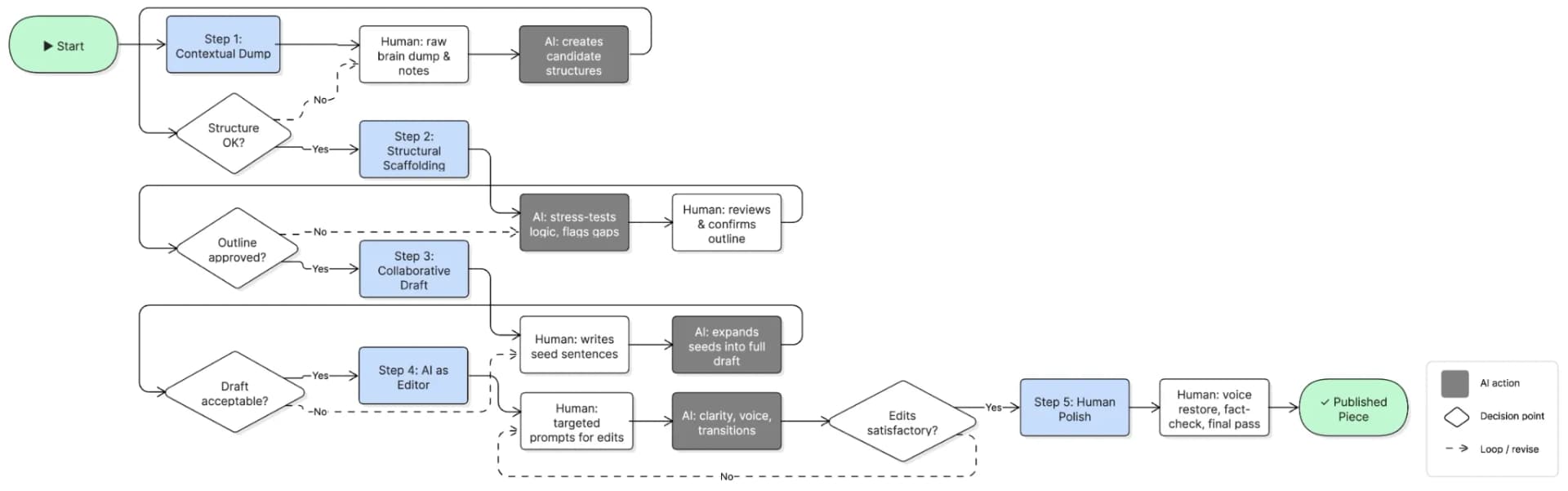
5-Step Human-in-the-Loop Writing Workflow✅
Step 1️⃣: Contextual Dump, Feed AI your raw, unstructured thinking, let it organize.
Step 2️⃣: Structural Scaffolding. Use AI to stress-test logic and surface gaps before drafting.
Step 3️⃣: Collaborative Draft, Write your own seed sentences; AI expands around them.
Step 4️⃣: AI as Editor, Targeted prompts for passive voice, transitions, clarity.
Step 5️⃣: Final Human Polish, Restore voice, add insight, cut padding, verify facts.
Step 1: The Contextual Dump
Start by giving the AI everything you know about the topic in whatever order it occurs to you – fragmented, half-formed, contradictory. Include your tentative angle, your audience assumptions, the one example you keep returning to, and the counterargument you are not sure how to address. Do not organize it. That is the AI’s job in this step.
Then ask, "Identify the core argument buried inside this material. Propose three possible structural approaches for a 1,500-word article. For each, note what it emphasizes and what it sacrifices.”
This step eliminates the paralysis of the blank page. You are not asking AI to write. You are asking it to organize what you already know. The ideas remain entirely yours. The architecture becomes visible. Once you have a structure you believe in, the actual drafting is two to three times faster.
Step 2: Structural Scaffolding
Once you have a rough structure, ask AI to stress-test it from the perspective of a skeptical reader. The most reliable prompt: “What questions does a skeptical, well-informed reader have after reading this outline that the current structure does not answer? List the five most important gaps.”
This surfaces logical weaknesses you cannot see because you are too close to the material. You know what is meant by each heading. A reader does not. AI, which has no insider context, approaches the outline the way a reader actually will.
A well-constructed argument before you write a single paragraph is worth more than three rounds of structural editing after the fact. Address the gaps at the outline stage, not the draft stage, and the draft becomes assembly rather than invention.
Step 3: The Collaborative Draft
This is the most important step and the one most commonly skipped. Do not ask AI to write the full draft. Write your own seed sentences for each section, the specific claim, example, or observation that only you can supply, and then ask the AI to expand around them.
A seed sentence for a section on email prompting might be "The mistake most writers make with AI email prompts is treating the email as the starting point rather than the ask.” That sentence contains your actual insight. Ask AI to expand it into a 150-word paragraph, and the result will reflect your thinking, not the average of the training data.
Without seed sentences, AI fills the space with its own default framing. With them, AI is building a structure around your idea. The distinction is the difference between a ghostwriter who interprets a brief and one who writes what you actually meant.
Step 4: AI as Editor
Once you have a draft, however rough, use AI as a targeted copyeditor. The crucial word is 'targeted'. Prompting for specific failure modes produces far better results than open-ended revision requests, because specific constraints give the model something to optimize against.
High-value targeted editing prompts:
- Identify every passive voice construction in this draft and rewrite each in active voice
- Flag every sentence longer than 25 words and propose two shorter alternatives for each
- Find the three weakest logical transitions and suggest specific replacements
- List every factual claim that is stated without a supporting example or specific detail
- Identify every paragraph where the first sentence does not state that paragraph’s main claim
- Find any places where the same idea is stated more than once and flag the weaker instance
Alongside AI editing, grammar tools like Grammarly handle surface-level corrections automatically. But the targeted prompt approach above addresses argumentative and structural weaknesses that grammar tools are not designed to catch. Use both in sequence: AI for structure and grammar tools for surface.
Step 5: Final Human Polish
The last pass belongs exclusively to the human writer. Add the specific example that requires lived experience and cannot be fabricated. Cut the paragraph AI expanded to meet a length without adding substance. Restore the sentence rhythm that reflects how you actually think. Verify every statistic and claim the AI introduced.
This step is not optional and cannot be abbreviated without visible cost to the quality of the output. Writers who skip it produce content that reads like AI-assisted writing. Writers who do it produce content that reads like theirs.
A practical rule: read the final draft out loud. Any sentence that does not sound like you belongs to one of two categories: it is either better than how you write and should stay, or it is flatter and should be rewritten. Make that judgment sentence by sentence.
Whether you are using a single model or comparing outputs across all three simultaneously with Lorka AI, the framework in this guide applies. The difference is how fast you find the best version.
Prompt Engineering for Writers: From Generic to Genius
The quality gap between mediocre and excellent AI writing assistance is almost entirely a prompting gap. Anthropic’s prompt engineering documentation and the broader literature on instruction tuning both arrive at the same conclusion: specificity drives quality.
The more constrained and precise the instruction, the less average the output. This is not a marginal improvement; it is the difference between the output you delete and the output you build on.
You can refer to the following diagram to understand how prompt quality maps to output quality:
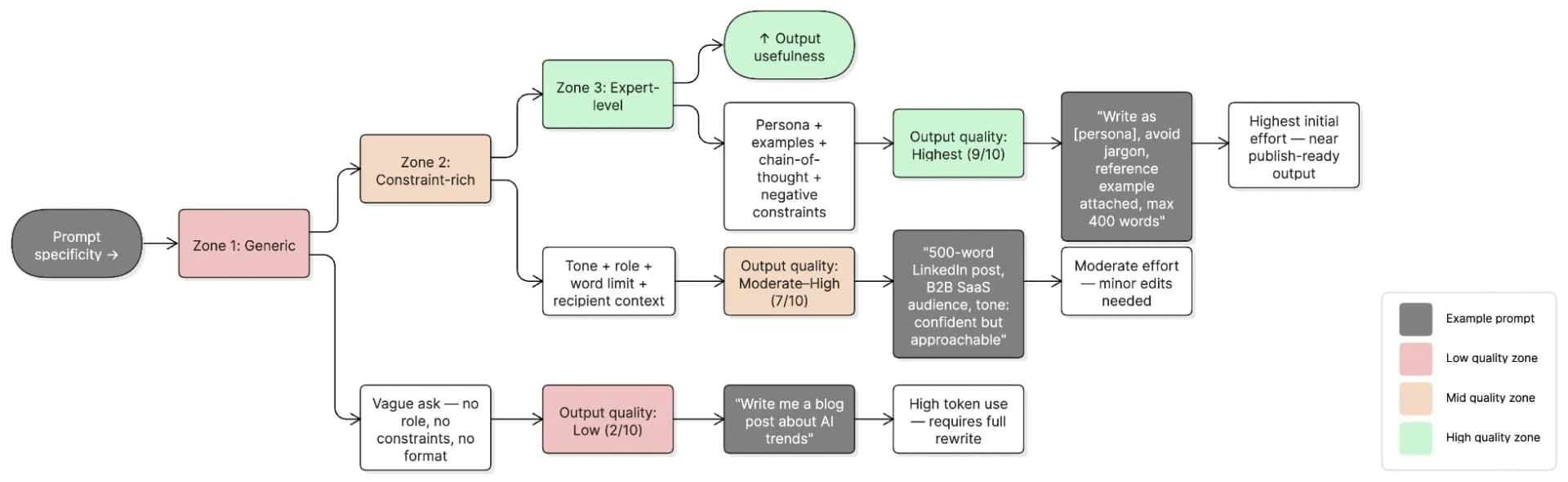
| Prompt Type | Example Prompt | What You Actually Get |
|---|---|---|
| Generic | Write a blog post about email marketing | A generic 5-point overview with no angle, no audience specificity, and no distinct perspective. Requires a complete rewrite. |
| Constraint-Rich | Write the opening 150 words of a post for B2B SaaS marketers arguing that open rates are a vanity metric. Tone: direct, slightly contrarian. Start mid-thought. No questions in the first sentence. | A specific, opinionated opening with an actual argument that is 70–80% publishable as a starting draft. |
| Expert-Level | You are a senior editor at a B2B tech publication. Rewrite this paragraph so that (1) the first claim is falsifiable, (2) every sentence is under 20 words, (3) there is no passive voice, (4) it ends on a concrete implication, not a summary. | Precision output targeting specific craft weaknesses. Often usable with minor edits. |
Using Personas for Tonal Control
When you need a specific register, formal, conversational, clinical, sardonic, or instructional, give the model a persona rather than an adjective.
“Write as a senior editor at The Economist reviewing this draft” produces more precise tonal guidance than “write in a professional tone" because the model has extensive exposure to what that editorial voice actually sounds like at the lexical and structural level.
Personas work best when they reference specific, recognizable editorial standards:
- Senior editor at The Economist
- Tech lead writing internal documentation for an engineering team
- Copywriter at a DTC brand known for sardonic product descriptions
All of these produce more consistent tonal outputs than generic adjectives like “professional” or "casual".
The persona acts as a bundled constraint set. You get word choice, sentence rhythm, level of formality, and argument style in one instruction, rather than having to specify each element separately.
Constraint-Based Prompting
Constraints produce better creative work than openness. This is true in human writing, and it is true in AI prompting. The mechanism is the same: constraints force attention away from default patterns and toward specific solutions.
The most effective constraint types for writing prompts:
- Length constraints: “First sentence under 10 words. Second sentence 20–25 words. Third sentence under 15 words.”
- Vocabulary constraints: “Do not use the words leverage, synergy, holistic, or innovative.”
- Format constraints: “No bullet points. No headers. Continuous prose only.”
- Structural constraints: “Each paragraph must make one claim and support it with one specific example.”
- Tonal constraints: “Do not use hedging language. Every sentence must assert something directly.”
Few-Shot Prompting with Your Own Writing Samples
If you want AI to match your voice, give it examples before making any request. Paste two or three paragraphs you have written that represent your style at its best. Ask the model to extract a style profile, sentence rhythm, vocabulary range, use of concrete versus abstract language, and characteristic sentence openers. Then require all output to conform to that profile.
This style transfer technique, documented in detail in Anthropic’s few-shot prompting guide, consistently produces the highest-fidelity voice matching of any technique available to writers in 2026.
The reason it works: the model now has a specific, concrete target rather than the average of its entire training distribution. Providing examples of the output you want is, in practical terms, the single highest-leverage action available in prompt construction.
Copy-Paste Prompt Template 1: Brainstorming
✍🏻 BRAINSTORM PROMPT
I'm writing about [TOPIC] for [TARGET AUDIENCE].
My angle is: [YOUR SPECIFIC ARGUMENT OR PERSPECTIVE].
Generate 10 counterintuitive sub-arguments I haven't considered.
For each, note:
- What type of reader would it resonate with most
- What evidence would make it defensible
- What assumption does it challenge
Do NOT generate generic points. Every item must challenge
a commonly held assumption about [TOPIC].
Copy-Paste Prompt Template 2: Targeted Editing
🖌️EDITING PROMPT
Edit the following text for clarity, concision, and argumentative strength.
Rules (non-negotiable):
1. No sentence longer than 22 words.
2. Remove every instance of passive voice.
3. Replace every abstract noun with a concrete equivalent.
4. Flag the two weakest sentences and explain exactly why.
5. Do not add new information; only sharpen what is here.
6. Preserve the author's vocabulary range and sentence rhythm.
TEXT: [PASTE YOUR DRAFT HERE]
Copy-Paste Prompt Template 3: Voice-Matched Rewrite
🗣️ VOICE REWRITE PROMPT
Here are three paragraphs I wrote that represent my writing at its best:
[PASTE YOUR SAMPLE PARAGRAPHS]
Analyze: sentence length pattern, vocabulary level, use of concrete vs
abstract language, characteristic openers, and transitional style.
Now rewrite the following paragraph to match that style exactly.
Preserve all factual claims. Do not add information.
PARAGRAPH TO REWRITE: [PASTE TARGET PARAGRAPH]
Copy-Paste Prompt Template 4: Structural Stress-Test
👀 STRUCTURE REVIEW PROMPT
Read the following outline for a [TYPE] piece targeting [AUDIENCE]:
[PASTE YOUR OUTLINE]
Act as a skeptical, well-informed reader encountering this content.
Identify:
1. The five questions a skeptical reader will have that this structure
does not answer.
2. The two sections most likely to lose reader attention and why.
3. One structural alternative that would make the argument stronger.
Be specific. Do not give generic feedback.
Strategic Use Cases: When to Call for AI Writing Help
AI is not equally useful at every point in the writing process or across all content types. These are the five scenarios where AI helps with writing to produce the clearest, most consistent returns on the time invested in prompting.
AI Help Writing Emails and Professional Correspondence
Email is where AI writing assistance delivers the fastest, most measurable ROI. The format is highly constrained, the stakes are often significant, and the cost of the wrong tone is immediate. A misfired email to a client or executive is not recoverable the way a blog post is.
The most reliable formula: write the core ask in one plain sentence yourself, then ask the AI to structure the full email around it. The intent stays human. The structure is AI-assisted. The result avoids the robotic phrasing that emerges when the entire message is fully delegated.
The Email Writing Formula That Consistently Worksℹ️
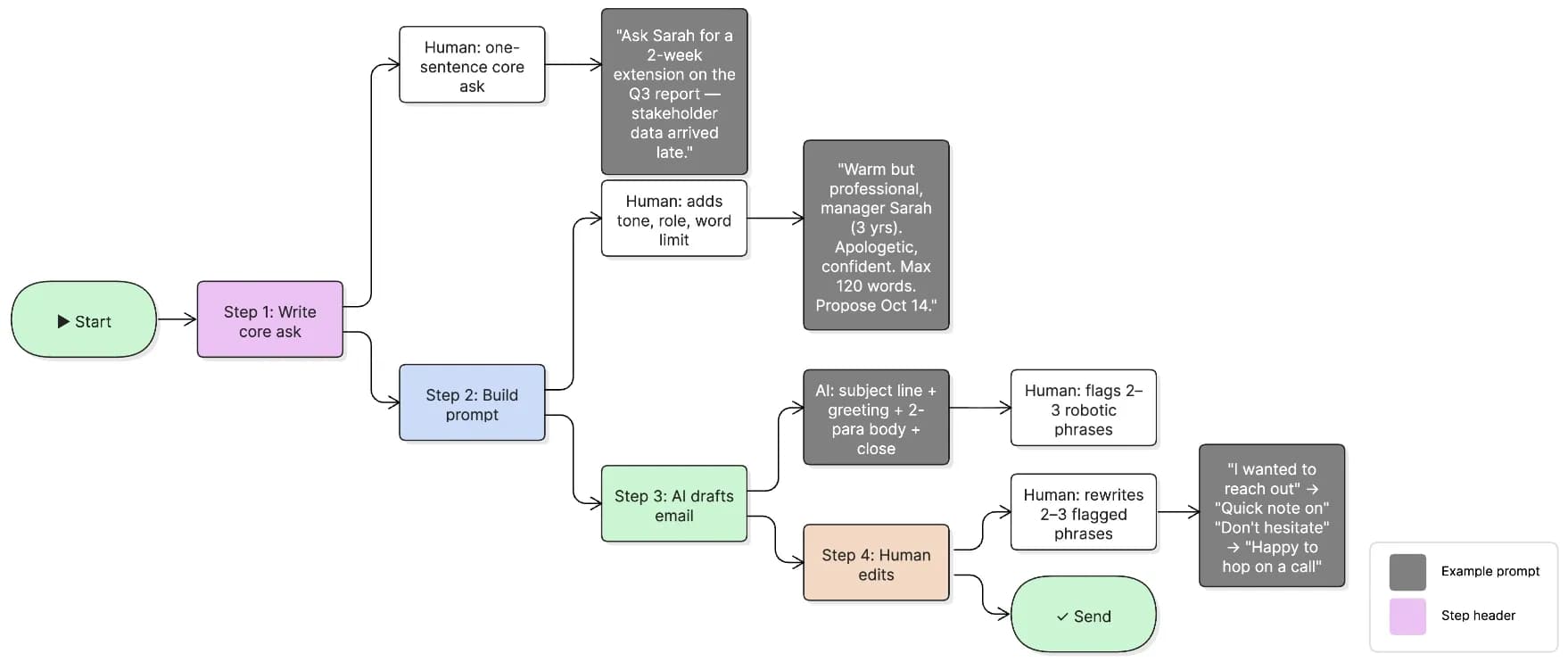
Step 1: Write your core ask in one sentence: what you need, from whom, by when.
Step 2: Prompt exactly as follows:
“Draft a [follow-up / update / proposal] email to [recipient relationship].
Core ask: [your one sentence]. Tone: [warm/direct/formal].
Max 120 words. No generic opener. End with one clear next step.”
Step 3: Edit the output for 2–3 phrases that still read as machine-generated.
For recurring types (project updates, meeting recaps, client follow-ups):
• Build a dedicated prompt template for each type with context pre-filled
• Include one previous email you wrote as a style reference in the prompt
• Set a hard word limit; AI padding is most visible in email
For teams managing high email volumes across multiple senders, Notion AI integrates email drafting directly into workspace documents, useful for project communication templates where consistency of tone across team members matters.
You can refer to the following diagram to see the recommended email prompting workflow from ask to send:
Overcoming Creative Blocks
The blank page problem is, at its root, a constraint problem. You have not given yourself enough parameters to push against. When blocked, the worst thing you can do is stare at the page waiting for inspiration. The second worst is asking AI to “write something about X” without parameters.
The most reliable unblocking technique: ask AI to generate five incompatible opening sentences for your piece. They should contradict each other in tone, angle, and structure. Then write a sixth that reacts to, argues with, or synthesizes one of them.
You are not publishing the AI’s output. You are using it as productive friction to provoke your own response. The best writing often comes from arguing with a bad first sentence. Disagreement is generative. Use the model as the provocation.
Simplifying Complex Technical Concepts
Give AI your most jargon-heavy paragraph and ask for three versions: one for a domain expert who knows the field deeply, one for a smart non-specialist, and one for someone with no technical background at all. Then use a readability tool like Readable to score the reading level of each version and confirm you actually hit the target register.
The non-expert version almost always reveals something. If AI cannot simplify a claim without making it inaccurate or without losing something essential, the original claim may not be as clearly understood by you as you assumed.
Simplification is a test of conceptual clarity, not just vocabulary.
This technique is particularly powerful for technical writers, product marketers, and anyone translating domain expertise for a broader audience, a group that includes nearly every professional writer in 2026.
Rewriting for Audience, Tone, or Reading Level
When you need the same core content adapted for different contexts, an executive summary versus a technical brief, a LinkedIn post versus a whitepaper section, or an internal memo versus a public-facing article, AI eliminates the redundant rewriting work. Write the canonical, fully developed version once. Then prompt for audience-specific adaptations.
For writers who want to compare how different frontier models handle the same adaptation task before committing to a tool, Lorka AI makes that cross-model comparison practical in under a minute.
Building a Persistent Prompt Library
The compounding advantage of AI-assisted writing comes from building a prompt library over time. Every time you write a prompt that produces genuinely useful output, save it with a descriptive label and the context it works best in.
After six weeks of deliberate AI-assisted writing, you should have 20 to 30 prompts that reliably produce strong output for your most common writing tasks, your standard email types, your section-level editorial prompts, your tonal rewrite templates, and your brainstorming formats. This prompt library is the actual productivity asset.
The model is the execution layer. You are the engineer.
This is why writers who have been deliberately using AI for a year consistently outperform writers who are new to it, even when both have access to the same models: the experienced writer has a tested library of prompts calibrated to their specific voice and use cases.
The Best AI to Help with Writing in 2026
Model choice matters in ways that most writing guides understate. Different models have genuinely different strengths across writing-specific dimensions, and defaulting to one model for all tasks consistently underperforms a deliberate, task-matched approach.
| Dimension | Claude Sonnet 4.6 | GPT-5.5 | Gemini 3.1 Pro |
|---|---|---|---|
| Writing Style | Natural, nuanced, varied sentence cadence; strongest tonal range across all three models | Structured, precise, consistent; excels at instruction-following and clean logical prose | Fluid and research-integrated; strongest at synthesizing voice across multiple source inputs |
| Best Use Case | Blog posts, essays, email, creative non-fiction, tone-sensitive client content | Technical writing, structured reports, proposal documents, and content transformation tasks | Whitepapers, research briefs, long-form synthesis, and content requiring breadth of sources |
| Rewriting Strength | Exceptional for tonal preservation and voice matching; best for style-transfer tasks | Strong for structural clarity and logical restructuring; best for argument tightening | Good for restructuring long-form content; best when source material needs synthesis |
| Outlining Strength | Strong for narrative arcs and argument flows; good at identifying emotional structure | Excellent for hierarchical logical structures; best for complex multi-section frameworks | Strong when pulling structure from reference material or research outputs |
| Research Strength | Moderate; strong analysis, weaker on citation depth and source variety | Strong reasoning chains and evidence synthesis; good factual accuracy | Strongest across all three; excels with 1M+ token contexts and multi-document synthesis |
| Best Fit By Content | Any content where voice, rhythm, and tonal specificity determine quality | Any content where logical structure, precision, and technical accuracy are primary | Any content requiring the synthesis of multiple sources or the management of long inputs |
| Weakest Area | Can drift from technical precision when prioritizing flow | Can produce mechanically correct but tonally flat prose in creative contexts | Can over-hedge in contexts requiring direct, assertive voice |
Disclaimer: Based on hands-on testing across common writing tasks; your results may vary by prompt and use case.
Model documentation worth consulting before committing to a workflow:
- Anthropic’s Claude documentation covers prompt formatting and few-shot construction
- OpenAI’s GPT-5.5 product page covers structured output and function calling
- Google’s Gemini overview covers multimodal and long-context capabilities in detail
Writers who want an evidence-based routing strategy before building any workflow can run their most representative prompts through all three models simultaneously using Lorka AI.
The benchmark results provide task-specific performance data across writing, summarization, and editing, far more actionable for writers than generic benchmark leaderboards built for coding tasks.
How to Improve Your Writing Without Losing Your Voice
The most consistent complaint about AI-assisted writing is that everything starts sounding the same. This is not a model limitation. It is a workflow problem, and it has reliable solutions.
Style Injection: The Core Technique
Style injection is the most reliable and highest-leverage technique for voice preservation. Before every writing session, paste two or three paragraphs of your own work that represent your style at its best.
Ask the model to extract a style profile:
- average sentence length
- short-to-long sentence ratio
- vocabulary range (formal vs. colloquial, abstract vs. concrete)
- use of rhetorical questions
- characteristic transitional patterns; and preferred paragraph structure
Then require every AI-generated output in that session to conform to that profile. You now have a specific target rather than the average of the model’s training distribution. The difference in output quality is significant and consistent.
Build this into your prompt template library. Every major prompt you write should begin with your style sample and the extracted profile. This adds thirty seconds to prompt construction and saves five minutes of voice-restoration editing per section.
Reverse Outlining
Reverse outlining is a technique borrowed from academic editing. After receiving AI output for any substantial section, ask the model to extract the underlying argument structure as a numbered outline. Then compare that outline to what you originally intended.
The gap between the intended outline and the extracted one reveals precisely where the AI drifted from your thinking. This almost always happens in sections where your original seed sentence was vague or underspecified. The reverse outline makes that causal relationship visible: vague seed, large drift; specific seed, small drift.
Use this diagnostic to improve your seeding practice over time. The sections that consistently diverge are the sections where your own thinking is least developed. The AI is not drifting. It is filling a gap you left.
Preserving Sentence Rhythm and Cadence
Sentence rhythm is the most invisible and most impactful element of voice. Readers do not consciously notice it, but they notice when it is gone. AI defaults to a medium-length sentence rhythm with predictable stress patterns. If your natural voice uses shorter declarative sentences followed by longer elaborations, that pattern disappears in unguided AI output.
The solution is explicit structural instruction at the paragraph level: “Rewrite this paragraph so the first sentence is under 10 words, the second expands the idea in 20–25 words, and the third delivers the key insight in under 15 words.”
Rhythm is architecture. When you give it explicit parameters, AI can replicate it. When you leave it open, AI defaults to its own, and its own is the statistical average of all the text it has ever processed.
Before and After: AI-Assisted Rewriting in Practice
The following examples show the same content before and after a targeted AI editing pass. In each case, the prompt included the writer’s style sample and specific constraint instructions.
Example 1: Clarity and Active Voice Edit:
| BEFORE | AFTER |
|---|---|
| The implementation of the new onboarding system was completed by the product team in a manner that was generally considered to be successful by most of the relevant stakeholders who were involved in the review process. | The product team deployed the new onboarding system successfully. Every stakeholder in the review signed off. |
Example 2: Tonal Rewrite (Formal → Direct and Conversational):
| BEFORE | AFTER |
|---|---|
| It is recommended that users avail themselves of the available platform features in order to optimize their experience and achieve the desired workflow outcomes that the platform was designed to support. | To get the most out of the platform, use the features built for your workflow. They’re there for a reason, use them. |
Example 3: Technical Simplification (Expert → Smart Generalist):
| BEFORE | AFTER |
|---|---|
| The transformer architecture’s self-attention mechanism enables the model to compute contextual representations by weighing token relationships across the full sequence length of the input. | The model reads every word in the document simultaneously and calculates how much each word should influence the meaning of every other word. That’s how it understands context across a long piece of text. |
Example 4: Weak Opening → Mid-Thought Strong Entry:
| BEFORE | AFTER |
|---|---|
| In today’s rapidly evolving digital landscape, content marketing has become an increasingly important strategy for businesses looking to reach their target audience effectively. | Most content marketing advice assumes the hard part is creating content. It isn’t. The hard part is creating content that earns the next click. |
Common Pitfalls: Why AI Writing Help Can Hurt Quality
AI writing assistance can actively damage content quality when the workflow is wrong. These failure modes are not hypothetical; they are the patterns that produce the most complaints about AI writing in professional settings.
The 6 Most Dangerous AI Writing Habits ⚠️
- Publishing raw AI output without a voice pass and fact verification
- Using vague editing prompts (‘make this better’) instead of targeted ones
- Treating AI-generated statistics and citations as accurate without checking
- Pasting sensitive client or business data into a public AI interface
- Running so many editing passes that all personality is smoothed out
- Asking AI to ‘write in your voice’ without providing actual voice samples
Hallucinations And False Confidence
All major models, Claude, GPT-5.5, and Gemini, will state incorrect statistics, misattribute quotes, and invent citations with complete grammatical confidence. No model is exempt from hallucinations. Every factual claim that matters requires independent verification before publication. This rule has no exceptions.
Average Tone And Style Flattening
Without explicit constraints, AI produces output optimized for the average reader. Average in vocabulary level. Average in sentence rhythm. Average in argument structure.
“Average” for a model trained on the internet means corporate-brand, hedging, and tonally uniform. The cure is embedding your style sample and tonal constraints in every prompt. No constraints, no distinctiveness.
The Over-Editing Trap
Each additional AI editing pass risks removing what made the piece distinctive. After the third AI editing pass, the prose is clean but characterless.
Set a hard limit: three AI editing passes maximum, followed by one mandatory human voice-restoration pass where you read the output against your style sample and restore anything that was flattened.
Privacy And Data Exposure
Public AI interfaces process and may log the content you submit. Do not paste sensitive client information, confidential business strategy, unreleased product details, or personal data into a public model interface.
Review Anthropic’s usage policies and your organization’s AI governance guidelines before using AI for commercially sensitive work.
Misaligned Tool Selection
Using the wrong model for a task is a consistent source of suboptimal output. Using Claude Sonnet 4.6 for technical documentation that requires precise structural logic may produce beautiful prose with weak architecture. Using GPT-5.5 for a personal essay that requires voice and cadence may produce perfectly organized flatness.
Match the model to the task. Test before committing.
Lorka AI: A Unified Workspace for Writers
The practical challenge with multi-model writing workflows is friction. Switching between three browser tabs, maintaining separate context windows, and copying and pasting outputs for comparison, it is slow, cognitively expensive, and easy to lose track of which output came from where.
Lorka AI solves this by letting writers run the same prompt across Claude Sonnet 4.6, GPT-5, and Gemini 3.1 Pro simultaneously, with outputs displayed side by side in a single workspace. No tab-switching. No context re-establishment needed. No output hunting.
What Writers Use It For
For writing workflows specifically, Lorka enables:
- Parallel rewriting: Submit the same rewriting prompt to all three models and cherry-pick the strongest phrasing from each. One model’s opening sentence + another’s supporting structure + the third’s closing insight.
- Style-matching tests: Run the same voice-injection prompt across all three and compare which model produces the closest match to your style sample before committing to that model for a full draft.
- Brainstorm merging: Run a brainstorming prompt across all three simultaneously. Models produce different sets of counterintuitive angles. Take the non-overlapping insights from each, and you have a richer idea set than any single model produces alone.
- Prompt calibration: Test a new prompt constraint across models. If all three produce similar improvements, the constraint is working. If only one improves, the constraint may be model-specific.
Writers who use multi-model comparison via Lorka AI consistently produce better outputs in less time than writers committed to a single model, not because any one model is insufficient, but because each model has genuine blind spots that the others do not share. Using Lorka’s benchmark data before building a prompt library helps you identify which model to default to for your most common writing task types, so you are not running full three-model comparisons every time.
Access to all frontier models starts at $19.99/month. For writers evaluating purpose-built tools like Jasper or Copy.ai, Lorka’s differentiator is model flexibility: rather than inheriting one model’s defaults and limitations, you use the right model for the right task, informed by direct comparison.


Find the Best AI Model for Every Writing Task
Compare Claude, GPT, Gemini, and more side by side to improve writing quality, preserve your voice, and build a faster AI-assisted workflow.
Create Better ContentConclusion: AI as Editorial Partner, Not Author
The single most important mental shift in AI help with writing is treating the model as a collaborative editorial partner rather than an autonomous author.
The thinking is yours. The argument is yours. The voice is yours.
The AI handles friction reduction: structural scaffolding, mechanical revision, synonym variety, and audience adaptation. That division of labor, consistently maintained, produces writing that is both faster and better than either purely manual or purely AI-generated output.
Writers who master this approach in 2026 will produce better work faster than writers without AI and significantly better work than writers who outsource the thinking entirely. The winning method is human-in-the-loop at every critical decision point: what to say, how to frame it, what to cut, and whether the final output actually sounds like you.
Start with the five-step workflow. Build a prompt library over the next two weeks. Use Lorka AI to compare outputs across Claude Sonnet 4.6, GPT-5, and Gemini 3.1 Pro before committing to a single-model workflow. The investment is two weeks of deliberate practice. The return is a writing process that compounds for as long as you use it.
FAQs About AI Writing Help
No, in the same way that using a spellchecker, a grammar tool, a thesaurus, or an editor is not cheating. AI is a writing instrument.
The ethical question is context and transparency: if the context requires original unaided human authorship, academic submissions under examination conditions, journalism attributed entirely to a named writer, or certain creative competitions, you must disclose AI involvement or refrain from using it.
For the vast majority of professional writing in 2026, AI assistance is accepted and increasingly expected as a standard part of the craft.