

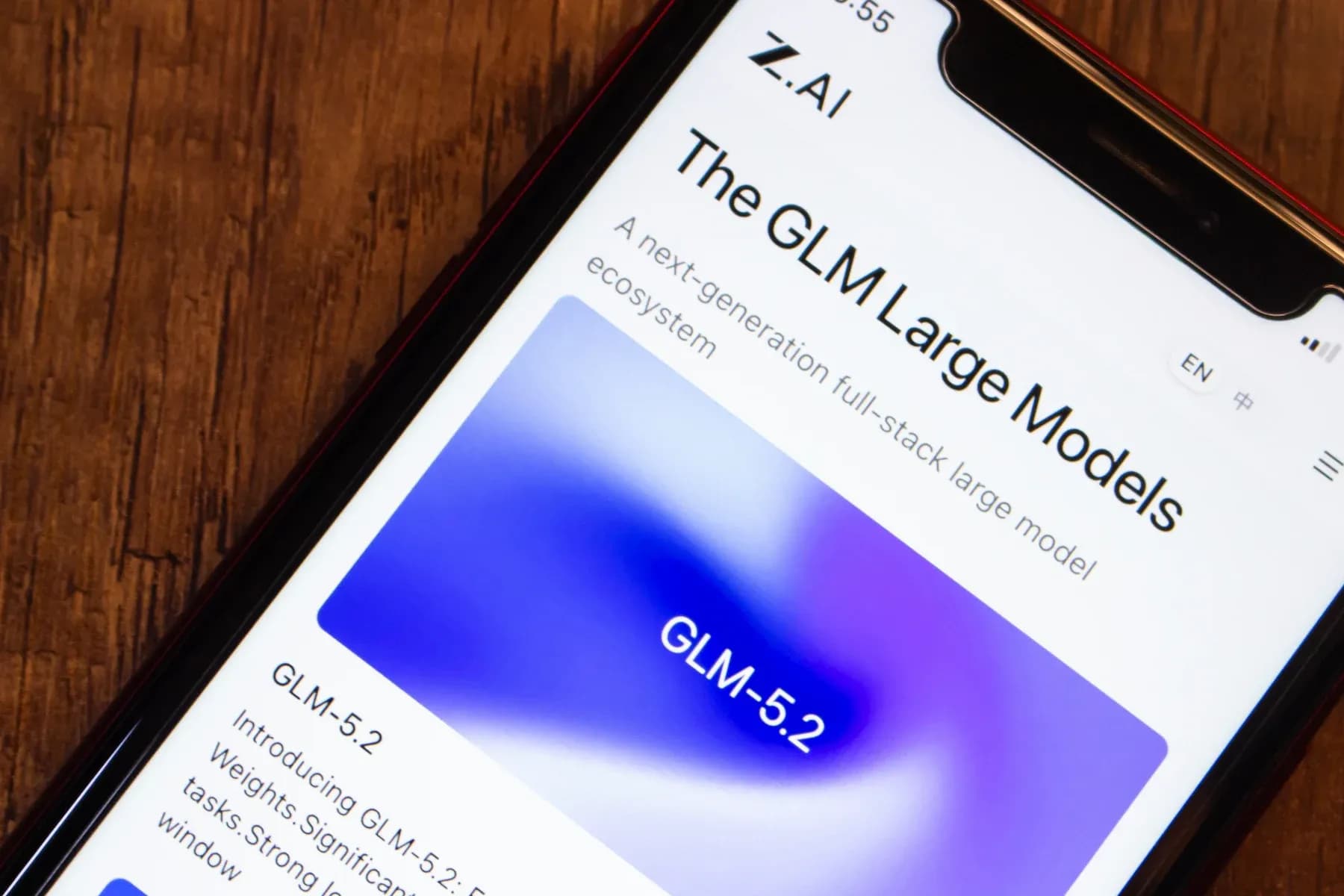
What Is GLM? (The Model Family)
GLM (General Language Model) is a family of large language models built by Z.ai. The company was formerly known as Zhipu AI, which is a Beijing-based lab.
GLM's first open-weight model was released in 2024, with the latest model, GLM 5.2, being released in June 2026.
GLM-4 (2024)
Early general-purpose foundation model
GLM-4.5 (2025)
Released around the same time, the company rebranded internationally to Z.ai
GLM-5 (Feb 2026)
A major-scale jump to a much larger mixture-of-experts architecture
GLM-5.2 (June 2026)
The current flagship, refined specifically for long-horizon coding and agentic work
GLM 5.2 in a Nutshell
The GLM AI model is a large-scale, open-weight AI model built on a mixture-of-experts (MoE) architecture. The model is designed to handle unusually long and complex tasks without losing track of context.
- Developer: Z.ai (formerly known as Zhipu AI)
- Scale: 744 billion total parameters, with around 40 billion active per task
- Context window: Up to 1 million tokens
- License: MIT, open weights available for download and self-hosting
- Best suited for: Long, repository-scale coding projects, multi-document reasoning, and autonomous agent workflows
Put simply, GLM 5.2 is built for teams that need frontier-level reasoning over huge amounts of context without being tied to a single vendor's API.
GLM 5.2 Open Weight Model Architecture and Key Features
GLM 5.2 uses a mixture-of-experts (MoE) design that routes each task to a smaller subset of specialized "experts" rather than activating the entire network each time, keeping inference faster and cheaper despite the model's huge total size.
Its headline feature is a 1-million-token context window, letting it hold an entire codebase or hundreds of pages of documents in memory at once without needing to summarize or re-upload chunks.
| Feature | How it works |
|---|---|
| Architecture | Sparse-attention mixture-of-experts (MoE) |
| Total parameters | 744 billion |
| Active parameters | ~40 billion per task |
| Context window | Up to 1 million tokens |
| IndexShare | Reuses one lightweight indexer across every 4 layers, cutting per-token compute at long context |
| Multi-token prediction | Predicts several tokens per step instead of one, speeding up output |
| Reasoning modes | "High" for everyday tasks, "Max" for harder, multi-step problems |
| Long-horizon design | Tuned to stay accurate and on track across extended, multi-step agentic tasks |
GLM 5.2 vs. GPT-5.5 and Opus Benchmarks
GLM 5.2 is the strongest open-weight model tested to date; however, it still trails the very top closed models, such as ChatGPT and Claude Opus, on raw reasoning.
| Benchmark | GLM 5.2 | Claude Opus 4.8 | GPT-5.5 |
|---|---|---|---|
| SWE-bench Pro | 62.1 | 69.2 | 58.6 |
| FrontierSWE (long-horizon coding) | 74.4 | 75.1 | 72.6 |
| Terminal-Bench 2.1 (best reported) | 82.7 | 78.9 | 83.4 |
| Design Arena (Elo) | 1360 | — | 1280 |
The most notable result is on long-horizon, repository-scale coding. On the FrontierSWE test, which measures how well a model handles messy, real-world engineering work over many steps, GLM 5.2 trails Claude Opus 4.8 by only about 1%, while edging ahead of GPT-5.5. For an open-weight model, that's a genuinely narrow gap to the closed frontier.
GLM 5.2 also stands out in areas where coding models don't usually excel: design and visual judgment. It currently holds the top spot on the Design Arena leaderboard, with human reviewers often preferring its feedback on UI and UX work over GPT-5.5's.
That said, on the toughest, marathon-length engineering benchmarks, the gap to Opus 4.8 widens considerably, so GLM 5.2 isn't a drop-in replacement for every advanced use case. Among other open-weight models such as DeepSeek and Qwen, it's widely regarded as the leader.
Why GLM 5.2 Matters (Open-Weight and Licensing)
Released under the MIT license with fully downloadable weights, GLM 5.2 allows organizations to self-host the model. This keeps sensitive data entirely in-house rather than routing it through third-party APIs.
| Feature | Open-weight (GLM 5.2) | Closed API (GPT, Claude) |
|---|---|---|
| Access | Download and self-host | Rented via vendor's API |
| Customization | Full fine-tuning of the weights | Limited to prompting/fine-tuning options offered |
| Data handling | Can stay entirely on your own infrastructure | Routed through the provider's servers |
| Pricing/access | Fixed once downloaded | Can change with vendor policy |
GLM 5.2 vs. Claude Opus 4.8, GPT-5.6, and Other Models
From a distance, GLM, Claude, and ChatGPT look similar, as they are all general-purpose LLMs built for tasks like coding and handling large amounts of context.
The real differences between these models come down to ownership, licensing, and how you're allowed to deploy them.
When Should You Use or Care About GLM 5.2?
GLM 5.2 isn't the right fit for every team, but the model can be extremely useful in a few specific situations:
GLM 5.2 Use Casesℹ️
- You need to self-host models for data privacy, compliance, or jurisdiction reasons
- You're building long-horizon coding agents that need to reason over an entire codebase at once
- You want to avoid depending on a single closed API for critical workflows
- You're in a region where access to certain closed models is limited or uncertain
That said, there are real trade-offs, such as running GLM 5.2 yourself, which means owning the infrastructure (it requires serious GPU hardware), managing your own safety and update cycles, and accepting a smaller tooling ecosystem than established closed providers.
How GLM Fits into a Multi-Model Workflow
No single model wins at everything. GLM 5.2 excels at long-context coding and self-hosted flexibility, while GPT-5.6 and Claude Opus 4.8 lead in other areas like tool integration and enterprise reasoning.
But teams don't have to be stuck using only one model, and that's exactly what Lorka AI is built for. With Lorka, you can:
- Work with multiple top models in a single workspace, such as Claude, ChatGPT, Gemini, and more, without juggling separate accounts or APIs
- Compare outputs side by side to see which model actually handles your task best
- Stay future-ready as new open-weight models like GLM continue to join the frontier conversation
As GLM-style models mature, Lorka AI aims to make them just as accessible as GPT or Claude.


Compare GLM 5.2 with Top AI Models
Test GLM 5.2 alongside GPT, Claude, Gemini, and more in one workspace to find the best model for every task.
Try LorkaFAQs about GLM 5.2
GLM 5.2 is a large, open-weight AI model from Z.ai built for coding and long, complex tasks. It combines a 1 million token context window with performance that rivals closed models like GPT and Claude.