


For developers, AI teams, and product managers evaluating models in 2026, the key question is rarely, "Which model is the most powerful?" Instead, the practical decision is which model delivers the best balance between capability, cost, and speed for real-world applications.
Historically, flagship models like Opus have provided clearly superior reasoning capabilities, but they also come with significantly higher inference costs.
With Claude 4.6, Anthropic appears to have narrowed that gap considerably. Sonnet 4.6 achieves near-flagship performance on several practical benchmarks while costing roughly five times less than Opus, making it an attractive default model for many production systems.
In other words, instead of running every request through the most expensive model available, organizations can route the majority of workloads to Sonnet while reserving Opus for the small percentage of tasks that require deeper reasoning.
Claude Sonnet 4.6 vs Opus 4.6 – Quick comparison
| Aspect | Winner | Explanation |
|---|---|---|
| Coding (SWE-bench) | Sonnet 4.6 | Nearly matches Opus while costing ~5× less |
| Scientific reasoning (GPQA Diamond) | Opus 4.6 | Strong lead in PhD-level science reasoning |
| Cost efficiency | Sonnet 4.6 | ~$3/$15 vs ~$15/$75 per million tokens |
| Latency/speed | Sonnet 4.6 | Faster responses for production workloads |
| Complex reasoning | Opus 4.6 | Better multi-step reasoning and analysis |
For example, consider a company building an AI coding assistant for internal developer workflows. Most requests in that environment involve tasks such as the following:
- generating helper functions
- explaining code snippets
- fixing syntax errors
- writing documentation
These tasks require strong language understanding and coding ability, but they rarely require extremely deep reasoning. In such cases, Sonnet 4.6 provides nearly identical output quality to Opus while dramatically reducing operational cost.
On the other hand, imagine a research team asking the model to analyse complex scientific data, derive theoretical explanations, or reason about multi-step security vulnerabilities in a large system architecture.
These problems require long chains of reasoning and high factual precision, which is where Opus typically performs better.
Key Takeaways⭐
- Claude Sonnet 4.6 is the best default model for most tasks (fast + cost-efficient).
- Claude Opus 4.6 is built for deep reasoning and complex analysis.
- Sonnet delivers near-Opus performance at ~5× lower cost.
- The biggest gap appears in scientific and multi-step reasoning tasks.
- A hybrid approach (Sonnet + Opus) gives the best balance of cost and performance.
- Adaptive Thinking lets Sonnet handle some complex tasks more efficiently.
- Most production workloads (70–90%) can run on Sonnet.
- Model routing is becoming the standard architecture for AI systems.
Typical model deployment strategy
| Task Category | Recommended Model |
|---|---|
| Code generation and debugging | Sonnet 4.6 |
| Content generation and summarization | Sonnet 4.6 |
| Knowledge retrieval (RAG systems) | Sonnet 4.6 |
| Scientific reasoning | Opus 4.6 |
| Security analysis | Opus 4.6 |
| Multi-step planning tasks | Opus 4.6 |
In practice, this means that Sonnet becomes the default engine for most requests, while Opus functions as a specialised reasoning layer that is triggered only when necessary.
Many organizations implement this logic using an LLM router, which automatically decides which model should handle each request based on task complexity.
Platforms such as Lorka allow teams to route prompts across multiple models without rewriting their applications, helping them optimize both performance and cost.
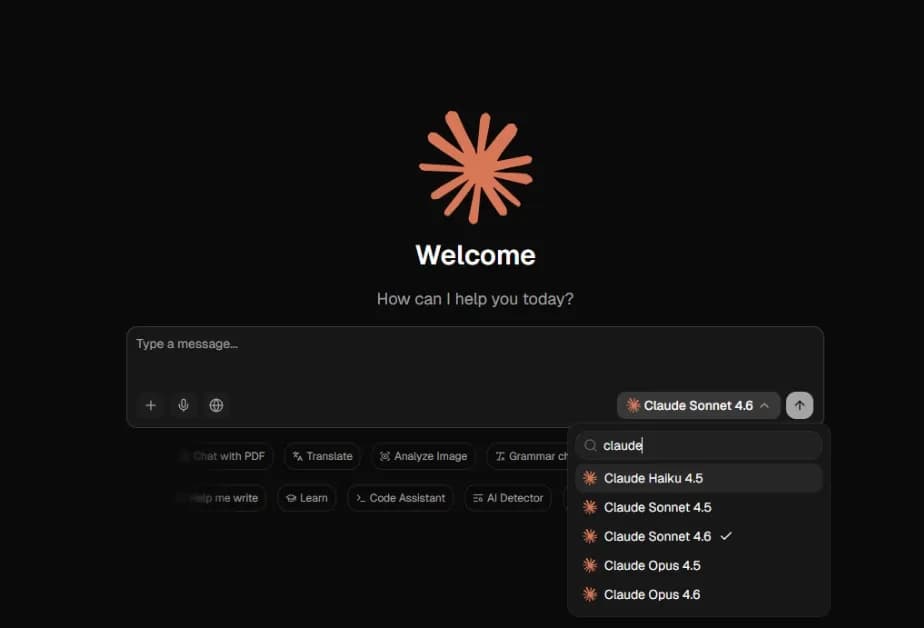
Full Benchmarks Head-to-Head
Benchmarks provide one of the most useful ways to compare large language models because they measure performance across standardised tasks. While no benchmark perfectly reflects real-world use cases, they still offer valuable insight into where a model performs best and where its limitations appear.
For modern AI systems, several benchmarks have become particularly important because they evaluate capabilities that directly affect production applications.
The table below summarises how Claude Sonnet 4.6 and Claude Opus 4.6 perform across these evaluations.
Claude 4.6 benchmark comparison
| Benchmark | Sonnet 4.6 | Opus 4.6 | What It Tests |
|---|---|---|---|
| SWE-bench | 79.6% | 83.0% | Real GitHub bug fixes and coding tasks |
| GPQA Diamond | 74.1% | 91.3% | Expert scientific reasoning |
| OSWorld | 72.5% | 72.7% | Computer automation tasks |
| MMLU-Pro | 80.4% | 86.2% | Multidisciplinary academic knowledge |
| TAU-bench | 74% | 79% | Tool usage and structured workflows |
Coding performance: A surprisingly small gap
One of the most interesting findings appears in SWE-bench, a benchmark designed to simulate real software engineering tasks by evaluating whether a model can fix actual issues in open-source repositories.
In SWE-bench, the tasks go far beyond simple coding problems. A typical task requires the model to:
- Understand the problem: Interpret a real GitHub issue, which may be vague, incomplete, or require implicit assumptions to identify what is actually broken.
- Navigate a real codebase: Work across multiple files, classes, and dependencies in complex repositories such as Django or scikit-learn—far from toy examples.
- Debug effectively: Trace logic across different parts of the code to identify the root cause of the issue.
- Write a fix (patch): Modify existing code while maintaining consistency with the broader codebase, rather than simply generating new code in isolation.
- Pass tests (critical requirement): The solution is validated by running the repository’s test suite; tests must fail before the fix and pass after it for the task to be considered successful.
This setup makes SWE-bench a strong proxy for real engineering work, as it evaluates not just code generation but also reasoning, debugging, and integration within existing systems.
Here, the difference between the two models is relatively small:
| Model | SWE-bench Score |
|---|---|
| Sonnet 4.6 | 79.6% |
| Opus 4.6 | 80.8% |
While Opus technically leads, the difference is only a few percentage points. When combined with the cost difference between the models, this makes Sonnet extremely attractive for development workflows.
For example, imagine a company running 100,000 coding-related requests per day through an internal AI assistant. If they rely exclusively on Opus, the cost could be several times higher than using Sonnet while delivering only marginal improvements in output quality.
Scientific reasoning: Where opus dominates
The largest performance gap appears in GPQA Diamond, a benchmark specifically designed to test expert-level reasoning in scientific fields such as physics, chemistry, and biology.
The scores reveal a significant difference:
| Model | GPQA Diamond |
|---|---|
| Sonnet 4.6 | 74.1% |
| Opus 4.6 | 91.3% |
This roughly 17-point gap suggests that Opus is significantly better at handling questions that require the following:
- deep conceptual reasoning
- multi-step problem-solving
- advanced technical knowledge
For instance, tasks such as analysing a research paper, explaining a complex mathematical proof, or evaluating scientific hypotheses may require the additional reasoning depth that Opus provides.
Real-world automation: Nearly identical results
Another interesting result appears in the OSWorld benchmark, which measures how well AI models perform tasks that resemble real computer usage.
These tasks may include:
- navigating software interfaces
- completing step-by-step workflows
- interacting with structured data
In this benchmark, the difference between the two models is almost negligible:
| Model | OSWorld Score |
|---|---|
| Sonnet 4.6 | 72.7% |
| Opus 4.6 | 73.0% |
What the benchmarks mean for production systems
Taken together, these results suggest that the best strategy is rarely to choose only one model.
Instead, many organizations adopt a hybrid model architecture.
In this architecture:
- Most requests are processed by Sonnet 4.6
- Complex tasks are identified dynamically
- Those tasks are escalated to Opus 4.6
To illustrate the potential impact, consider a simplified example of monthly model usage.
| Deployment Strategy | Estimated Monthly Cost |
|---|---|
| All requests on Opus | $10,000 |
| All requests on Sonnet | $2,000 |
| Hybrid routing strategy | ~$2,800 |
The hybrid approach preserves the ability to use the most powerful model when needed while reducing overall costs by a large margin.
This shift toward multi-model orchestration is becoming increasingly common as organizations seek to optimize performance across different AI workloads.
Adaptive thinking to get opus-level reasoning at sonnet prices
One of the most interesting developments in the Claude 4.6 generation is the introduction of Adaptive Thinking, a mechanism available through the Anthropic API that allows models to dynamically adjust their reasoning depth.
Traditionally, language models apply roughly the same level of computational effort to every request. Whether the prompt is simple or extremely complex, the model uses similar reasoning processes.
Adaptive thinking changes this behaviour by allowing the model to scale its reasoning effort based on the complexity of the prompt.
How Adaptive Thinking Works
With Adaptive Thinking enabled, the model analyzes the incoming request and determines how much reasoning is required before generating the response.
For simple prompts, the model produces answers quickly using minimal reasoning steps.
For complex prompts, the model automatically performs deeper reasoning before generating the final output.
Conceptually, the workflow looks like this:
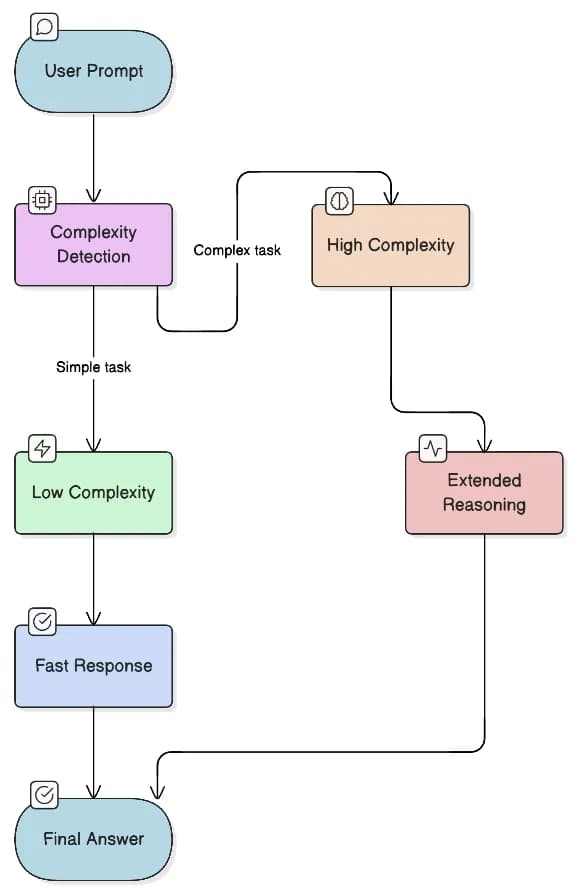
This mechanism allows developers to obtain strong reasoning performance without always paying the full cost of the flagship model.
Example: Simple vs Complex Prompt
Consider two different prompts.
Example: Simple Prompt
"Summarise this email in two sentences.”
This request requires minimal reasoning. With Adaptive Thinking enabled, the model can produce a fast response without engaging deeper reasoning processes.
Why This Changes Model Economics
Previously, organizations had to choose between the following:
- cheap models with limited reasoning
- expensive models with deep reasoning
Adaptive Thinking partially bridges this gap by allowing efficient models like Sonnet to occasionally apply deeper reasoning when necessary.
This means that some tasks that previously required Opus can now be handled by Sonnet with slightly increased computation.
As a result, organizations can achieve Opus-like reasoning in some cases while maintaining Sonnet-level pricing for most requests.
Pricing Breakdown & Cost Calculator
One of the most important differences between Claude Sonnet 4.6 and Claude Opus 4.6 is pricing. In many real-world deployments, model costs scale directly with usage, meaning that even small differences in token pricing can translate into significant operational expenses when systems run at production scale.
Anthropic designed the Claude model family with a tiered pricing structure. The flagship Opus models prioritise maximum capability, while Sonnet models aim to deliver strong performance at a dramatically lower cost.
With the 4.6 generation, this difference becomes especially significant because Sonnet now achieves near-flagship performance on many practical tasks.
To understand how this impacts real systems, it helps to look at the raw token pricing first. As of March 2026, the latest pricing details can be found on Anthropic’s official documentation:
Since pricing may change over time, it’s important to reference the official source when estimating long-term costs or building production-scale systems.
To understand how this impacts real systems, it helps to look at the raw token pricing first.
Claude 4.6 token pricing
| Model | Input Tokens (per 1M) | Output Tokens (per 1M) |
|---|---|---|
| Claude Sonnet 4.6 | ~$3 | ~$15 |
| Claude Opus 4.6 | ~$15 | ~$75 |
At first glance, the relationship is simple: Opus costs roughly five times more than Sonnet for both input and output tokens.
However, the real financial impact becomes clearer when these costs are applied to realistic usage scenarios.
Example: Daily API Usage
Imagine a product team building an AI-powered documentation assistant that processes 1 million tokens per day. These tokens might include:
- user prompts
- internal context retrieved via RAG
- model-generated responses
If the team runs the system exclusively on Sonnet, the approximate daily cost would be:
| Model | Daily Cost |
|---|---|
| Sonnet 4.6 | ~$18 |
| Opus 4.6 | ~$90 |
While this difference may appear modest at a small scale, the gap widens dramatically as traffic increases.
For instance, consider a SaaS product serving thousands of users daily.
Example: Production workload (10M tokens per day)
| Model | Daily Cost | Monthly Cost |
|---|---|---|
| Sonnet 4.6 | ~$180 | ~$5,400 |
| Opus 4.6 | ~$900 | ~$27,000 |
In this scenario, choosing Sonnet instead of Opus saves more than $21,000 per month.
This is why many AI infrastructure teams treat Sonnet as the default model for high-volume workloads.
Cost implications for different application types
Different AI applications generate very different token usage patterns. Understanding these patterns helps determine when the extra cost of Opus might be justified.
Example: AI Coding Assistant
A developer assistant typically processes relatively short prompts but generates moderate output.
Typical request:
- 1,200 input tokens (context + prompt)
- 600 output tokens (code response)
If an engineering team processes 20,000 such requests per day, the monthly cost difference becomes substantial.
| Model | Estimated Monthly Cost |
|---|---|
| Sonnet 4.6 | ~$8,000 |
| Opus 4.6 | ~$40,000 |
Given that coding benchmarks show only a small performance difference between the models, most companies prefer Sonnet for this use case.
Cost optimization with hybrid model routing
Rather than choosing one model exclusively, many organizations implement hybrid routing architectures.
In this design, a system routes tasks dynamically:
- Most requests are handled by Sonnet
- Complex tasks are escalated to Opus
For example, a production AI system might follow logic like this:
| Request Type | Model |
|---|---|
| Basic coding help | Sonnet |
| Simple summarization | Sonnet |
| Customer support answers | Sonnet |
| Advanced reasoning queries | Opus |
| Complex research questions | Opus |
If only 10–20% of requests require Opus, organizations can reduce total infrastructure costs by more than 70% compared to running all tasks on the flagship model.
Platforms such as Lorka are designed to support this architecture by enabling teams to compare, route, and orchestrate multiple language models within a single interface.


Try Sonnet and Opus with Lorka AI
Route prompts between Sonnet, Opus, GPT & Gemini automatically. Get better results at lower cost with one platform.
Test Sonnet vs Opus in One PlaceUse Cases – When Sonnet Wins
Claude Sonnet 4.6 is designed to handle the majority of practical AI workloads. While Opus remains stronger for deep reasoning tasks, Sonnet’s combination of speed, efficiency, and strong benchmark performance makes it the preferred choice for many production systems.
In practice, Sonnet excels in tasks that require strong language understanding and technical ability but do not require extremely complex reasoning chains.
Several categories of workloads illustrate this clearly.
💻 Coding and developer productivity
One of the most important domains for modern LLMs is software development. Developers increasingly rely on AI assistants to help with tasks such as writing functions, debugging code, and generating documentation.
Benchmarks such as SWE-bench show that Sonnet performs extremely well in these scenarios. Because coding tasks often follow clear logical patterns, the performance difference between Sonnet and Opus is relatively small.
🧑🏻💻 Typical Sonnet-powered developer tasks include the following:
- generating boilerplate code
- explaining unfamiliar codebases
- fixing syntax errors
- translating code between languages
- writing unit tests
For example, a developer might ask:
“Convert this Python function into TypeScript and add error handling.”
This task requires strong programming knowledge, but not necessarily the deep reasoning required for scientific research problems. Sonnet handles these requests efficiently while keeping operational costs low.
Because of this balance, many companies deploy Sonnet as the default coding assistant model.
🔧 Automation and tool integration
Another area where Sonnet performs particularly well is automation workflows.
⚙️ Many organizations now integrate language models with internal tools such as:
- project management platforms
- documentation systems
- data dashboards
- internal APIs
In these environments, the model’s primary role is to interpret instructions and interact with structured systems.
For example, an employee might ask:
"Summarise today’s support tickets and create Jira issues for the three most urgent problems.”
The model must:
- read structured data
- extract key insights
- generate formatted output
These tasks require good comprehension and organization skills but relatively modest reasoning complexity.
Because Sonnet performs nearly identically to Opus on automation benchmarks like OSWorld, it is often the most efficient choice for these systems.
📋 Instruction-following tasks
Sonnet also performs strongly on instruction-following workloads, which include many everyday productivity applications.
📝 Instruction-following examples include
- summarizing long documents
- rewriting text in different tones
- generating structured reports
- extracting information from text
For instance, a marketing team might use an AI system to transform a long research report into several short summaries tailored for different audiences.
Example prompt:
"Summarise this 5-page report for a non-technical audience in three paragraphs.”
This type of task requires clarity, language fluency, and good summarisation ability. Sonnet handles such instructions reliably while delivering faster responses than heavier models.
💬 Customer support and knowledge systems
Customer support systems are another area where Sonnet’s efficiency becomes especially valuable.
Large companies often process thousands of support requests per day, making cost efficiency critical.
For example, if a system costs $1,000/month when running on Sonnet, the same workload could scale to around $5,000/month on Opus. In percentage terms, this represents an increase of roughly +400% in cost for comparable usage.
🤝 Typical AI-powered support tasks include
- answering product questions
- retrieving documentation
- generating troubleshooting steps
- summarizing support conversations
Because these tasks often rely on retrieval-augmented generation (RAG) rather than pure reasoning, Sonnet performs extremely well in this role.
For example, a support AI might receive a prompt such as:
“The customer’s dashboard shows a data sync error. What troubleshooting steps should we recommend?”
The system retrieves relevant documentation and then asks the model to produce a clear explanation.
In these situations, the heavy reasoning capabilities of Opus provide limited additional value. Sonnet can generate accurate responses while keeping operational costs manageable.
Use Cases – When Opus Wins
While Claude Sonnet 4.6 delivers impressive performance for most everyday workloads, there are still several categories of tasks where Claude Opus 4.6 remains the better choice.
These situations typically involve problems that require deep reasoning, extended chains of logic, or highly specialised expertise.
Understanding where Opus truly adds value helps teams avoid unnecessary costs while still benefiting from the model’s advanced capabilities.
🧑🏻🔬 Expert-level scientific reasoning
One of the clearest areas where Opus outperforms Sonnet is in scientific and technical reasoning.
Benchmarks such as GPQA Diamond, which evaluate PhD-level questions in physics, chemistry, and biology, show a significant gap between the two models. Opus achieves scores above 90% on this benchmark, while Sonnet remains substantially lower.
This difference reflects the kinds of reasoning required for advanced scientific questions.
For example, consider a prompt like the following:
“Explain why a particular catalyst accelerates this reaction and derive the thermodynamic implications of the change in activation energy.”
🧪 Answering this question correctly requires the model to:
- recall scientific concepts
- connect multiple theoretical principles
- perform step-by-step reasoning
- synthesize a coherent explanation
These types of problems involve multi-layer reasoning chains, where errors can easily propagate if the model does not maintain logical consistency throughout the response.
In academic research environments, pharmaceutical companies, and engineering teams working on complex simulations, this type of reasoning capability can make a meaningful difference.
For this reason, Opus is often used in environments where accuracy and analytical depth are more important than response speed or cost.
🛡️ Security auditing and vulnerability analysis
Another domain where Opus tends to perform better is security analysis, particularly when evaluating large codebases or identifying subtle vulnerabilities.
🔒 Security reviews often involve tasks such as
- identifying hidden attack vectors
- analyzing complex system architectures
- evaluating cryptographic implementations
- detecting multi-step vulnerabilities
For example, a prompt might look like:
"Analyse this authentication system and identify potential vulnerabilities related to session management, token handling, and privilege escalation.”
To answer correctly, the model must understand:
- how authentication flows work
- where vulnerabilities typically appear
- how multiple system components interact
Because these problems require deep contextual reasoning across large systems, Opus tends to produce more reliable results.
Security teams sometimes run automated scans using Sonnet and then escalate suspicious results to Opus for deeper analysis.
♟️ Multi-Step research and strategic analysis
Another scenario where Opus excels is long-form analytical tasks, particularly when the model must reason through multiple layers of abstraction.
📊 Advanced Research & Strategic Analysis examples include
- market analysis reports
- strategic planning scenarios
- technical research synthesis
- large-scale architecture design
Imagine a prompt like:
“Evaluate the long-term implications of switching from a monolithic architecture to a microservices architecture for a company with 50 engineering teams.”
This question requires the model to consider multiple dimensions simultaneously:
- technical complexity
- organizational structure
- deployment pipelines
- cost tradeoffs
- long-term scalability
Because the reasoning chain spans several layers of analysis, Opus tends to produce more structured and nuanced responses.
In consulting-style analysis or research environments, these capabilities often justify the higher cost of the flagship model.
🤖 Complex multi-agent workflows
Advanced AI systems increasingly rely on multi-agent architectures, where several models collaborate to complete a complex task.
In these systems, one model may act as the following:
- a planner
- a coordinator
- an evaluator
These roles require strong reasoning abilities because the model must understand how different components interact and ensure that tasks are executed in the correct order.
🧩 For example, an AI system tasked with writing a research report might include agents that
- retrieve relevant documents
- summarize findings
- synthesize insights
- evaluate factual accuracy
The coordination step decides which information is relevant.It decides how different pieces fit together and often benefits from the deeper reasoning capabilities of Opus.
Because of this, many multi-agent systems use Opus as the orchestration layer while delegating simpler subtasks to faster models.
Decision Framework & Router Strategy
Given the differences between Sonnet and Opus, most organizations eventually face the same question:
How should we decide which model to use for each request?
Instead of choosing a single model, many production systems now rely on model routing, a strategy that dynamically selects the best model for each task.
The basic idea is straightforward: start with a fast, affordable model, and escalate only when necessary.
A simple model routing framework
A common routing strategy follows a three-step process:
- Start with Sonnet 4.6 🟰 Use the efficient model for most requests.
- Evaluate task complexity 🟰 Determine whether the request requires deeper reasoning.
- Escalate to Opus if necessary 🟰 Send complex tasks to the flagship model.
This approach ensures that high-cost models are used only when their capabilities are truly needed.
Example Routing Logic
| Task Type | Model Choice |
|---|---|
| Short prompts | Sonnet |
| Coding assistance | Sonnet |
| Document summarization | Sonnet |
| Scientific reasoning | Opus |
| Security analysis | Opus |
| Multi-step planning | Opus |
This type of routing logic allows organizations to maintain high-quality responses while dramatically reducing infrastructure costs.
Example: API-based router implementation
A simple router can be implemented in code by evaluating prompt complexity before sending the request to the model.
Example code:
import anthropic
client = anthropic.Anthropic(api_key="YOUR_API_KEY")
def is_complex_prompt(prompt: str) -> bool:
    """
    Very simple complexity detector.
    In production you could replace this with
    a classifier model or heuristic rules.
    """
    complex_keywords = [
        "analyze",
        "research",
        "architecture",
        "security",
        "multi-step",
        "design",
        "scientific",
        "strategy"
    ]
    if len(prompt.split()) > 80:
        return True
    for word in complex_keywords:
        if word in prompt.lower():
            return True
    return False
def route_prompt(prompt: str):
    if is_complex_prompt(prompt):
        model = "claude-opus-4-6"
    else:
        model = "claude-sonnet-4-6"
    response = client.messages.create(
        model=model,
        max_tokens=1000,
        messages=[
            {
                "role": "user",
                "content": prompt
            }
        ]
    )

    return {
        "model_used": model,
        "response": response.content[0].text
    }
# Example usage
user_prompt = "Analyze this microservices architecture and identify scalability issues."
result = route_prompt(user_prompt)
print("Model:", result["model_used"])
print("Response:", result["response"])
The function is_complex_prompt() might analyze factors such as:
- prompt length
- presence of technical terminology
- multi-step reasoning instructions
- user intent
More advanced systems may use a classifier model to determine the correct routing decision automatically.
Example Router Flow
A typical routing architecture might look like this:
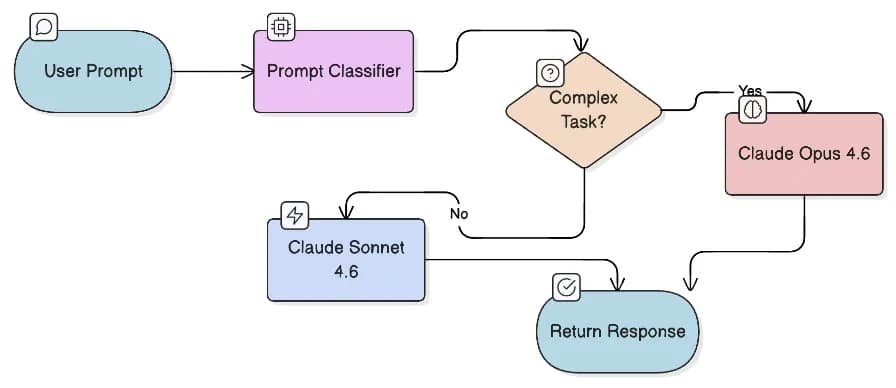
This architecture allows organizations to capture the best qualities of both models:
- Sonnet for speed and efficiency
- Opus for deep reasoning
Platforms such as Lorka help teams implement this type of model orchestration by enabling developers to compare outputs across multiple LLMs and route prompts dynamically within a single interface.
As AI systems grow more sophisticated, this multi-model routing strategy is becoming the standard architecture for production-grade applications.
Claude Sonnet/Opus Vs Competitors (GPT-5.4, Gemini 3)
While the comparison between Claude Sonnet 4.6 and Claude Opus 4.6 is important for organizations already using Anthropic models, most teams evaluating AI infrastructure in April 2026 also consider competing systems such as OpenAI GPT-5.4 and Google Gemini 3.
These models differ not only in benchmark performance but also in architectural priorities such as context length, multimodal capabilities, reasoning depth, and cost efficiency.
Understanding where Claude models fit within this broader ecosystem helps teams make better platform decisions.
High-level model comparison
| Model | Primary Strength | Typical Use Case |
|---|---|---|
| Claude Sonnet 4.6 | Cost-efficient reasoning | Production workloads |
| Claude Opus 4.6 | Deep reasoning and analysis | Research and complex tasks |
| GPT-5.4 | Broad capability and multimodality | Consumer AI assistants |
| Gemini 3 | Google ecosystem integration | Workspace and search workflows |
While benchmark comparisons vary across evaluations, the major distinction between these models often comes down to design philosophy rather than raw performance numbers.
Anthropic tends to prioritize:
- long-context reasoning
- structured thinking
- safety and reliability
Other providers emphasize different strengths.
📚 Context window advantages
One of Claude’s most distinctive capabilities is its extremely large context window, which allows models to process much longer documents than many competing systems.
📄 Large context windows enable tasks such as
- analyzing entire research papers
- summarizing long contracts
- reviewing large code repositories
- processing multi-document datasets
For example, imagine a legal team asking an AI system to review a 150-page contract bundle and identify inconsistencies across multiple clauses.
In this scenario, the model must maintain context across thousands of tokens while preserving logical coherence.
Claude models are often particularly strong at this type of task, largely due to their ability to handle very large context windows (up to ~1M tokens) and maintain consistency across long documents.
However, Gemini and GPT models are not necessarily worse; they perform differently depending on the use case:
- Gemini 3.1 Pro offers even larger context windows (up to ~2M tokens), making it highly effective for extremely large datasets and multimodal inputs.
- GPT-5.4 provides strong reasoning and workflow integration, often performing better when long-context tasks are combined with tools, automation, or agentic workflows rather than pure document analysis.
🖥️ Computer use and tool interaction
Another area where Claude models perform well is tool integration and computer interaction.
Benchmarks such as OSWorld measure how effectively models can perform real-world actions like:
- navigating applications
- executing multi-step workflows
- interacting with structured systems
🛠️ Because of this capability, Claude models are commonly used in:
- enterprise automation systems
- internal developer platforms
- AI copilots integrated with productivity software
Comparative capability table
The following table summarises how the leading models in 2026 generally compare across several key dimensions.
These comparisons are based on publicly available benchmarks, pricing documentation, and industry analyses as of March 2026.
| Capability | Sonnet 4.6 | Opus 4.6 | GPT-5.3 | Gemini 3 |
|---|---|---|---|---|
| Cost efficiency | ⭐⭐⭐⭐ | ⭐⭐ | ⭐⭐⭐ | ⭐⭐⭐ |
| Deep reasoning | ⭐⭐⭐ | ⭐⭐⭐⭐⭐ | ⭐⭐⭐⭐ | ⭐⭐⭐ |
| Coding ability | ⭐⭐⭐⭐ | ⭐⭐⭐⭐ | ⭐⭐⭐⭐ | ⭐⭐⭐ |
| Context window | ⭐⭐⭐⭐⭐ | ⭐⭐⭐⭐⭐ | ⭐⭐⭐ | ⭐⭐⭐ |
| Multimodal ability | ⭐⭐ | ⭐⭐ | ⭐⭐⭐⭐⭐ | ⭐⭐⭐⭐⭐ |
These comparisons highlight an important point: no single model dominates every dimension.
Instead, different models are optimized for different goals.
For organizations building production systems, the most practical approach is often to use multiple models together, routing requests to whichever system performs best for the task.
Platforms that aggregate multiple models allow teams to experiment with these combinations without becoming locked into a single provider.
Migration from Claude 4.5
For organizations already using Claude 4.5 models, upgrading to the 4.6 generation is typically straightforward. Anthropic designed the newer models to maintain compatibility with existing APIs and prompt structures, which means most applications can transition with minimal changes.
However, there are still several important considerations when migrating production systems.
Improved performance without major prompt changes
One of the most convenient aspects of the upgrade is that most prompts written for Claude 4.5 work equally well with Claude 4.6.
This is because the core instruction-following behaviour of the models remains consistent.
For example, an existing prompt like this:
"Summarise the following report and highlight the three most important risks.”
will typically produce improved output quality when run on the newer models without requiring prompt adjustments.
Testing sonnet first
When upgrading systems, a common strategy is to begin by replacing older models with Sonnet 4.6 rather than switching directly to Opus.
This approach makes sense for two reasons.
First, Sonnet already handles the majority of common workloads effectively. Second, its lower cost allows teams to test large volumes of requests without dramatically increasing infrastructure spending.
A typical migration workflow might look like this:
- Replace Claude 4.5 with Sonnet 4.6
- Run benchmark tests on production prompts
- Identify tasks where reasoning quality drops
- Route those tasks to Opus 4.6
This incremental migration allows teams to capture most of the benefits of the new generation while maintaining reliability.
Monitoring output quality
Whenever a new model is introduced into production, teams should monitor several metrics to ensure that system performance remains stable.
Important metrics include:
| Metric | Why It Matters |
|---|---|
| Response accuracy | Ensures the model produces correct answers |
| Latency | Measures user experience |
| Token usage | Affects cost control |
| Hallucination rate | Indicates the reliability of outputs |
These metrics help teams identify whether routing rules need to be adjusted.
For example, if certain queries consistently produce incorrect answers with Sonnet, they can be automatically escalated to Opus.
Best Practices for Production
Deploying large language models in production systems requires more than simply selecting the most capable model. Organizations must also consider factors such as cost control, system reliability, latency, and long-term scalability.
Because Claude Sonnet 4.6 and Claude Opus 4.6 are designed for different roles, the most effective production environments typically combine them through structured model orchestration strategies.
Below are several best practices that many AI teams follow when deploying Claude models in production.
Implement hybrid model routing
The most common architecture for production systems today is a hybrid model routing, where multiple models are used together rather than relying on a single model for every request.
In this architecture, a routing layer determines which model should handle a request based on its complexity.
For example:
| Task Type | Model Choice |
|---|---|
| Short prompts | Sonnet |
| Content summarization | Sonnet |
| Code generation | Sonnet |
| Scientific reasoning | Opus |
| Security analysis | Opus |
| Multi-step research | Opus |
This routing strategy significantly reduces infrastructure costs because the majority of requests are handled by the more efficient model.
In many real-world applications, 70–90% of tasks can be processed by Sonnet, while only a small percentage require Opus-level reasoning.
Monitor model behavior continuously
Even highly capable language models can occasionally produce incorrect or misleading outputs. As a result, production systems should include monitoring mechanisms that track model behavior over time.
Important metrics to monitor include:
| Metric | Why It Matters |
|---|---|
| Hallucination rate | Detects incorrect or fabricated responses |
| Response latency | Measures user experience |
| Token usage | Helps control infrastructure costs |
| Task success rate | Evaluates whether outputs meet requirements |
Monitoring these metrics allows teams to identify situations where routing rules should be adjusted.
For example, if Sonnet begins to struggle with a certain type of technical question, those prompts can automatically be redirected to Opus.
Use Retrieval-Augmented Generation (RAG)
One of the most effective ways to improve model reliability is to combine LLMs with retrieval systems.
In a RAG architecture, the model retrieves relevant documents before generating a response. This approach ensures that answers are grounded in real data rather than relying entirely on the model’s training.
Typical RAG workflow:
- The user asks a question
- The system retrieves relevant documents
- Retrieved context is added to the prompt
- The model generates a grounded response
This architecture is particularly useful for:
- internal knowledge bases
- customer support systems
- documentation assistants
- enterprise search tools
Because the reasoning required is often moderate, Sonnet performs very well in RAG systems.
Implement caching for frequent queries
Another important cost optimization technique is response caching.
In many applications, users ask the same or similar questions repeatedly. Instead of generating a new response each time, the system can store previous responses and return them instantly.
This is typically achieved through response caching and similarity matching mechanisms. When a query is received, the system first checks whether a similar request has already been processed. This can be done using techniques such as the following:
- Exact or normalised matching: Comparing cleaned versions of queries (e.g., removing punctuation, lowercasing) to detect duplicates.
- Semantic similarity search: Converting queries into embeddings (vector representations) and retrieving past queries that are meaningfully similar, even if phrased differently.
- Cache layers: Storing frequently requested prompts and responses in fast-access storage (e.g., in-memory caches or vector databases) for quick retrieval.
If a match is found above a certain similarity threshold, the system returns the cached response instead of invoking the model again. Otherwise, the query is processed normally, and the new response is added to the cache for future use.
This approach can significantly reduce latency and cost, especially in high-volume systems where repeated queries are common, while still maintaining response quality through controlled matching thresholds.
For example:
| Query | Cached Response? |
|---|---|
| “How do I reset my password?” | Yes |
| “What is your refund policy?” | Yes |
| “Explain our pricing tiers.” | Yes |
Caching reduces both latency and token usage, making the system more efficient.
FAQs
Yes. Sonnet 4.6 is designed specifically for production workloads. Its combination of strong benchmark performance, lower latency, and significantly reduced token pricing makes it suitable for high-volume applications such as developer tools, automation systems, and customer support platforms.