


Quick Comparison
| Category | Best Model | Reason |
|---|---|---|
| Best reasoning | Gemini 3.1 Pro | Highest GPQA and reasoning benchmarks |
| Best coding value | Claude Sonnet 4.6 | Strong SWE-bench score with lower cost |
| Best agent workflows | GPT-5.4 | Mature tool ecosystem and orchestration |
| Cheapest at scale | Gemini 3.1 Pro | Extremely low token pricing |
| Most balanced overall | GPT-5.4 | Good across reasoning, coding, and agents |
Many engineering teams now deploy multiple models simultaneously, routing tasks dynamically depending on cost, latency, and capability.
Platforms such as Lorka allow developers to compare outputs across models and route prompts to the most appropriate LLM.
Model Overview (March 2026 Releases)
The latest generation of LLMs continues the trend toward specialized strengths rather than one universal model dominating everything.
Claude Sonnet 4.6
Claude Sonnet 4.6 represents Anthropic’s mid-tier model optimized for software engineering workloads and tool-based reasoning.
A key advancement in Sonnet 4.6 is its massive 1 million token context window, enabling the model to process entire codebases, long documents, or multiple datasets within a single prompt while maintaining strong reasoning across them.
Compared to the larger Opus model, Sonnet delivers nearly the same capability while being significantly cheaper.
🔑 Key characteristics
- Strong code reasoning and repository navigation
- Reliable structured output and tool usage
- Consistent multi-step reasoning
- Lower API cost than flagship models
One of the biggest reasons developers choose Sonnet 4.6 is cost efficiency. It delivers roughly 98% of the performance of larger models at about one-fifth of the cost, making it attractive for production systems.
This balance between price and performance makes it especially popular for:
- code generation
- refactoring tasks
- automated debugging pipelines
- developer copilots
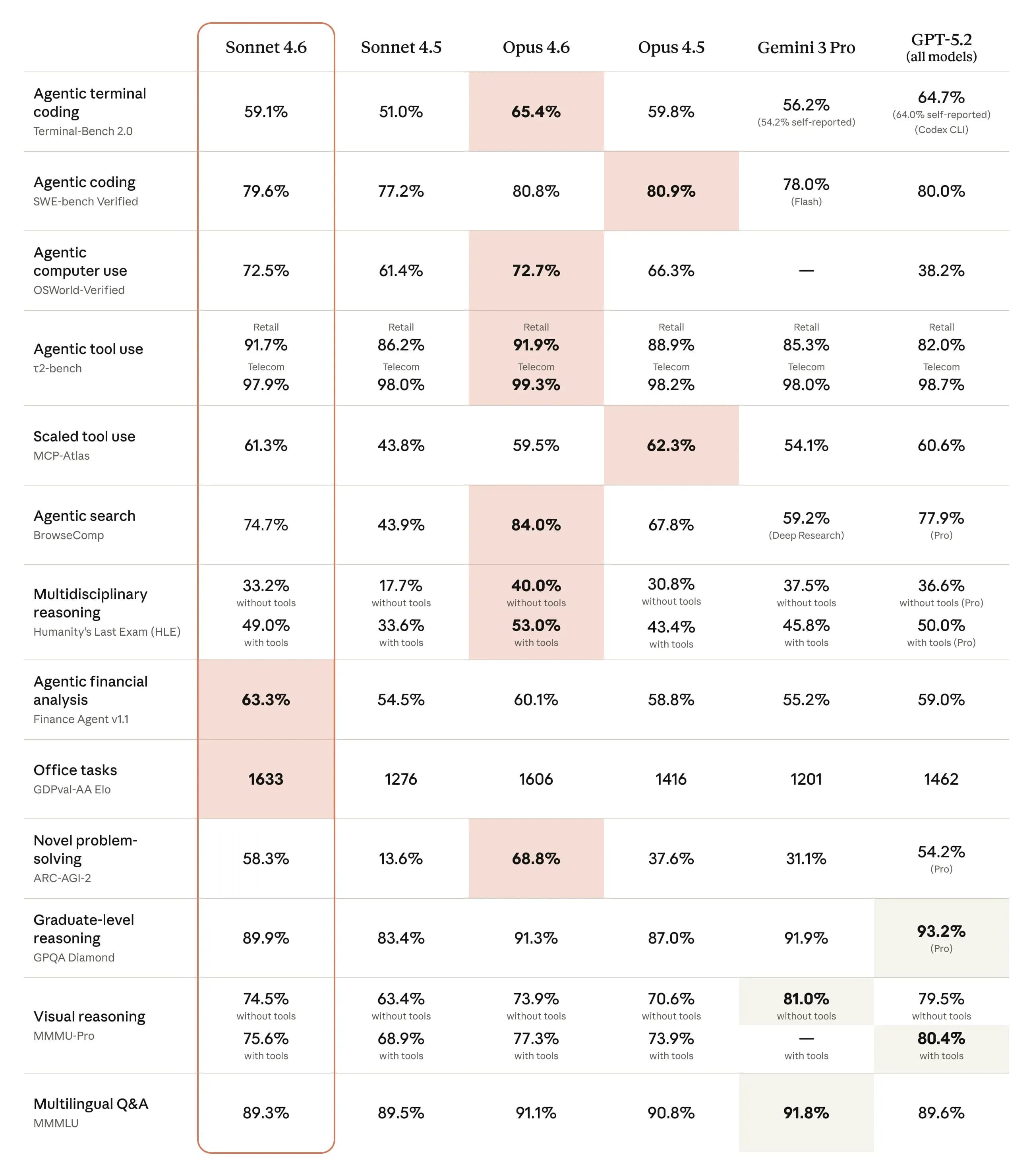
Image Source: https://www.anthropic.com/news/claude-sonnet-4-6
Gemini 3.1 Pro
Google’s Gemini 3.1 Pro focuses heavily on reasoning, multimodal understanding, and large context windows.
The model performs particularly well in benchmarks that require complex logical reasoning or scientific knowledge.
💪🏻 Core strengths
- Top scores on reasoning benchmarks
- Native multimodal input (image, audio, video)
- Extremely large context windows
- Low cost per token
One standout feature is Gemini’s long-context capability, allowing it to process extremely large documents such as:
- entire codebases
- research papers
- technical documentation
- large internal knowledge bases
This makes Gemini particularly attractive for analysis and research tasks.
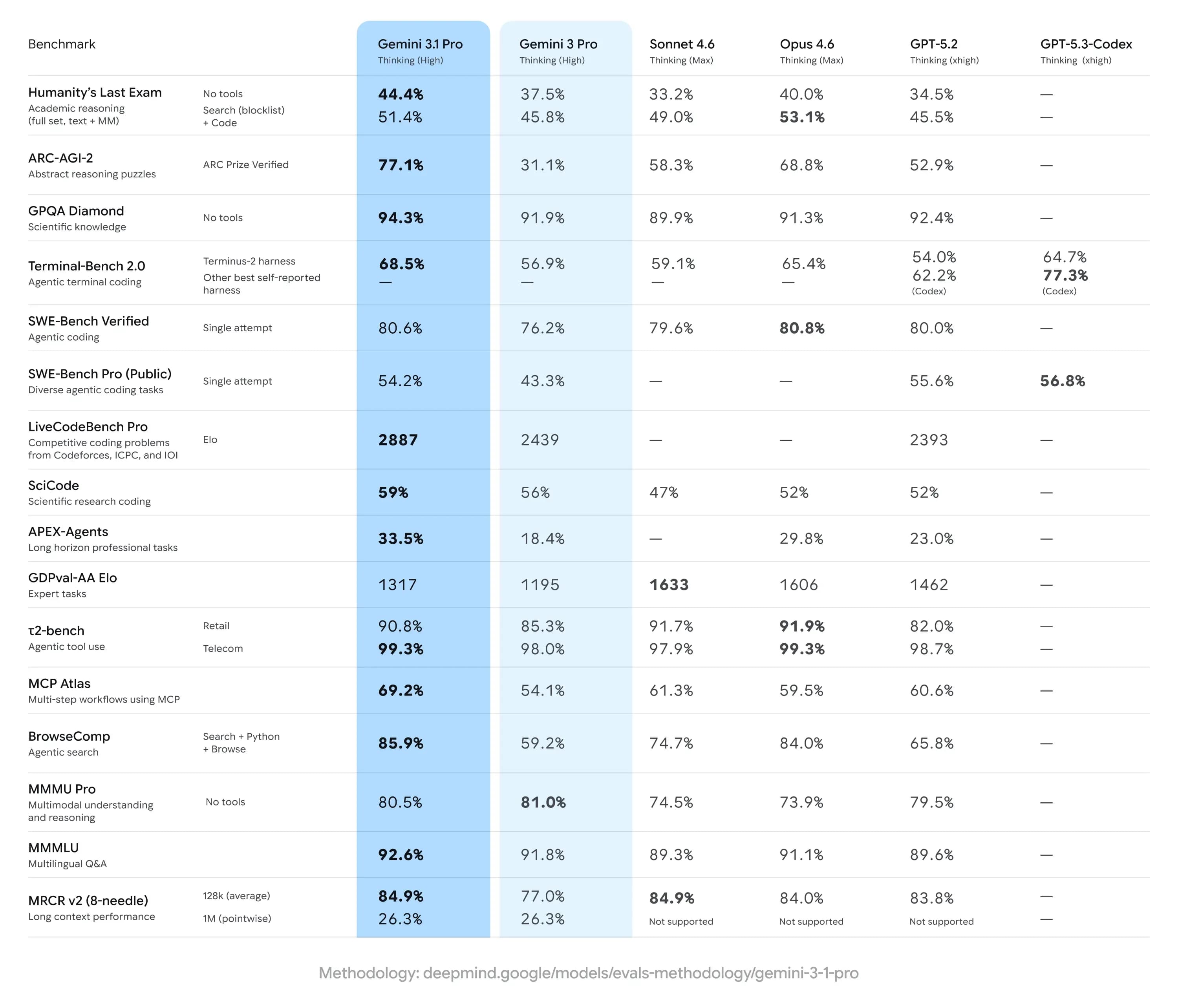
Image Source: https://blog.google/innovation-and-ai/models-and-research/gemini-models/gemini-3-1-pro/
GPT-5.4
GPT-5.4 is OpenAI’s latest frontier model designed for professional work, agent-based workflows, and complex task execution. It represents a major step forward by combining advanced reasoning, coding, and native computer-use capabilities into a single system.
Rather than focusing on a single specialization, GPT-5.4 is built to operate across tools, applications, and long-running workflows, making it highly effective for automation and orchestration use cases.
⚡ Strengths include
- Native computer-use capabilities (UI interaction, automation across apps)
- Advanced tool integration and tool search for efficient workflow execution
- Strong coding, reasoning, and knowledge-work performance
- Large context window (up to ~1M tokens) for long-horizon tasks
- Improved factual accuracy and reduced hallucinations
GPT-5.4 is particularly well-suited for organizations building AI agents and end-to-end automation systems, as it can plan, execute, and verify tasks across extended workflows with minimal human intervention.
While highly capable, GPT-5.4 is positioned as a premium model, with higher pricing compared to smaller or more specialized alternatives, especially for large-scale production workloads.
Core Benchmarks
Benchmarks are one way to evaluate model performance across different categories such as coding, reasoning, and automation.
Below are several widely referenced evaluations :
SWE-bench (coding)
SWE-Bench evaluates a model’s ability to solve real software engineering problems in open-source repositories.
| Model | SWE-Bench Score | Notes |
|---|---|---|
| Claude Sonnet 4.6 | ~79.6% | Best price/performance; top-tier repository-level coding |
| GPT-5.4 | ~77.2% | Leads on computer use and agentic workflows; weaker on repository-level coding |
| Gemini 3.1 Pro | ~76% | Strong coding performance; competitive with top models |
Claude Sonnet performs particularly well because of its ability to:
- analyze code structure
- reason about dependencies
- apply multi-file patches
This is why many development teams deploy Sonnet as their primary coding model.
GDPval-AA (professional knowledge work)
GDPval-AA measures performance across 44 real-world professional tasks, making it highly relevant for enterprise use cases.
| Model | GDPval-AA (Elo) | Notes |
|---|---|---|
| Claude Sonnet 4.6 | 1633 | Leads all models; strongest for enterprise knowledge work |
| GPT-5.4 | 1462 | Strong general reasoning; excels in agentic workflows |
| Gemini 3.1 Pro | 1317 | Solid performance but trails top models |
Claude Sonnet 4.6 clearly leads this benchmark, highlighting its strength in real-world enterprise workflows such as analysis, documentation, and decision support.
GPQA (reasoning)
The GPQA benchmark (Graduate-Level Google Proof Q&A) tests graduate-level reasoning across scientific topics.
| Model | GPQA Score | Strength |
|---|---|---|
| Gemini 3.1 Pro | ~94.1% | Strongest reasoning; leads the benchmark |
| GPT-5.4 | ~92–94% | Advanced multi-step reasoning; strong across domains |
| Claude Sonnet 4.6 | ~89–90% | Reliable reasoning; slightly behind frontier models |
Gemini 3.1 Pro currently leads GPQA Diamond, reaching ~94% accuracy and surpassing human PhD-level performance (~65–70%), highlighting its strength in complex scientific reasoning.
GPT-5.4 follows closely in the ~92–94% range depending on evaluation setup, demonstrating strong multi-step reasoning but not consistently leading the benchmark.
Claude Sonnet 4.6 delivers highly reliable reasoning (~89–90%), but trails the top frontier models in peak scientific reasoning benchmarks.
Gemini leads in this benchmark because its architecture is optimized for complex logical reasoning tasks.
For example, a GPQA-style task could involve analyzing a complex biochemical pathway and determining how a mutation affects downstream protein synthesis, requiring multiple steps of scientific reasoning rather than retrieving a single fact.
AIME / HLE (math & logic)
Mathematical reasoning benchmarks test abstract problem-solving ability.
| Model | Math Performance |
|---|---|
| Gemini 3.1 Pro | strongest abstract reasoning |
| GPT-5.4 | strong multi-step logic |
| Claude Sonnet 4.6 | consistent but slightly weaker |
Gemini’s reasoning capability often makes it the preferred model for:
- scientific analysis
- complex planning tasks
- research workflows
OSWorld (agents)
OSWorld evaluates how well models can use tools, interact with software environments, and complete multi-step tasks across real computer systems.
| Model | Agent Capability | Notes |
|---|---|---|
| GPT-5.4 | Strongest orchestration | Leads in native Computer Use APIs and agentic workflows |
| Claude Sonnet 4.6 | Best task completion (OSWorld) | Leads on OSWorld-Verified task success and reliability |
| Gemini 3.1 Pro | Improving rapidly | Competitive but still maturing in agent environments |
For example, an OSWorld-style task could involve opening a spreadsheet, extracting specific financial data, updating formulas, and generating a summary report across multiple applications.
GPT-5.4 leads broadly in computer-use benchmarks and agent orchestration, benefiting from native system-level integration and parallel tool execution.
However, Claude Sonnet 4.6 performs better on OSWorld-Verified task completion, demonstrating more consistent execution in real-world multi-step workflows (~72.5% success rate).
ARC-AGI-2 (generalization)
ARC-AGI-2 evaluates a model’s ability to generalize to entirely unfamiliar problems, requiring abstract reasoning rather than pattern recall.
| Model | ARC-AGI-2 Score | Notes |
|---|---|---|
| Gemini 3.1 Pro | 77.1% | Highest generalization performance; leads benchmark |
| GPT-5.4 | ~53–60% | Balanced generalization; improves over prior GPT models |
| Claude Sonnet 4.6 | ~58.3% | Strong, structured reasoning; slightly less flexible on novel tasks |
For example, an ARC-AGI-style task could involve identifying an unseen visual pattern rule (e.g., transforming shapes based on hidden logic) and applying it correctly to a new grid, without prior examples.
- Gemini 3.1 Pro leads clearly with ~77.1%, significantly outperforming other models on abstract reasoning tasks.
- Claude Sonnet 4.6 (~58.3%) performs well on structured reasoning but trails on novel abstraction tasks.
- GPT-5.4 (~53–60%) shows solid generalization but remains behind both Gemini and Claude on this benchmark (based on the latest comparative evaluations).
This benchmark measures something closer to true reasoning ability rather than memorized knowledge.
Multimodal Capabilities
Modern LLMs are no longer limited to text.
They can process multiple types of data, including images, audio, video, and complex documents.
| Capability | Gemini 3.1 Pro | GPT-5.4 | Claude Sonnet 4.6 |
|---|---|---|---|
| Image reasoning | Leader | Strong (MMMU-Pro: 81.2%) | Strong |
| Audio understanding | Leader | Competitive | Limited |
| Video reasoning | Leader | Improving | Limited |
| Document analysis | Leader | Strong (enterprise workflows) | Strong |
Real-world example:
A multimodal task could involve analyzing a scanned financial report (PDF), extracting tables, interpreting charts, and generating a structured executive summary.
- GPT-5.4 significantly improves multimodal performance, achieving 81.2% on MMMU-Pro, a benchmark for visual reasoning across disciplines.
- It also introduces enhanced image input handling, enabling more precise interpretation of visual data in workflows.
- Gemini 3.1 Pro still leads overall in native multimodal capabilities, particularly in audio and video understanding (per Google DeepMind model positioning).
- GPT is now much more competitive, especially in enterprise use cases like document analysis and agent workflows.
Gemini’s architecture was designed with multimodal input from the start, which explains its strong performance here.
Speed & Latency
Performance is not just about accuracy, as speed matters in production systems.
| Model | Tokens/sec | TTFT | Long Context Stability |
|---|---|---|---|
| Gemini 3.1 Pro | Very fast | High (Thinking mode) / Low (non-thinking)* | Excellent |
| GPT-5.4 | Fast | Moderate (higher in Pro / deep reasoning mode) | Strong |
| Claude Sonnet 4.6 | Moderate | Low | Stable |
*TTFT is high in reasoning mode due to internal chain-of-thought processing, but output speed reaches 122 tokens/sec once generation starts.
GPT-5.4 introduces variable latency depending on reasoning mode, with higher TTFT in Pro / deep reasoning settings due to additional computation. However, it is still designed to maintain competitive responsiveness compared to prior models, especially outside heavy reasoning workloads.
Claude Sonnet 4.6 typically has lower initial latency, making it more predictable for real-time applications. Gemini 3.1 Pro remains one of the fastest models overall, especially for high-throughput and streaming use cases (per vendor positioning).
Latency can affect:
- user experience
- API costs
- system scalability
This is why many companies deploy smaller models for fast responses and larger models for complex reasoning tasks.
Pricing Deep Dive
API pricing plays a major role in deciding which model to deploy.
Base API Pricing
Pricing is typically measured per 1 million tokens (input/output) and can vary based on context size and usage tier. Always refer to official pricing pages for the latest updates.
| Model | Input Cost (per 1M tokens) | Output Cost (per 1M tokens) |
|---|---|---|
| Gemini 3.1 Pro | $2.00 | $12.00 |
| Claude Sonnet 4.6 | $3.00 | $15.00 |
| GPT-5.4 | $2.50 (≤272K context) | $15.00 |
Gemini often wins in raw token pricing, making it attractive for large-scale workloads.
Monthly Cost Scenarios
Example usage: 10,000 requests per day (~300K/month)
| Model | Monthly Cost Estimate |
|---|---|
| Gemini 3.1 Pro | ~$450 – $700 |
| Claude Sonnet 4.6 | ~$800 – $1,200 |
| GPT-5.4 | ~$700 – $1,500 (varies by context tier) |
How is this calculated?
- Gemini 3.1 Pro: ~$2.5 input / $15 output per 1M tokens
- Claude Sonnet 4.6: ~$3 input / $15 output per 1M tokens
- GPT-5.4: variable pricing (~$2.5–$5 input depending on context tier; output ~$15)
Startups frequently optimize by routing tasks dynamically across models using orchestration layers like Lorka.


Compare AI Models Side-by-Side in Seconds
Test Gemini, GPT, and Claude in one place. Compare outputs, evaluate quality, and route prompts to the best model for each task without switching tools.
Try Lorka Multi-AI ChatCoding Performance Deep Dive
Software engineering tasks often require more than simple code generation.
Models must handle:
- multi-file repositories
- debugging
- architecture reasoning
- refactoring
| Capability | Best Model |
|---|---|
| Code generation | Claude Sonnet 4.6 |
| Refactoring | Claude Sonnet 4.6 |
| Debugging | GPT-5.4 |
| Architecture reasoning | Gemini 3.1 Pro |
Sonnet performs particularly well in repository-scale reasoning, making it valuable for real-world development environments.
Reasoning & Math Breakdown
Reasoning benchmarks often highlight different strengths
| Task | Best Model |
|---|---|
| multi-step reasoning | Gemini |
| logical planning | Gemini |
| structured analysis | GPT |
| consistent outputs | Claude |
Gemini’s architecture tends to perform better when tasks require deep logical reasoning rather than pattern matching.
Agents & Tool Use
AI agents require models to:
- Call APIs
- Execute tools
- Maintain state
- Follow workflows
| Capability | Leader | Notes |
|---|---|---|
| Function calling | GPT-5.4 | Strong native APIs and ecosystem support |
| Workflow automation | GPT-5.4 | Best orchestration across multi-step pipelines |
| Reliable tool execution | Claude Sonnet 4.6 | High consistency in task completion |
| Autonomous planning | Gemini 3.1 Pro | Strong long-horizon reasoning |
| Agentic tool use (T2-Bench) | Claude Sonnet 4.6 | Strongest benchmark performance for multi-tool execution |
GPT-5.4 remains the most mature agent platform, largely due to its developer ecosystem.
Use Cases by Category
Different organizations use AI models for different purposes. Each model tends to perform better in specific types of workloads. Understanding these strengths helps teams select the most suitable model for their use case.
💻 Developers
Developers commonly use LLMs for coding, debugging, and software architecture tasks. Claude Sonnet 4.6 is often preferred for production coding because of its strong repository-level reasoning and reliable code generation.
GPT-5.4 is frequently used in developer workflows, especially for automation, documentation generation, and tool-integrated development environments.
🔬 Researchers
Researchers often require models capable of deep reasoning and analysis across complex datasets or academic material. Gemini 3.1 Pro performs particularly well in these scenarios due to its strong logical reasoning benchmarks and ability to handle large context windows.
This makes it suitable for tasks such as research synthesis, scientific analysis, and long-document evaluation.
🚀 Startups
Startups typically balance performance with cost efficiency when selecting AI models. Gemini 3.1 Pro is often chosen for large-scale workloads because of its relatively lower token pricing.
At the same time, GPT-5.4 is commonly used for building productized AI features and agent-based applications that require automation and tool integration.
📣 Marketing & Content Teams
Marketing and content teams use AI models for tasks such as copywriting, campaign ideation, and content optimization. GPT-5.4 is widely used for structured workflows, editing, and content generation.
Gemini 3.1 Pro is particularly useful when working with multimodal inputs such as images, documents, or video-based content.
Enterprise AI Operations
Large organizations increasingly deploy hybrid model stacks instead of relying on a single large language model. Different models are used for different workloads depending on their strengths.
This approach allows enterprises to optimize performance, reliability, and cost across complex AI systems.
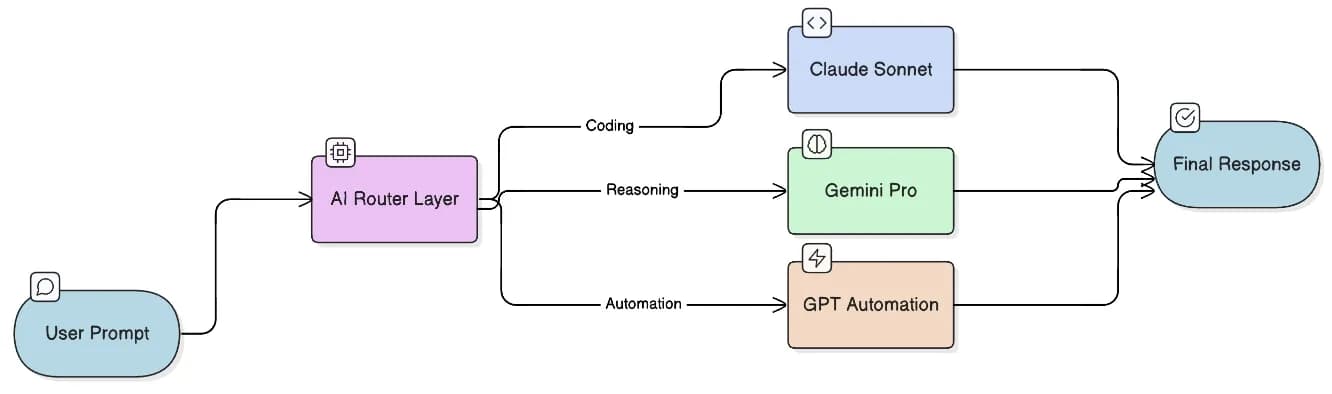
A typical enterprise architecture may route tasks across models in the following way:
- Claude ➡️ coding and software development tasks
- Gemini ➡️ reasoning-heavy analysis and complex problem solving
- GPT ➡️ automation workflows and agent-based operations
By distributing tasks across specialized models, organizations can ensure that each request is handled by the system best suited for it. This strategy improves output quality while preventing unnecessary compute costs from using expensive models for simple tasks.
As AI adoption grows across departments such as engineering, operations, and analytics, hybrid model architectures are becoming a standard design pattern for enterprise AI platforms.
Router Strategy (Hybrid Architecture)
Instead of relying on a single AI model, many organizations now implement routing systems that distribute tasks across multiple models. This approach allows each model to handle the type of problem it performs best.
By combining different strengths, teams can improve performance while maintaining flexibility in their AI infrastructure.
A common routing strategy may look like the following:
| Task | Model |
|---|---|
| Coding | Claude Sonnet 4.6 |
| Deep reasoning | Gemini 3.1 Pro |
| Automation workflows | GPT-5.4 |
A routing layer sits between the application and the model providers. It analyzes incoming requests and forwards them to the most appropriate model.
This approach provides several advantages:
- Reduced costs by sending simple tasks to cheaper models
- Improved reliability through fallback models when needed
- Reduced vendor lock-in by supporting multiple providers
Platforms such as Lorka simplify this process by allowing developers to compare outputs and automatically route prompts across multiple LLMs from a single interface.
Migration Guide
Many organizations upgrading their AI systems in 2026 are transitioning from earlier generations of large language models. Newer models offer improvements in reasoning ability, coding performance, context handling, and multimodal processing.
Migrating to these updated models helps teams improve reliability, reduce latency, and access newer capabilities such as better tool usage and larger context windows.
The table below highlights common upgrade paths that organizations follow when modernizing their AI stack.
| Old Model | Recommended Upgrade |
|---|---|
| GPT-5.2 | GPT-5.4 (Pro/Thinking) |
| Claude 3 | Claude Sonnet 4.6 |
| Gemini 2 | Gemini 3.1 Pro |
Gemini 3 pro preview was officially deprecated and shut down on March 9th: This makes the Gemini 2 to Gemini 3.1 Pro migration path even more urgent and relevant for readers still on Gemini 3 Pro.
While upgrading models is usually straightforward through API changes, teams typically perform several steps to ensure stability and consistent performance.
Prompt updates
Newer models often respond differently to prompts compared with earlier versions. Organizations usually refine prompt structures, instructions, and formatting to take advantage of improved reasoning capabilities.
Evaluation testing
Before deploying a new model in production, teams run evaluation tests using existing datasets or workflows. This helps verify that outputs remain accurate and aligned with expected behavior.
Latency benchmarking
Model upgrades can affect response speed and throughput. Developers often benchmark latency, token usage, and API performance to ensure the new system meets application requirements.
By combining prompt adjustments, evaluation testing, and performance benchmarking, organizations can migrate their AI systems while minimizing disruptions.
Best Practices for 2026
As AI systems mature, several engineering practices have become standard when deploying large language models in production environments. These practices help teams improve performance, control costs, and maintain reliable AI workflows.
Hybrid model routing
Many organizations now use multiple models for different tasks rather than relying on a single LLM. For example, one model may handle coding tasks while another focuses on reasoning or workflow automation. Routing prompts across models improves both efficiency and output quality.
Context window optimization
Although modern models support very large context windows, sending unnecessary tokens can increase cost and latency. Developers often optimize prompts by including only the most relevant information needed for a task.
Modular prompting
Complex tasks are often broken into smaller prompts or steps rather than handled in a single request. This modular approach improves reasoning accuracy and makes it easier to debug or adjust workflows.
Evaluation frameworks
Continuous evaluation is essential when working with AI models. Teams frequently test outputs against benchmark datasets or predefined criteria to ensure the system remains reliable as models or prompts evolve.
Cost monitoring
LLM usage is typically billed based on token consumption. Organizations therefore monitor token usage, API costs, and model routing decisions to maintain predictable operating expenses.
Together, these best practices help organizations build more reliable, scalable, and cost-efficient AI systems in modern production environments.
2026 Outlook
Every new generation of models introduces improvements in reasoning ability, context handling, and integration with real-world software systems. What we are seeing in 2026 is not just bigger models, but a shift in how AI systems are designed, deployed, and used in production environments.
Earlier stages of AI development focused on building a single model that could perform as many tasks as possible. The emerging trend now is different. Model providers are increasingly designing systems that excel at specific categories of tasks, while companies adopt multi-model strategies to combine those strengths.
Several key trends are shaping the next phase of AI development.
A few of the most important trends are outlined below, highlighting how modern models are evolving and how organizations evaluate them when choosing the right AI system.
Model specialization
One of the most noticeable changes in the AI ecosystem is the move toward model specialization.
Earlier models attempted to be general-purpose systems capable of performing a wide variety of tasks equally well. While this approach made early LLMs extremely versatile, it also revealed limitations. Some tasks require different architectural optimizations, training data, or evaluation metrics.
As a result, AI companies are now building models that are optimized for specific domains or workloads rather than trying to dominate every benchmark simultaneously.
For example:
- Some models are optimized for coding and software engineering
- Others focus on scientific reasoning and complex problem-solving
- Some prioritize tool use and agent workflows
- Others emphasize multimodal processing, such as images, audio, and video
This specialization allows vendors to improve performance without dramatically increasing model size or compute cost. It also makes it easier for organizations to select the most appropriate model for each task.
Instead of asking “Which model is the best overall?”, the more practical question in 2026 is:
“Which model is best for this specific task?”
This shift toward specialization is one reason why many engineering teams now design AI systems that can route tasks across multiple models automatically.
Reasoning models vs agent models
Another emerging distinction in the AI landscape is the difference between reasoning-focused models and agent-oriented models.
Reasoning models prioritize the ability to solve complex problems that require deep logical analysis. These tasks often involve multiple steps, abstract reasoning, or scientific knowledge. Benchmarks that measure reasoning ability include things like advanced mathematics problems, scientific questions, or logic puzzles.
Reasoning-focused models tend to perform well at tasks such as:
- research and scientific analysis
- complex planning problems
- mathematical reasoning
- knowledge synthesis across long documents
Agent models, on the other hand, focus on interacting with software systems and completing tasks in real-world environments. These models are designed to call APIs, execute tools, and maintain workflows over long interactions.
Agent-oriented models typically prioritize capabilities such as:
- function calling and API interaction
- multi-step task automation
- workflow orchestration
- interaction with external systems
For example, an AI agent might:
- Retrieve data from a database
- Analyze the results
- Generate a report
- Send the output to another system
This type of behavior requires models that can coordinate multiple tools reliably, which is a different challenge from solving reasoning puzzles.
As a result, many AI vendors are now optimizing models along these two axes:
- deep reasoning capability
- tool-driven automation
Future AI systems will likely combine both strengths, but the current generation often emphasizes one more than the other.
Long context windows
Another major trend shaping the AI landscape is the rapid expansion of context window sizes.
The context window determines how much text a model can process in a single prompt. Early language models could only handle a few thousand tokens at once. Modern systems in 2026 can process hundreds of thousands or even millions of tokens.
This capability allows developers to build tools that operate on complete systems rather than fragments of information.
For example, a model with a million-token context window could potentially analyze:
- the entire documentation of a product
- multiple source code files simultaneously
- a long conversation history with a user
Long context windows also reduce the need for complicated data retrieval pipelines. In earlier systems, developers often relied on techniques like Retrieval-Augmented Generation (RAG) to fetch relevant information from databases. While RAG is still useful, larger context windows allow models to handle more information directly.
However, there are still trade-offs. Processing large amounts of text increases computational cost and latency, so developers must carefully design prompts to include only the most relevant information.
Multi-model architectures
Perhaps the most important architectural shift happening in AI systems is the rise of multi-model architectures.
Instead of relying on a single LLM for every task, organizations increasingly build systems that use multiple models working together.
Each model handles the type of task it performs best.
For example, a modern AI system might route tasks like this:
- A coding request is handled by a model optimized for software development.
- A reasoning-heavy problem is sent to a model specialized in logical analysis.
- Workflow automation tasks are handled by an agent-focused model.
This routing strategy provides several advantages.
Tools and platforms that aggregate multiple models make it easier for developers to experiment with different architectures without rewriting large parts of their systems.
The direction of AI systems
Taken together, these trends suggest that the future of AI will look different from the early days of large language models.
Rather than a world dominated by one single universal model, we are likely moving toward ecosystems of specialized models connected through intelligent orchestration systems.
In this environment:
- Some models will focus on reasoning
- Others will specialize in automation
- Others will excel at multimodal understanding
Developers and organizations will increasingly focus on how to combine these models effectively, rather than simply choosing one.
This shift marks the beginning of a new phase in AI development where the emphasis is not only on the models themselves, but also on the systems that coordinate them.
Use the Best Model Every Time with Lorka AI
Different models win at different tasks. Lorka lets you compare responses instantly and choose the best output so you get higher quality results without extra effort.
Try LorkaFAQs
There is no single best model.
GPT-5.4 is the most balanced, Gemini excels in reasoning, and Claude Sonnet 4.6 offers the best coding value.
Final Thoughts
The AI ecosystem in 2026 is no longer about choosing a single LLM. Instead, successful teams deploy multiple models and route tasks dynamically depending on capability, latency, and cost.
Understanding the strengths of Gemini, GPT 5.4, and Claude allows organizations to build more efficient AI systems.
If you want to experiment with multiple models without switching APIs, platforms like Lorka allow developers to compare outputs, benchmark prompts, and route requests across different LLMs from a single interface.