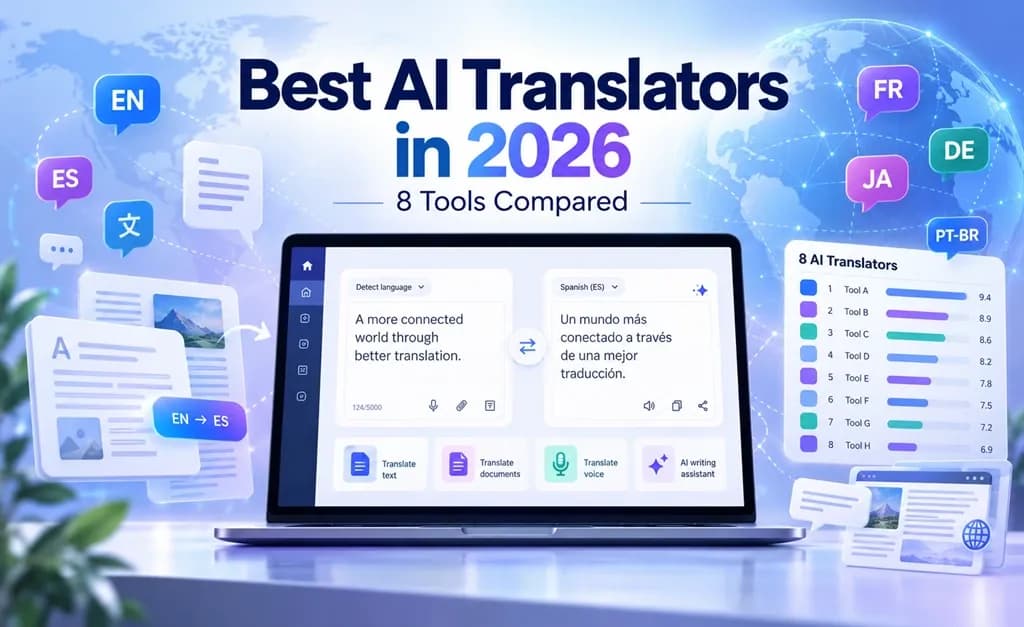
What Is an AI Translator?
An AI translator uses artificial intelligence to convert content into another language while aiming to preserve meaning. We look at 3 types of AI translation tools.
- Dedicated translation engines: Focus on translating text and documents.
- General-purpose AI assistants: Use large language models to translate and adjust tone through conversational instructions.
- Translation-management and localization platforms: Used to organize multilingual projects.
The AI translator you need will depend on whether you need a quick translation or a repeatable process for a team.
How We Evaluated the AI Translation Tools
The comparison below covers the following translators that are considered the best in 2026:
- Lorka AI
- DeepL
- Google Translate
- ChatGPT
- Claude
- Lokalise
- Smartcat
- Microsoft Translator
The samples we used include emails, marketing copy, instructions, conversation, and a formatted document, and we evaluated these translations in the following language pairs: US English into Spanish (Spain/Mexico), Portuguese (Brazil), French (France), German (Germany), and Japanese (Japan).
These samples were graded by our team based on the evaluation criteria below.
| Scoring criterion | Weight |
|---|---|
| Meaning preservation | 35% |
| Naturalness and tone | 20% |
| Terminology consistency | 15% |
| Ease of use and refinement | 15% |
| Value | 15% |
The 8 Best AI Translator Tools in 2026
These tools cover everyday messages, document translation, creative improvements, and team localization.
1. Lorka AI: Best all-in-one translation workspace 🏆
Score: 9.2/10 | Strengths: Model switching, rewriting, research | Limitations: Specialist translation controls need verification | Pricing: $29.99/month.
Lorka AI’s translator combines translation with multiple AI models, such as ChatGPT, Claude, Gemini, and additional AI tools. It is our top pick for translating and refining content in one workspace. Its workflow score of 9.4 exceeds its translation-quality score of 8.9, reflecting flexibility rather than universal accuracy.
2. DeepL: Best for dedicated translation 🥈
Score: 9.1/10 | Strengths: Document translation, glossaries | Limitations: File and character allowances | Pricing: Free version; $10.49/month.
If your primary goal is translating text and documents, DeepL is the top choice. Its translation-quality score of 9.3 leads this shortlist, making it a close contender. Check language support, document allowances, and formatting results against your needs.
3. Google Translate: Best for everyday translation 🥉
Score: 9.0/10 | Strengths: Free access, camera and conversation tools | Limitations: Regional phrasing and tone need review | Pricing: Free consumer access.
Google Translate is a practical choice for quick messages, travel, and everyday understanding. Camera translation and supported offline languages add convenience. Its translation-quality score is 8.8, so assess idioms and locale suitability before using output in published content.
4. ChatGPT: Best for contextual translation and optimization
Score: 9.0/10 | Strengths: Context, alternative wording, follow-up editing | Limitations: Check for meaning changes | Pricing: Free plan; Plus $20/month.
OpenAI models are well designed for translations you want to discuss and refine. Explain your audience, request alternatives, and adjust tone through conversation. Its quality and workflow scores are 9.0 and 9.1.
5. Claude: Best for style-sensitive translation drafts
Score: 8.8/10 | Strengths: Tone adjustment, iterative editing | Limitations: Terminology and fidelity require review | Pricing: Free plan; Pro $20/month.
You can use Anthropic Claude models as a conversational assistant worth considering for longer prose and style-sensitive drafts. Provide audience and voice guidelines, then improve the wording. You can go with a Claude model when editorial flexibility is important.
6. Lokalise: Best for managed localization
Score: 8.7/10 | Strengths: Translation memory, glossaries, collaboration | Limitations: Setup and subscription overhead | Pricing: From $149/month.
Lokalise manages recurring website, app, and software localization. Its workflow score of 9.2 shows the importance of coordinating updates and reviews. Choose it for a repeatable team process; confirm billing terms and included allowances before subscribing.
7. Smartcat: Best for AI and human-review workflows
Score: 8.7/10 | Strengths: Team workflows, reviewer options | Limitations: Review access and fees vary | Pricing: From $100/month.
Smartcat is a combination of AI translation and multilingual content workflows. Think about using this tool if reviewer engagement is a key part of what you do.
8. Microsoft Translator: Best for routine translation
Score: 8.5/10 | Strengths: Everyday communication, conversation tools | Limitations: Features vary by interface | Pricing: Free consumer tools; Azure services priced separately.
If you need a practical tool, Microsoft's tool is a solid option for straightforward messages and basic translation. Go over the context and regional phrasing, and assess consumer functionality separately from business API capabilities.
AI Translator Comparison Table: Scores, Access, and Best Uses
Review our table below that mentions each AI translator's scores, how you can use it, and what each one costs a month.
*Scores are based out of 10.
| Translator | Best use case | Translation quality | Workflow | Overall | Free access/trial | Paid access (Price/month) |
|---|---|---|---|---|---|---|
| Lorka AI | All-in-one translation, model comparison, rewriting, and additional AI tasks | 8.9 | 9.4 | 9.2 | No | $29.99 (includes AI humanizer, AI models, image models, and more AI tools) |
| DeepL | Text and document translation | 9.3 | 8.9 | 9.1 | Yes | $10.49 |
| Google Translate | Everyday messages, travel, and quick translations | 8.8 | 9.0 | 9.0 | Yes | Free |
| ChatGPT | Contextual translation, alternative wording, and tone adjustment | 9.0 | 9.1 | 9.1 | Yes | $20 (ChatGPT Plus) |
| Claude | Longer writings, style adaptation, and translation refinement | 8.9 | 8.8 | 8.8 | Yes | $20 (Claude Pro) |
| Lokalise | Website, app, and software localization | 8.8 | 9.2 | 8.7 | Trial | From $149 |
| Smartcat | Team translation, localization, and human-review workflows | 8.8 | 9.1 | 8.7 | Trial | From $100 |
| Microsoft Translator | Routine messages, conversations, and everyday translation | 8.5 | 8.7 | 8.5 | Yes | Free |
Why Use More Than One Translation Model in Lorka?
In Lorka's all-in-one platform, you can follow a simple workflow to help you get the best translation and make sure your emails and content are correctly written:
- Translate: Specify your target language, locale, audience, and terminology.
- Optimize: Ask a model like GPT-6 or a Claude model like Sonnet or Opus, available on Lorka AI, for different wording while keeping the same meaning.
- Review: Compare both versions against the source, checking facts, omissions, and consistency.
Keep in mind that any agreement between models does not always guarantee accuracy. Both can repeat the same mistake, so if possible, it's recommended to also use qualified human review when writing a critical email or other type of content.


Translate Smarter with Lorka AI
Use multiple AI models in one workspace to translate content, compare results, and refine tone. Find the right words for your audience.
Try Lorka's AI Translator nowWhen AI Translation Needs Human Review
Use qualified human review when a translation could affect someone's rights, health, finances, safety, or trust in your organization, which includes:
- Legal contracts and notices
- Medical instructions and patient information
- Financial reports and investment materials
- Official applications and supporting documents
- Safety warnings and operating instructions
- High-visibility webpages, campaigns, and public announcements
Even though the models mentioned in our comparison are considered the best AI for translation, it's still a good idea to verify the tool's privacy terms, including data retention, model-training use, and third-party access before uploading confidential material.
FAQs
Ultimately, the best AI translation tool for you will depend on your workflow and tasks. Lorka AI is our top recommendation if you want translation and multiple AI models and tool access under one plan.
However, if you only need a model for a specific workflow, DeepL can be a great choice, or if you just want to translate a simple message once in a while, a free choice like Google can be better.