


Key Takeaways ⭐
- Most major AI tools have gone from free to use to up to $30 per month since 2023, with premium tiers reaching as high as $200 per month.
- A typical freelance creative who uses multiple AI tools could be currently spending over $1,200 a year on subscriptions alone.
- Many users are unknowingly paying for duplicate features across their AI tools, a problem known as "subscription sprawl".
- Global spending on AI is forecast to rise 44% in 2026, suggesting further price hikes are likely in the near future.
- Running a regular audit of your AI tech stack and consolidating overlapping tools could save you hundreds of dollars a year.
The Rising Cost of AI Tools
At the outset, AI tools were often available for free to demonstrate their power and enable businesses and individuals to visualize how they could integrate AI into their workflows to work smarter.
Pricing was introduced across platforms in 2023 to offer users even greater capabilities.
▪️Most major tools now charge $20-30 a month for basic paid plans, from $0 in early 2023.
▪️In addition, 31% of Americans say they interact with AI at least several times a day, up from 22% in February 2024, according to Pew Research.
▪️Out of an estimated 1.8 billion AI users worldwide, only around three per cent pay for premium services, according to Menlo Ventures.
▪️Analyst group Gartner forecasts that global spending on AI will rise 44% year-on-year in 2026.
As a result, access to Large Language Models (LLMs) is now ‘pay to play’; they come with tiered systems. The more you pay, the more intuitive the offering becomes, with greater usage allowance, longer time on the platform, and more sophisticated output.
While the basic price point for many AI tools of around $20-30 per month has not changed, what you get for your money often has.
Why? Running an LLM is not cheap; datacenters required to process the levels of information needed to answer complex questions or generate images and video demand high levels of energy, plus water to cool systems.
In addition, microchip costs are rising, and AI firms are in a highly competitive race, so they have huge development budgets. So, the chances are AI companies will need to raise prices or encourage users to upgrade in the coming years.
| Tool | Cost at launch | Cost in April 2026 |
|---|---|---|
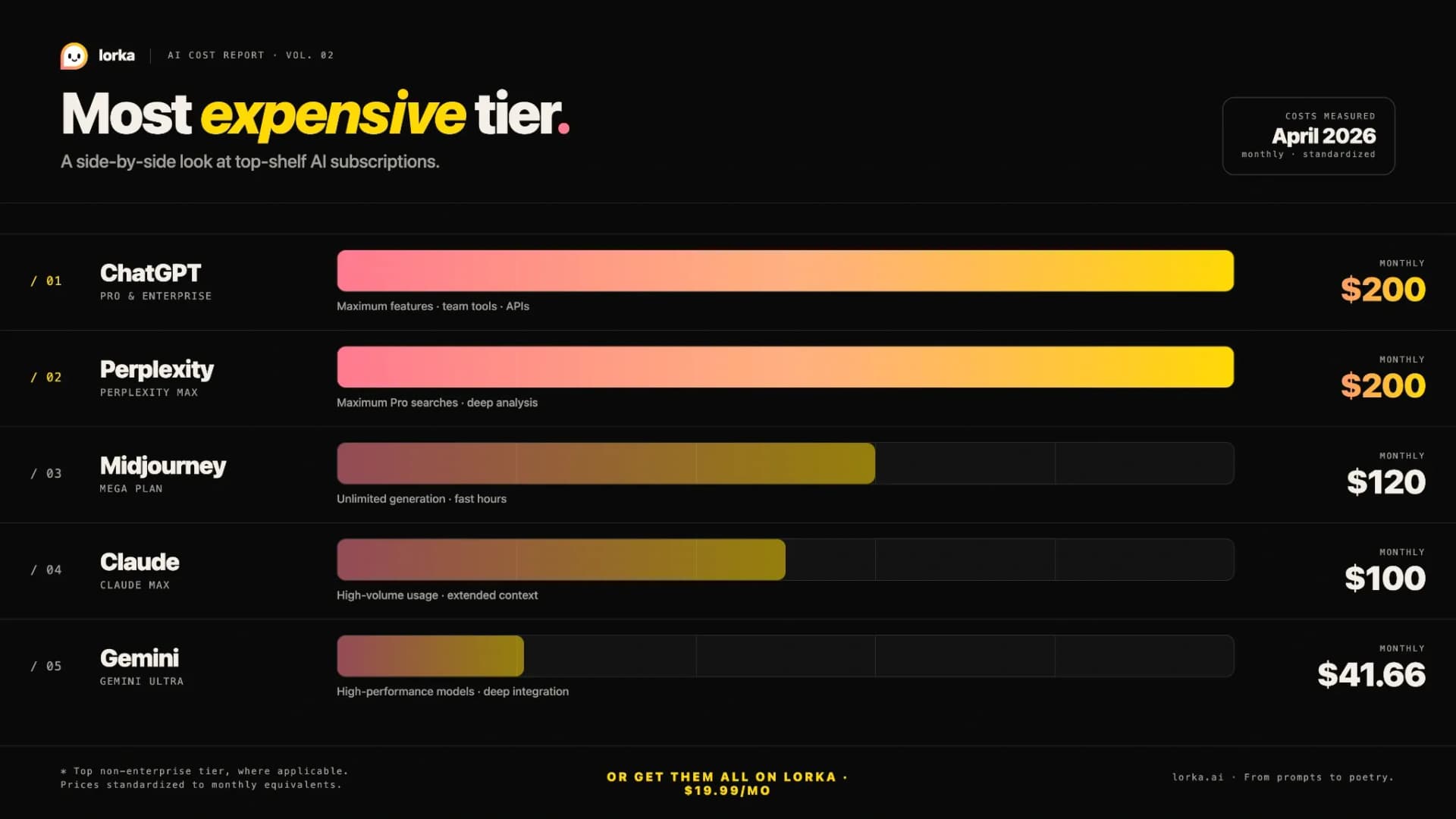
| Midjourney | Free trial of 25 images (Jul 2022) | Midjourney has four tiers, ranging from a basic $10 per month offering, right up to a monthly $120 Mega Plan. |
| ChatGPT | Free access to GPT3.5 (Nov 2022) | ChatGPT has six offerings, ranging from free to $200/month for its Pro model, with custom options for enterprises. |
| Perplexity | Free unlimited basic search (Dec 2022) | Perplexity has a Pro offering that starts at $20/month and a Max offering at $200/month. Perplexity’s free plan is limited to five Pro searches per day. |
| Microsoft Copilot | Free at launch as Bing Chat (Feb 2023) | Microsoft Copilot is built into other Microsoft applications, including Excel, PowerPoint, and Word. |
| Google Gemini | Free at launch as Bard (Feb 2023). Paid tiering was introduced when Google rebranded Bard as Gemini in Dec 2023) | Gemini is also tiered from free to an Ultra option at $124.99 for three months. The Google AI Pro plan is $19.99/month. |
| Claude | Free invite-only beta (Mar 2023) | Claude is available for free, with a $20/month Pro plan (less if paid annually), while Max plans start at $100/month. Claude has a Team offering for a minimum of five members, from $25-30/user/month for Standard or $150/user/month for Premium. |
This graphic compares the most expensive tier of each of these services:
However, many users are currently happy with their free version. For example, ChatGPT has an estimated 900 million weekly active users, yet only 35 million are paying users, according to research. That’s just under four per cent. Most paying users are likely individual professionals or companies.
In a competitive space, AI companies are encouraging users towards higher plans using a pattern of ‘same price, more tiers’. The pricing of AI has been kept artificially low to prove the business case and draw users in.
Pricing is based on usage; the more complex your request, the more processing power it requires, and that is reflected in the cost. So far, we have been undercharged, so we should probably get used to paying more for premium AI tools before long.
When AI Tools Collide: Meeting the Duplication Challenge
The price of individual platforms is just part of the story on the cost of AI; the real issue is that subscriptions can soon mount up. We call this process ‘subscription sprawl’.
Imagine the typical AI tech stack of a freelance creative. They might need specialist AI tools to assist with a range of tasks, from writing to image creation, filmmaking to deep analytical research.
Their basic AI tech stack could include*:
| Tool | Function | Subscription costs (paid annually) |
|---|---|---|
| ChatGPT Plus | Content ideas, written content | $240 |
| Midjourney Standard | Image creation | $288 |
| Runway Standard | Video editing | $144 |
| Perplexity Standard | Research | $200 |
| Canva Pro | Design tools | $120 |
| Otter.ai Pro | Interview transcription | $100 |
| Grammarly | Grammar and spellchecking | $144 |
| Annual Total | $1,236 |
*using pricing billed annually, calculated in April 2026
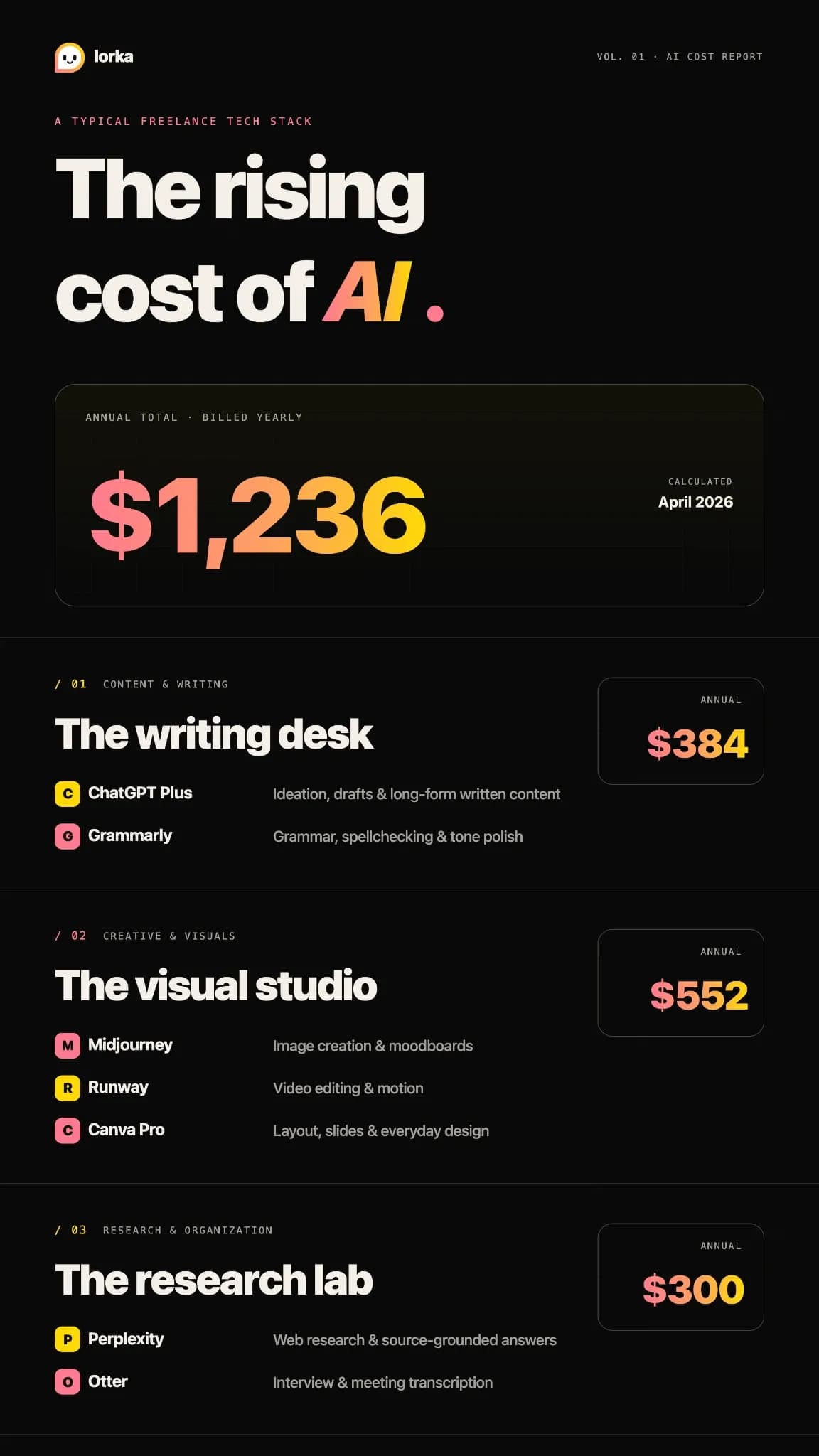
Back in early 2023, the freelancer would have been enjoying free or trial pricing for ChatGPT, Midjourney, Runway, and Perplexity for basic usage that did not exceed their limits. So, their tech stack is now at least $872 more expensive in 2026 than it was in early 2023.
Alongside the rising costs of their AI tech stack, individual users, like our freelancer example, must manage increasing complexity. They are, in effect, their own IT department.
They need to keep on top of:
-
Subscription management: Their packages will most likely run out at different times of the year.
-
Duplication: Some tools might offer the same functionality at some level as another AI tool that the user is paying for. Do they need both?
-
Demand management: What if a client comes in with a job that requires the freelancer to upgrade an AI product to get more credits and capability? Can they scale easily according to demand?
-
Changing tool capabilities: As AI products update features and evolve in capability, a user might trial another and decide to use that for one of their core functions rather than an existing tool.
What Do the Experts Say?
AI pricing tiers are changing. We asked three PR and digital marketing experts what that means for businesses that have built their AI strategies around current pricing models.
Neville Hobson is a senior UK-based PR consultant, podcaster, and industry commentator. He uses three main AI tools, and he views them not as single tools, but as part of his workflow, to accelerate research, clarify thinking, and draft more effectively, but always with human judgment at the center.
Neville believes that the rising cost of AI is a natural part of a maturing market. “What’s unusual is the speed and spread, with AI becoming a layer across multiple tools at once, so professionals are accumulating overlapping subscriptions rather than paying for just one,” he says, adding that AI business models are still evolving.
“Many professionals are already paying for overlapping capabilities across multiple tools - assistants, office software, meeting platforms, and specialist apps. That duplication won’t be sustainable, so I expect consolidation at the user level, even as the market itself continues to expand.”
“For users, the implication is straightforward. The value of AI won’t be measured by how many tools you subscribe to, but by how effectively it improves your thinking, your decisions, and your outcomes. That puts the emphasis back where it belongs – on judgment, not just technology.”
Neville Hobson, PR consultant, podcaster, and industry commentator
Originally from the US, now based in Belfast, Northern Ireland, Emily McDaid is a senior PR consultant and graphic designer who speaks about the role of AI in marketing at business events. Many of her clients are in the engineering sector, so they were early adopters, and they use self-trained AI models.
She says that platforms have enticed users with offers that are too good to last, and many features are slowly disappearing from the free versions.
Emily believes that it is important that AI users shop around, rather than become over-reliant on any one tool. “It's important to keep your eyes open. Each provider excels in different ways,” she adds.
“The average user doesn't care about who creates what; they just want to know what will help them in their day-to-day role, and that is very unclear to a lot of people.”
Emily McDaid, marketing consultant
Users get way more “bang for their buck” now than previously, according to Jamie Ralph, an independent digital marketing consultant based in Ireland.
Jamie has alternated between LLMs and currently uses three of the main tools with paid plans. He says, “The ethics of AI use and how AI LLMs protect your data will be an important issue for users when making a choice to pay for a certain plan in the future.”
“For any independent creators and small businesses who need to justify the cost, I would encourage them to do an audit of the current tools and software they pay for. They may be paying for another tool that offers a task or service that an AI LLM can now perform.”
Jamie Ralph, digital marketing consultant
Assessing the Value of Your AI Tech Stack
Managing an AI tech stack has become more costly and complex since 2023. However, businesses and individuals now benefit from powerful new capabilities.
The tools have improved significantly, too. As Jamie highlights, you get way more AI power for $20-30 per month today than back in 2023.
Yet, our example freelancer faces a dilemma; when using multiple AI tools, there is inevitably some overlap. For example, ChatGPT Plus now includes DALL•E image creation technology and can conduct high-quality research and synthesis. Our freelancer faces a value-per-dollar fragmentation challenge because they are paying for overlapping capabilities across multiple tools.
If you find yourself in a situation where you have potential duplications, here are some steps to consider:
-
Run an audit: What functionality do you actually use within your AI tech stack? Is there any overlap?
-
Assess your needs: List what you need from your AI tech stack, rather than the name of the tools you use. You might note some overlap.
-
Evaluate tools: Is there a single tool that does most of what you need to a standard you expect? Is there a specific functionality that you cannot do without? Could you get what you need by upgrading an existing account?
-
Consider your scope: Would a team account make more economic sense over individual licenses?
-
Consolidate your tech stack: Consider tools that bundle AI tools, so you can access the capabilities you need without paying over-the-odds for individual accounts with each platform.
There’s no doubt the tools are worth the money; recent studies estimate workers could be saving nearly an hour a day with AI tools. That’s great news, but there’s no point paying for functionality that you don’t need or already have elsewhere.
It is evident that the AI tools market is due for consolidation or bundling. This is why Lorka AI bundles a range of AI capabilities into one single monthly subscription.
Have Your Say: How Much Are You Paying for AI Tools?
We can see that AI subscription costs have escalated since 2022. The fragmentation of tools is proving to be a real financial burden to individuals and businesses, and prices are likely to rise. Most users probably have no idea what they are actually spending money on, or if they’re getting value from their tool.
It could be sapping hundreds of dollars from your personal or business budget each year. Users just want clarity and control over their AI costs and usage.
Are you clear on your AI spending and where you get value from your AI tech stack? Keep your total spending under control by using Lorka AI.
Methodology:
First, we gathered data from several sources, including Pew Research, Menlo Ventures, Gartner, Incremys and the official pricing pages for each service, to create tables of information. Then we used Claude to transform the data into graphics, thoroughly checking to ensure all the information was carried over correctly.
The interviews were conducted via email by Chris Lee, who incorporated the answers into the final text.