

Use Claude Opus 5.5 Without an Anthropic Subscription
Chat with Anthropic’s Claude Opus for demanding work alongside GPT, Gemini, Grok, and more models in a single subscription.
How to Choose a Claude Model for Your Workflow
Go over the following model families’ features to understand which model works best for your work. You can work with Opus, Sonnet, Haiku, and Fable on Lorka AI.
Choose Opus for more complex tasks
Use Opus for hard-to-disentangle work, but be prepared for a longer wait than lighter models of Claude. If the connections you trace matter more than a fast reply, use Opus.
Try Sonnet for most of your daily work
Working with the latest version of Sonnet is a useful starting point for everyday coding and writing that isn’t too complicated.
You can also start with Sonnet and move to Opus when it misses dependencies or needs repeated corrections.
Go with Fable when Opus falls short
If Opus keeps missing the same architectural problem or cannot carry a difficult analysis through to a rational conclusion, you can test the latest version of Fable. Give it the same materials and keep it only if the result improves enough to justify the extra wait.
Use Haiku for repetitive work at a high volume
For tagging support tickets or summarizing batches of short documents, go with Haiku and save Opus for the exceptions.
Explore the full Claude model comparison →
What Claude Opus Excels at
Choose Opus when your task spans a codebase or several decisions that affect one another.
| Capability | What you can use it for |
|---|---|
| Migrations, audits, and refactors | Trace dependencies across the supplied project files, plan changes that touch multiple services, and identify tests that could catch unintended effects. |
| Documents that disagree | Compare contracts, appendices, research papers, and meeting records to surface conflicting terms, changed assumptions, and questions that a summary would miss. |
| Decisions that need evidence | Examine forecasts or architecture proposals, challenge the assumptions behind them, and connect each recommendation to evidence you can review. |
| Work that takes multiple steps | In a tool-enabled workflow, carry a task through planning, execution, and checks, then report unresolved problems and decisions needing your input. |
See How Claude Opus Handles Real Work
Discover how the Anthropic model can do advanced tasks such as coding, analysis, and more.
Audit our monorepo (api-gateway, catalog-service, checkout-service, shared/) for slow API responses. Rank bottlenecks by impact across all services, fix the top one safely, add regression coverage, and explain how to validate before rollout.
Output: | # | Location | Issue | Impact | | - | -------------------------- | --------------------------------------------------- | --------------------------- | | 1 | shared/auth/jwks.py | JWKS keys fetched over the network on every request | +110 ms on all 41 endpoints | | 2 | catalog-service/search.py | Inventory looked up one SKU at a time (N+1) | +340 ms P95, 1 endpoint | | 3 | checkout-service/orders.py | Confirmation email sent synchronously | +210 ms P95, 2 endpoints | | 4 | api-gateway/config.yaml | Compression disabled for JSON responses | +60 ms on large payloads | Why #1 first: #2 has the largest single spike, but #1 is in shared middleware imported by every service, so fixing it cuts total request time across the system by roughly 4× more than fixing #2.
1# shared/auth/jwks.py2_TTL, _MIN_FORCED_REFRESH = 600, 303_cache = {"keys": {}, "fetched_at": 0.0, "forced_at": 0.0}4_lock = threading.Lock()56def get_signing_key(kid):7 keys = _load_keys()8 if kid not in keys: # handles key rotation9 keys = _load_keys(force=True)10 return keys.get(kid)1112def _load_keys(force=False):13 with _lock:14 now = time.monotonic()15 stale = now - _cache["fetched_at"] > _TTL16 # rate-limit forced refreshes so bogus kids can't trigger a fetch storm17 can_force = force and now - _cache["forced_at"] > _MIN_FORCED_REFRESH18 if stale or can_force:19 _cache["keys"] = fetch_jwks()20 _cache["fetched_at"] = now21 if force:22 _cache["forced_at"] = now23 return _cache["keys"]2425# Regression tests26def test_keys_fetched_once_across_requests(mocker, reset_jwks_cache):27 fetch = mocker.patch("shared.auth.jwks.fetch_jwks", return_value={"k1": KEY})28 for _ in range(100):29 get_signing_key("k1")30 assert fetch.call_count == 13132def test_unknown_kid_cannot_cause_fetch_storm(mocker, reset_jwks_cache):33 fetch = mocker.patch("shared.auth.jwks.fetch_jwks", return_value={"k1": KEY})34 for i in range(50):35 get_signing_key(f"bogus-{i}")36 assert fetch.call_count <= 2Validate before rollout 1. Run the full auth test suite for all three services, since they all import this module. 2. In staging, rotate the signing key and confirm new tokens are accepted within one request. 3. Canary to 5% of gateway traffic for 24 h. Proceed if P95 drops by ~100 ms and the 401 rate is unchanged.
Claude Opus Benchmark Results
Here is how the latest Opus models perform vs. other models from OpenAI and Claude at max effort.
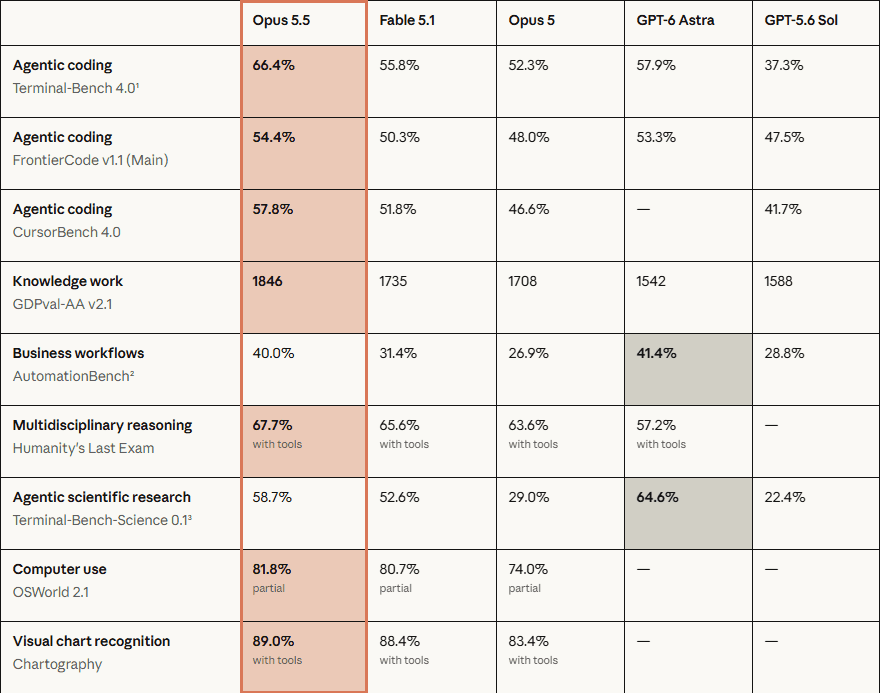
Source: Anthropic
Try Claude Opus With Leading Models in One AI Workspace
Lorka AI brings Claude, GPT, Gemini, and Grok together so you can choose how to tackle each task without juggling subscriptions.
Compare leading models
Compare responses from Opus, Fable, GPT, and Gemini using the same prompt and files to see which best addresses your task.
Match capability to difficulty
Choose Opus for complex investigations and switch to Sonnet when the next step calls for a quicker, simpler response.
Keep your project together
Keep documents and previous outputs in one workspace so you can change models without rebuilding your project context.
Test before standardizing
Review the accuracy and editing effort of Opus, Sonnet, Gemini, DeepSeek, and more on a recurring task before making a specific model part of your team’s workflow.
Reduce your AI spending
Get dozens of AI models for $29.99 a month under one plan, with different options for both demanding and lighter work.
Claude Opus vs. Other AI Models on Lorka AI
Compare Claude Opus and other frontier models found in Lorka’s AI chat.
| Models | Reasoning | Speed | Multimodality | Context | Ideal use cases |
|---|---|---|---|---|---|
Claude Opus | 💡💡💡💡💡 | ⚡⚡⚡⚡⚡ | 🤖🤖🤖🤖🤖 | 🧠🧠🧠🧠🧠 | Large codebase changes and complex analysis |
Claude Fable | 💡💡💡💡💡 | ⚡⚡⚡⚡⚡ | 🤖🤖🤖🤖🤖 | 🧠🧠🧠🧠🧠 | Demanding projects where Opus falls short |
Claude Sonnet | 💡💡💡💡💡 | ⚡⚡⚡⚡⚡ | 🤖🤖🤖🤖🤖 | 🧠🧠🧠🧠🧠 | Demanding projects where Opus falls short |
Claude Haiku | 💡💡💡💡💡 | ⚡⚡⚡⚡⚡ | 🤖🤖🤖🤖🤖 | 🧠🧠🧠🧠🧠 | Fast, repetitive tasks at scale |
GPT | 💡💡💡💡💡 | ⚡⚡⚡⚡⚡ | 🤖🤖🤖🤖🤖 | 🧠🧠🧠🧠🧠 | Advanced programming and technical investigations |
Gemini Flash | 💡💡💡💡💡 | ⚡⚡⚡⚡⚡ | 🤖🤖🤖🤖🤖 | 🧠🧠🧠🧠🧠 | Fast analysis of visual content and documents |
Claude Opus
Large codebase changes and complex analysis
Claude Fable
Demanding projects where Opus falls short
Claude Sonnet
Demanding projects where Opus falls short
Claude Haiku
Fast, repetitive tasks at scale
GPT
Advanced programming and technical investigations
Gemini Flash
Fast analysis of visual content and documents
Earlier Claude Opus Versions
Older Opus releases are no longer available separately on Lorka AI. Find the model you used below and continue with its replacement.
- Previous models: Opus 4.6, Opus 4.7, Opus 4.8, Opus 5
- What to use instead: Claude Opus 5.5
What improves when you switch?
Compared with older Opus versions, the latest model offers stronger coding performance, faster responses, and more efficient execution of complex tasks.
- Larger coding tasks: Better support for migrations, debugging, and changes across multiple project files.
- Faster execution: Less waiting for output, with fewer steps needed for some complex workflows.
- More efficient processing: Lower underlying model costs, while your access remains part of the same Lorka AI subscription.
- Stronger analysis: Improved performance on demanding research, financial analysis, and other professional task
Chat With Claude Opus Today
Access Claude Opus on Lorka now. Create an account and start a multi-LLM workflow with Opus, GPT, and more.
Claude Opus FAQs
You pay $29.99/month, with every model included, as well as AI image generation tools, an AI text humanizer, and more. Your Lorka AI subscription gives you access to Claude Opus alongside GPT, Gemini, Grok, and other available models.